- 618 pages
- English
- ePUB (mobile friendly)
- Available on iOS & Android
eBook - ePub
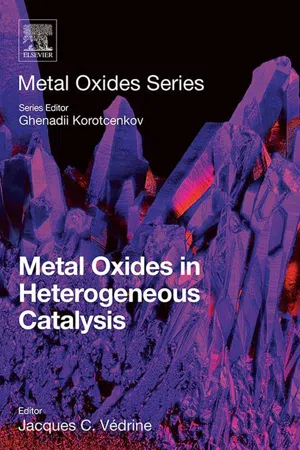
Metal Oxides in Heterogeneous Catalysis
About this book
Metal Oxides in Heterogeneous Catalysis is an overview of the past, present and future of heterogeneous catalysis using metal oxides catalysts. The book presents the historical, theoretical, and practical aspects of metal oxide-based heterogeneous catalysis.
Metal Oxides in Heterogeneous Catalysis deals with fundamental information on heterogeneous catalysis, including reaction mechanisms and kinetics approaches.There is also a focus on the classification of metal oxides used as catalysts, preparation methods and touches on zeolites, mesoporous materials and Metal-organic frameworks (MOFs) in catalysis. It will touch on acid or base-type reactions, selective (partial) and total oxidation reactions, and enzymatic type reactions
The book also touches heavily on the biomass applications of metal oxide catalysts and environmentally related/depollution reactions such as COVs elimination, DeNOx, and DeSOx. Finally, the book also deals with future trends and prospects in metal oxide-based heterogeneous catalysis.
- Presents case studies in each chapter that provide a focus on the industrial applications
- Includes fundamentals, key theories and practical applications of metal oxide-based heterogeneous catalysis in one comprehensive resource
- Edited, and contributed, by leading experts who provide perspectives on synthesis, characterization and applications
Information
Subtopic
Scienza dei materiali1
Fundamentals of heterogeneous catalysis
Jacques C. Védrine, Laboratoire de Réactivité de Surface, Sorbonne Université, Université P. & M. Curie, Paris, France
Abstract
This chapter deals with the basic principles of catalytic reactions and focuses on gas-solid heterogeneous catalysis. It includes historical aspects of catalysis in general and heterogeneous catalysis in particular, and the main principles and main parameters of catalytic reactions. In particular, a description of metal oxide catalyst features, of active sites and of catalytic activity and selectivity is given and discussed. Kinetics and main reaction mechanisms involved in catalytic reactions are described, while main industrial processes using metal oxide catalysts in the past and present are summarized. A brief description of metal oxide materials is given with special emphasis on the importance of crystalline structure, structure sensitivity of catalytic reactions, lattice defects, ions and electrons mobility, doping, and use of promoters on their catalytic properties. At last, characterization of heterogeneous catalysts and of catalytic reaction intermediates and a description of the main physical techniques, frequently, even routinely used, are given. Special emphasis is brought about in-situ characterization, i.e. in real working conditions with mass spectrometry and/or gas chromatography analyses on line. Possible relationships between catalytic properties and physical/chemical characteristics of the catalysts and reaction intermediates are discussed, and shown to be rarely reliable.
Keywords
Principles of the catalytic phenomenon; main parameters; metal oxide catalysts; main commercial applications; historical aspects of catalysis; main catalytic reaction mechanisms; main physical techniques of characterization
1.1 Introduction to catalysis [1–3]
It was Berzelius, who first used the word “catalysis” in 1836 from the Greek word “καταλεινν” (=loose down, dissolve) by analogy to the word “analysis” in order to rationalize experimental well-known observations such as starch transformation to sugar by acids, decomposition of H2O2 by metals, ethanol oxidation to acetic acid on Pt, etc. By definition, catalysis is a process by which a reaction rate is enhanced by a small amount of the so-called catalyst that supposedly does not undergo any change during the reaction, at variance with surface or stoichiometric reactions. As any manager of industrial plants knows, this is a too optimistic definition as real catalysts change in structure, activity, selectivity with time on stream and deactivate more or less rapidly.
Catalysis was defined as such by Berzelius, as this phenomenon was known since early times such as wine and beer fermentation, and soap and sulfuric acid (oil of vitriol) synthesis. It was illustrated in the 1800s by Döbereiner for the conversion of alcohol to acetic acid on Pt wire (1816), for the conversion of alcohol to acetic aldehyde on Pt wire (1832), and his famous Pt lighter (H2 from 25% H2SO4 on Zn and its oxidation on Pt sponge on top of the lighter), as illustrated in Fig. 1.1.

Some 60 years after Berzelius, Oswald established the kinetic nature of this phenomenon and in 1895 gave the definition: “A catalyst is a substance that changes the rate of a chemical reaction without itself appearing in the products.” According to the IUPAC (1976) a catalyst is a substance that, being present in small proportions, increases the rate of attainment of chemical equilibrium, without itself undergoing chemical change.
It turned out that the catalyst acts by reducing the energy necessary to proceed along the reaction pathway, i.e. the activation energy (Ea) that needs to be surmounted to yield products, as schematised in Fig. 1.2. The activation energy is the energy required to overcome the reaction barrier and determines how fast a reaction occurs. The lower the activation barrier, the faster the reaction will be. Note that the thermodynamics of the reaction remain unchanged and that the main observation done is that the catalyst influences the reaction rate. For a catalytic reaction, the first step is the reactant(s) adsorption and the reaction energy includes the activation barrier energies of adsorbed reactants (Aads), of adsorbed intermediates (Iads), and of desorption of products (Pads), as schematised in Fig. 1.2. Heterogeneous catalysis (gas or liquid phase and solid catalyst) proceeds via adsorption of one or two reactant molecule(s) on the solid surface, enhancing the reactant(s) concentration on the surface and favouring its (their) activation. For theoretical calculation it is important to know if the reactant molecules are adsorbed flat or oriented on a surface and/or are dissociated upon adsorption, as illustrated in Fig. 1.3. The degree of catalytic efficiency, gained in following a given path, is governed by the energetics of the various intermediate...
Table of contents
- Cover image
- Title page
- Table of Contents
- Copyright
- List of Contributors
- About the Editor
- About the Series Editor
- Preface to the Series
- Introduction: Editorial
- 1. Fundamentals of heterogeneous catalysis
- 2. Synthesis of metal oxide catalysts
- 3. Nanoporous oxide catalysts: A new catalyst paradigm of SYNGAS production for sustainable energy and environmental applications
- 4. Catalysts and catalysis for acid–base reactions
- 5. Gas phase heterogeneous partial oxidation reactions
- 6. Transition metal oxides for combustion and depollution processes
- 7. Photocatalytic water splitting on metal oxide-based semiconductor photocatalysts
- 8. Main industrial processes using metal oxides as catalysts or support and future trends in heterogeneous catalysis
- 9. Concluding remarks and challenges of heterogeneous catalysis on metal oxides
- Index
Trusted by 375,005 students
Access to over 1.5 million titles for a fair monthly price.
Study more efficiently using our study tools.
Frequently asked questions
Yes, you can cancel anytime from the Subscription tab in your account settings on the Perlego website. Your subscription will stay active until the end of your current billing period. Learn how to cancel your subscription
No, books cannot be downloaded as external files, such as PDFs, for use outside of Perlego. However, you can download books within the Perlego app for offline reading on mobile or tablet. Learn how to download books offline
Perlego offers two plans: Essential and Complete
- Essential is ideal for learners and professionals who enjoy exploring a wide range of subjects. Access the Essential Library with 800,000+ trusted titles and best-sellers across business, personal growth, and the humanities. Includes unlimited reading time and Standard Read Aloud voice.
- Complete: Perfect for advanced learners and researchers needing full, unrestricted access. Unlock 1.5M+ books across hundreds of subjects, including academic and specialized titles. The Complete Plan also includes advanced features like Premium Read Aloud and Research Assistant.
We are an online textbook subscription service, where you can get access to an entire online library for less than the price of a single book per month. With over 1.5 million books across 990+ topics, we’ve got you covered! Learn about our mission
Look out for the read-aloud symbol on your next book to see if you can listen to it. The read-aloud tool reads text aloud for you, highlighting the text as it is being read. You can pause it, speed it up and slow it down. Learn more about Read Aloud
Yes! You can use the Perlego app on both iOS and Android devices to read anytime, anywhere — even offline. Perfect for commutes or when you’re on the go.
Please note we cannot support devices running on iOS 13 and Android 7 or earlier. Learn more about using the app
Please note we cannot support devices running on iOS 13 and Android 7 or earlier. Learn more about using the app
Yes, you can access Metal Oxides in Heterogeneous Catalysis by Jacques C. Vedrine, Ghenadii Korotcenkov in PDF and/or ePUB format, as well as other popular books in Tecnologia e ingegneria & Scienza dei materiali. We have over 1.5 million books available in our catalogue for you to explore.