eBook - ePub
Widening Higher Education Participation
A Global Perspective
- 292 pages
- English
- ePUB (mobile friendly)
- Available on iOS & Android
eBook - ePub
Widening Higher Education Participation
A Global Perspective
About this book
Governments have introduced policies to widen the participation of disadvantaged students in higher education. Widening participation policies are also introduced to ensure that higher education contributes to social and economic outcomes. This book includes important insights from 23 leading scholars across 11 countries on a wide range of topics that focus on government policies, institutional structures and the social and economic impacts of widening participation. While widening participation policies and outcomes in developed countries are more widely documented, the policies, achievements, and challenges in other countries such as Brazil, China, Indonesia, South Africa and Palestine are not so widely disseminated. Therefore, the 'untold stories' of policies and outcomes of widening participation are a key part of this book. The chapters are organised according to three overarching themes, which include national and transnational studies of the history of widening participation and current policies; inclusive learning and academic outcomes; and socioeconomic structures, concepts and theories.
- Engages prominent academics, earlier career researchers, and research students
- Provides a wide range of topics related to widening participation
- Explores social and economic impact of widening student participation
- Presents untold stories of widening participation in developing countries experiencing growth in youth population
Information
Topic
EducationSubtopic
Higher EducationChapter 1
Systemic Equity Challenges
An Overview of the Role of Australian Universities in Student Equity and Social Inclusion
Ryan Naylor and Richard James, Melbourne Centre for the Study of Higher Education, The University of Melbourne, Melbourne, VIC, Australia
This chapter examines the challenges Australia has faced in creating greater social inclusion in higher education, tracing some of the policy interventions over the last quarter of a century in particular. The analysis examines not only the role of universities and other higher education providers but also the roles of schools and vocational educational and training. This chapter points to the need for more systemic thinking and policy to recognise the interrelationships and interresponsibilities between the education sectors and identifies the emergence of learning analytics as a new data tool for understanding and responding to individual educational disadvantage.
Keywords
Access; Australia; disadvantage; equity; higher education; social inclusion
Introduction
A social inclusion agenda has long been an explicit aspect of the Australian higher education system under various guises. Equity and social inclusion have been especially prominent in public policy since the Dawkins reforms of 1990 (Dawkins, 1990), including through the provision of funding for university-run social inclusion programs and the formation of funded bodies such as the National Centre for Student Equity in Higher Education (located at the University of South Australia from 2007, and Curtin University from 2011). The movement from an elite higher education system to a mass-universal system over the past 25 years has ensured that social inclusion has been, and continues to be, an important aspect of policy debate about the role of higher education within society and which people should or can attend university.
In the Australian higher education context, social inclusion is largely framed through the lens of population parity (Bradley, Noonan, Nugent, & Scales, 2008; Commonwealth of Australia, 2009; Dawkins, 1990). That is, that the representation of people from specific backgrounds traditionally underrepresented in higher education is judged against their proportional representation within the wider community. Personal background or characteristics are therefore used as proxies for individual educational disadvantage, and these are often identified in turn by its own proxies. Low socioeconomic (SES) background, for example, is determined by place of residence, rather than parents’ occupation or education levels—a policy that has attracted some critique (James et al., 2008; Willems, 2010). Whether defining social inclusion via group membership is the most effective method of pursuing equity in higher education is beyond the scope of this article; however, it must be acknowledged that there are significant disparities in access for people from particular population subgroups (Naylor, Baik, & James, 2013), and that these backgrounds have been enshrined in policy as the chief indicators for social inclusion.
Within this framework for social inclusion, it is appropriate to ask where the responsibilities for equity in higher education lie. Universities are the ultimate object of scrutiny in this debate, but what of the role of government in determining policy settings? This question is complicated by the fact that Australian universities are self-governing bodies, established typically by state or territory legislation, but largely supported by federal funding and overseen by a federal ministerial portfolio. What of vocational education, or schools, both of which are state government responsibilities, as well as important stakeholders in their own rights? What is the role of individuals in determining their own participation? In this complicated mass of stakeholders, it can be difficult to determine where individual roles and responsibilities for social inclusion lie.
The Role of Government—An Historical View
Although the publication of A Fair Chance for All in 1990 (Dawkins, 1990) is frequently presented as the birthplace of Australia’s policy framework for equity in higher education, it was arguably the third in a series of higher education reform and expansion phases following World War II that affected social inclusion (King & James, 2013).
Even prior to the 1950s, Australian higher education was relatively ‘open’ compared with most countries. Technical and teachers’ colleges, adult entry, external delivery, and part-time study have long been features of the system (James, Karmel, & Bexley, 2013). Indeed, James et al. reports that by 1960 nearly one-third of students were enrolled on a part-time basis, and one-tenth studied externally (James et al., 2013). Of course, while these proportions are relatively high, the overall number of students was not—in 1955, the higher education sector consisted of only 30,000 students (James et al., 2013)—most of whom were male and from relatively privileged backgrounds.
The higher education sector expanded dramatically and rapidly with the creation of colleges of advanced education (CAEs) in the 1960s, reaching in excess of 300,000 students by 1980 (Department of Education, 2014). This growth coincided with the emergence of access and equity as an issue. A number of schemes were instituted throughout this period, including the 1974 decision to abolish tuition fees and introduce a new scheme of studentships and allowances, with the express aim of increasing social inclusion (Solomon, 2007; Whitlam, 1985). This was expressed through platforms such as Gough Whitlam’s 1969 national election campaign launch, in which he said, “When government makes opportunities for any of the citizens, it makes them for all the citizens… We are all diminished when any of us are denied proper education. The nation is the poorer—a poorer economy, a poorer civilisation, because of this human and national waste” (Hocking, 2012), and echoed a decade later in policy statements from the Department of Employment, Education and Training, which represents access and equity as one of the “pressing issues confronting governments and institutions in the early 1980s” (Department of Education Employment and Training, 1993). The creation of AUSTUDY and ABSTUDY, which provided income support to students, the Higher Education Equity Program, which funded pilot programs to increase participation, and the Aboriginal Participation Initiative, which earmarked university places for Indigenous students, were all introduced in the early 1980s.
Reorganization of the higher education sector in 1989–1990 as part of the Dawkins reforms led to the incorporation of CAEs into the university system, the reintroduction of university fees (albeit alongside the introduction of the Higher Education Contribution Scheme) and the publication of A Fair Chance for All to frame a national approach to equity. By 1990, students numbers had increased to over 485,000, a 60% increase over 10 years (Department of Education, 2014). However, several studies (James et al., 2013; Karmel, 1995) have shown that, while the transition from elite to mass education may have benefited disadvantaged groups in terms of absolute numbers, there were no substantial changes in relative representation and thus inequality. That is, like the Red Queen in Alice Through the Looking Glass “it takes all the running you can do, to keep in the same place”; while absolute numbers of students from low SES backgrounds, for example, increased during this period, their participation share remained between 15 and 16%. This remained the case until the institution of the demand driven system from 2008 (Bradley et al., 2008).
Over the last six years in Australia following the uncapping of the number of student places post the pivotal 2008 Review of Australian Higher Education led by Professor Denise Bradley there has been enormous growth in the Australian higher education sector. In 2014, the number of domestic undergraduate students was greater than one million for the first time (Department of Education, 2014). The average annual growth rate for this group over this six year period has been 5.9%, or approximately double the average annual growth rate of the ten years before the Bradley Review (Department of Education, 2014; Naylor et al., 2013).
Although the numbers of students in several designated equity groups have shown moderate or strong growth rates in absolute numbers and in relative share of places, this has not been evenly distributed between all groups. The number of students from regional and remote backgrounds has more or less kept pace with growth across the sector. However, the growth rate in numbers of women in nontraditional areas has not, indicating that, if these trends continue, participation ratios for these groups will worsen, not improve. In contrast, the growth rate for students with a disability, Indigenous students, and students from low SES backgrounds has far outstripped the growth in the sector as a whole (Figure 1.1; Naylor et al., 2013).
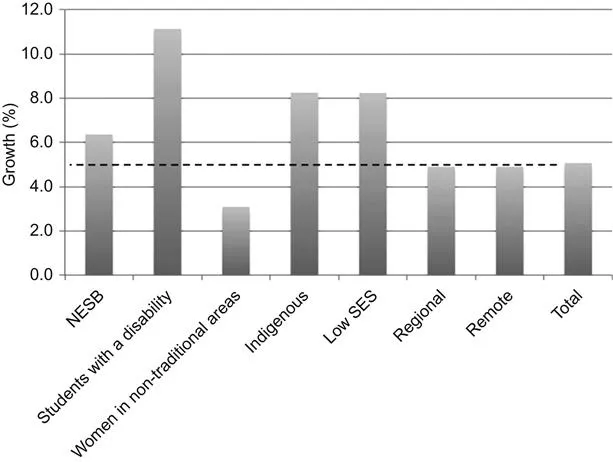
It is unclear why these groups should experience such rapid growth when other groups have not. Certainly, the figures indicate that there was unmet demand when student numbers were previously capped. Predictably in a time of expanding access, community concerns have been raised that universities have lowered standards to achieve new participation outcomes. However, the provision of funding from Higher Education Participation and Partnerships Programme, national targets for low SES participation, and performance-based funding for institutions have also had effects alongside the uncapping of volume of places. These factors are tightly interwoven and it is difficult, and risky, to speculate on their relative impact. Government policy—particularly the provision of funding based on student numbers, and for initiatives affecting participation from students from equity groups—has had a significant effect on social inclusion in the higher education sector though the agenda towards parity is incomplete.
The Role of Schools—Academic Preparation
As noted above, there has been a concern expressed in the media, and alluded to in recent government policy documents, that universities have lowered their “‘entrance standards” to achieve growth in participation from some equity backgrounds. This concern is based on assumptions about the relationship between academic preparedness and the Australian Tertiary Admission Rank (ATAR), which positions individuals on a rank from zero to 99.95 on the basis of their achievement in senior schooling.
In Australia, most students seeking entry to university do so directly from school (despite substantial growth in the numbers of nonschool leavers in recent times). In 2012, 54% of applicants were school leavers, and a further 12% were students who had taken a period of absence—typically a “gap year”—from study after completing school (Gale & Parker, 2013). Achievement in schooling therefore forms the basis of a student’s academic preparation in roughly two-thirds of cases.
In all states except Queensland, student admissions for most courses are based on ATAR, which is calculated from their Year 12 results. However, it is sometimes forgotten that ATAR is a ranking relative to the national student body each year, not an absolute score, and for large numbers of people is not a particular sound predictor of success once enrolled at university.
Previous work (Norton, 2013) has examined the relationship between ATAR and course completion over a six year timeframe. Further analysis of Norton’s data set reveals the complexities of this relationship. For the 17% of students with an ATAR of less than 60, there was almost no correlation; approximately 66% completed their degrees in this time. There was a moderate relationship (approximately 3% increased chance of success per five ATAR points) for students with an ATAR of between 60 and 80, who make up approximately 50% of commencing students. Finally, there was a much stronger relationship between course completions and ATAR for those with an ATAR of greater than 80% (approximately a third of commencing students), of approximately 5% per five ATAR points. Other research has shown some relat...
Table of contents
- Cover image
- Title page
- Table of Contents
- Copyright
- Dedication
- List of Figures
- About the Editors
- About the Contributors
- Preface
- Chapter 1. Systemic Equity Challenges: An Overview of the Role of Australian Universities in Student Equity and Social Inclusion
- Chapter 2. Taking Stock of 50 Years of Participation in Canadian Higher Education
- Chapter 3. Widening Participation in Aotearoa New Zealand Tertiary Education Since 2000
- Chapter 4. Higher Education in Europe: Widening Participation
- Chapter 5. The Challenge of Widening Participation to Higher Education in Brazil: Injustices, Innovations, and Outcomes
- Chapter 6. Barriers Impeding Access to Higher Education: The Effects of Government Education Policy for Disadvantaged Palestinian Arab and Jewish Citizens
- Chapter 7. Same Sky, Different Horizon: An Analysis of Disadvantaged Groups’ Access to Prestigious Universities in Mainland China
- Chapter 8. Access and Equity in Higher Education in Indonesia: A Review from the Periphery
- Chapter 9. Developing Inclusive Learning to Improve the Engagement, Belonging, Retention, and Success of Students from Diverse Groups
- Chapter 10. Widening Participation in Australia: Lessons on Equity, Standards, and Institutional Leadership
- Chapter 11. The Tension between Access and Success: Challenges and Opportunities for Community Colleges in the United States
- Chapter 12. Widening Access Through Higher Education Transformation: A Case Study of University of KwaZulu-Natal
- Chapter 13. The Economic and Social Benefits of Widening Participation: Rhetoric or Reality?
- Chapter 14. University Choosers and Refusers: Social Theory, Ideas of “Choice” and Implications for Widening Participation
- Chapter 15. Global Perspectives on Widening Participation: Approaches and Concepts
- Index
Trusted by 375,005 students
Access to over 1.5 million titles for a fair monthly price.
Study more efficiently using our study tools.
Frequently asked questions
Yes, you can cancel anytime from the Subscription tab in your account settings on the Perlego website. Your subscription will stay active until the end of your current billing period. Learn how to cancel your subscription
No, books cannot be downloaded as external files, such as PDFs, for use outside of Perlego. However, you can download books within the Perlego app for offline reading on mobile or tablet. Learn how to download books offline
Perlego offers two plans: Essential and Complete
- Essential is ideal for learners and professionals who enjoy exploring a wide range of subjects. Access the Essential Library with 800,000+ trusted titles and best-sellers across business, personal growth, and the humanities. Includes unlimited reading time and Standard Read Aloud voice.
- Complete: Perfect for advanced learners and researchers needing full, unrestricted access. Unlock 1.5M+ books across hundreds of subjects, including academic and specialized titles. The Complete Plan also includes advanced features like Premium Read Aloud and Research Assistant.
We are an online textbook subscription service, where you can get access to an entire online library for less than the price of a single book per month. With over 1.5 million books across 990+ topics, we’ve got you covered! Learn about our mission
Look out for the read-aloud symbol on your next book to see if you can listen to it. The read-aloud tool reads text aloud for you, highlighting the text as it is being read. You can pause it, speed it up and slow it down. Learn more about Read Aloud
Yes! You can use the Perlego app on both iOS and Android devices to read anytime, anywhere — even offline. Perfect for commutes or when you’re on the go.
Please note we cannot support devices running on iOS 13 and Android 7 or earlier. Learn more about using the app
Please note we cannot support devices running on iOS 13 and Android 7 or earlier. Learn more about using the app
Yes, you can access Widening Higher Education Participation by Mahsood Shah,Anna Bennett,Erica Southgate in PDF and/or ePUB format, as well as other popular books in Education & Higher Education. We have over 1.5 million books available in our catalogue for you to explore.