
eBook - ePub
Power Ultrasonics
Applications of High-Intensity Ultrasound
- 1,166 pages
- English
- ePUB (mobile friendly)
- Available on iOS & Android
eBook - ePub
About this book
The industrial interest in ultrasonic processing has revived during recent years because ultrasonic technology may represent a flexible "green alternative for more energy efficient processes. A challenge in the application of high-intensity ultrasound to industrial processing is the design and development of specific power ultrasonic systems for large scale operation. In the area of ultrasonic processing in fluid and multiphase media the development of a new family of power generators with extensive radiating surfaces has significantly contributed to the implementation at industrial scale of several applications in sectors such as the food industry, environment, and manufacturing. Part one covers fundamentals of nonlinear propagation of ultrasonic waves in fluids and solids. It also discusses the materials and designs of power ultrasonic transducers and devices. Part two looks at applications of high power ultrasound in materials engineering and mechanical engineering, food processing technology, environmental monitoring and remediation and industrial and chemical processing (including pharmaceuticals), medicine and biotechnology.
- Covers the fundamentals of nonlinear propagation of ultrasonic waves in fluids and solids.
- Discusses the materials and designs of power ultrasonic transducers and devices.
- Considers state-of-the-art power sonic applications across a wide range of industries.
Information
1
Introduction to power ultrasonics
J.A. Gallego-Juárez1; K.F. Graff2 1 Consejo Superior de Investigaciones Científicas (CSIC), Madrid, Spain
2 EWI, Columbus, OH, USA
2 EWI, Columbus, OH, USA
Abstract
Ultrasonics is the branch of acoustics that deals with the generation and applications of inaudible acoustic waves. This chapter is concerned with high-intensity ultrasound and its capacity to change the physical, chemical, or biological properties of materials or systems to which it is applied. It provides an overview of the generation, transmission, and process/material interaction that is the framework for an understanding of power ultrasonics.
Keywords
Ultrasonics
Power ultrasonics
Intensity
Generation
Transmission
Application
Frequency
Transducer
Nonlinear
Physical
Chemical and biological phenomena
1.1 Introduction
The fascinating phenomena that are associated with intense, inaudible acoustic waves have an enormous range of scientific, engineering, industrial, chemical, medical, and biological applications and present a challenge in the fields of fundamental and applied inquiry. J.C. Hubbard (historical references in this section are from Graff, 1981) noted of ultrasonics that, “While it is a logical extension of well-known principles, its growth has been signalized by the discovery of phenomena peculiar to the new range of frequencies.” This chapter explores the “phenomena peculiar” to these high frequencies and, in particular, defines power ultrasonics, covering both the fundamentals and state-of-art developments in the field.
1.2 The field of ultrasonics
Ultrasonics is a branch of acoustics dealing with the generation and use of inaudible acoustic waves and is a broad field. While the audible upper limit of frequency in humans varies with age, occupation, and other factors, it is generally considered as being about 20 kHz. The overall place of ultrasonics within the science of acoustics is illustrated in Figure 1.1 by a modification of Lindsay's “Wheel of Acoustics” (Lindsay, 1973).
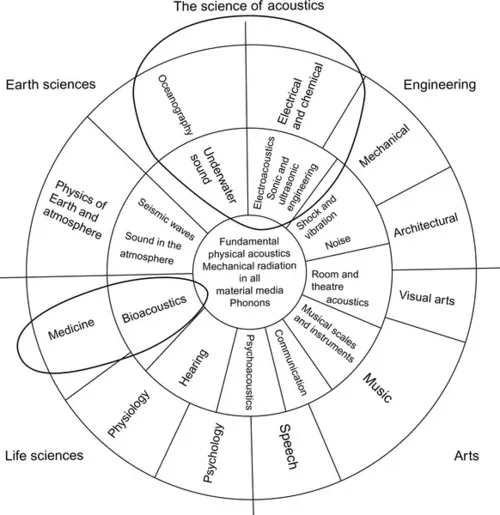
Figure 1.1 Ultrasonics within the “Wheel of Acoustics.” Source: Graff (1985) after Lindsay (1973).
The science and technology of acoustics, which encompasses such diverse areas as speech, seismology, architecture, and music, touches every facet of human existence. The field of ultrasonics, as shown in the encircled regions, is of great breadth and covers diverse topics such as underwater sound, medicine, electrical, chemical, and engineering applications. The field of ultrasonics may be divided into two broad areas:
• Low-intensity, high-frequency applications.
• High-intensity, low-frequency applications.
It is difficult to fix the limit between low- and high-intensity waves but it can be approximately established for intensity values that, depending on the medium, vary between 0.1 and 1 W/cm2 (Gallego-Juarez, 1999). In the case of low-intensity, high-frequency applications, some common examples are ultrasonic nondestructive testing; ultrasonic imaging, which is widely used in medicine; ultrasonic range finders; and surface acoustic waves, used in electronics. In accordance with the low intensity levels required, the power levels applied to the transducers are typically very low, often in the milliwatt range, while frequencies are very high, typically in the megahertz and higher ranges (e.g., nondestructive testing units typically operate at 2 MHz or higher). The general purpose of this field is the use of ultrasound as a means of exploration, detection, and information (e.g., the location of a crack, the shape of a human form, the transmission of a signal). Every definition has exceptions; submarine sonar, for example, while used to convey information, may operate at very high power levels.
It is well-known, of course, that the human use of high frequency ultrasonics was long preceded by nature; for example, in bats and dolphins who use these frequencies for navigation and communication.
1.3 Power ultrasonics
Power ultrasonics is the area of ultrasound devoted to the study of high-intensity applications. In this field, ultrasonics is used to permanently change the physical, chemical, or biological properties of materials or systems to which it is applied. Power levels for these uses may be in the range of 10s, 100s, or 1000s of watts, according to the intensity level required, while frequencies may be low, in the order of 1000s of Hz. Typical operating frequencies for most high-power applications will range between 20 and 100 kHz, although some may be as low as 10 kHz and as high as 500 kHz. Some chemical and cleaning applications may even be in the megahertz range. The applications of power ultrasonics are generally based on the effects of nonlinear phenomena created by high-intensity waves and include wave distortion, acoustic saturation, radiation pressure, streaming, cavitation in liquids, and formation and motion of dislocations in solids.
As a result of these nonlinear phenomena, a series of mechanisms may be activated by the ultrasonic energy. These include heat, agitation, diffusion, interface instabilities, friction, mechanical rupture, and chemical effects. These mechanisms can be employed to produce or enhance a wide range of processes that are dependent on the irradiated medium. A typical characteristic of high-intensity ultrasonic waves is their ability to produce different processes in different media to such an extent that they may appear to be opposites. For example, the application of power ultrasound to liquid suspensions produces particle dispersion, whereas its application to gas suspensions creates particle agglomeration. Such apparently opposing behaviors are due to the different mechanisms activated, which largely depend on the specific medium.
The many applications of high-power ultrasonics include the welding of metals and polymers, machining and metal forming in solids and fluids, cleaning, emulsification and dispersion, degassing, defoaming, particle agglomeration, drying, dewatering, and the enhancing of chemical reactions. Medical applications are another rapidly developing area in which high-intensity ultrasonic energy is used for noninvasive surgery, lithotripsy, and other therapeutic uses.
Although the demarcation between high-power ultrasonics and other areas of ultrasonics may be approximately indicated by the intensity levels, power densities, and/or frequency ranges, these boundaries are not always clear-cut. It should be kept in mind that the basic purpose of power ultrasonics is to permanently alter the characteristics of a material or system. It is this field of ultrasonics that is the subject of this book.
1.4 Historical notes
Although it is not known when humans first became aware of sounds beyond the limits of their hearing, the systematic study of these phenomena dates back to the early 1800s. The key developments from that era are significant in the field of power ultrasonics and include the discovery of the magnetostrictive effect by Joule, the piezoelectric effect in crystals by the Curie brothers, and the development of the ultrasonic whistle by Galton (historical notes from Graff, 1981).
Following the sinking of the Titanic in 1912, which resulted from a collision with an iceberg, many scientists rushed to develop acoustic methods for the detection of underwater obstacles. With the start of World War I, attention was focused on the detection of submarines. Work in this area came to fruition late in the war when the French scientist Langevin developed a powerful underwater sound projector based on quartz plates sandwiched between thick plates of steel.
The key development in high-power ultrasonics came when Professor Robert Wood, who had witnessed Langevin's experiments, showe...
Table of contents
- Cover image
- Title page
- Table of Contents
- Copyright
- List of contributors
- Woodhead Publishing Series in Electronic and Optical Materials
- 1. Introduction to power ultrasonics
- Part One: Fundamentals
- Part Two: Welding, metal forming, and machining applications
- Part Three: Engineering and medical applications
- Part Four: Food technology and pharmaceutical applications
- Part Five: Environmental and other applications
- Index
Trusted by 375,005 students
Access to over 1.5 million titles for a fair monthly price.
Study more efficiently using our study tools.
Frequently asked questions
Yes, you can cancel anytime from the Subscription tab in your account settings on the Perlego website. Your subscription will stay active until the end of your current billing period. Learn how to cancel your subscription
No, books cannot be downloaded as external files, such as PDFs, for use outside of Perlego. However, you can download books within the Perlego app for offline reading on mobile or tablet. Learn how to download books offline
Perlego offers two plans: Essential and Complete
- Essential is ideal for learners and professionals who enjoy exploring a wide range of subjects. Access the Essential Library with 800,000+ trusted titles and best-sellers across business, personal growth, and the humanities. Includes unlimited reading time and Standard Read Aloud voice.
- Complete: Perfect for advanced learners and researchers needing full, unrestricted access. Unlock 1.5M+ books across hundreds of subjects, including academic and specialized titles. The Complete Plan also includes advanced features like Premium Read Aloud and Research Assistant.
We are an online textbook subscription service, where you can get access to an entire online library for less than the price of a single book per month. With over 1.5 million books across 990+ topics, we’ve got you covered! Learn about our mission
Look out for the read-aloud symbol on your next book to see if you can listen to it. The read-aloud tool reads text aloud for you, highlighting the text as it is being read. You can pause it, speed it up and slow it down. Learn more about Read Aloud
Yes! You can use the Perlego app on both iOS and Android devices to read anytime, anywhere — even offline. Perfect for commutes or when you’re on the go.
Please note we cannot support devices running on iOS 13 and Android 7 or earlier. Learn more about using the app
Please note we cannot support devices running on iOS 13 and Android 7 or earlier. Learn more about using the app
Yes, you can access Power Ultrasonics by Juan A. Gallego-Juarez,Karl F. Graff in PDF and/or ePUB format, as well as other popular books in Technology & Engineering & Physics. We have over 1.5 million books available in our catalogue for you to explore.