- 680 pages
- English
- ePUB (mobile friendly)
- Available on iOS & Android
eBook - ePub
Practical Onshore Gas Field Engineering
About this book
Practical Onshore Gas Field Engineering delivers the necessary framework to help engineers understand the needs of the reservoir, including sections on early transmission and during the life of the well. Written from a reservoir perspective, this reference includes methods and equipment from gas reservoirs, covering the gathering stage at the gas facility for transportation and processing. Loaded with real-world case studies and examples, the book offers a variety of different types of gas fields that demonstrate how surface systems can work through each scenario. Users will gain an increased understanding of today's gas system aspects, along with tactics on how to optimize bottom line revenue.
As reservoir and production engineers face many challenges in getting gas from the reservoir to the final sales point, especially as a result of the shale boom, a new demand for more facility engineers now exists in the market. This book addresses new challenges in the market and brings new tactics to the forefront.
- Presents the full lifecycle of the gas surface facility, from reservoir to gathering and transmission
- Helps users gain experience through case studies that explain successes and failures on a variety of gas fields, including unconventional and shale
- Teaches how the surface gas facility system and equipment work individually, and as an integrated system
Information
Subtopic
EnergiaChapter One
Gas Reservoirs
Abstract
The source of value in Oil & Gas is hydrocarbons within reservoirs. The conditions that must exist to cause naturally occurring hydrocarbons to be trapped within these reservoirs, the methods that the reservoir fluids migrate within the reservoir, and the characteristics of storage and transport within the various types of reservoirs are discussed. The chapter goes on to discuss difference between gas reservoirs and oil reservoirs, between conventional reservoirs and unconventional reservoirs, and some of the key characteristics of each. Key reservoir parameters are defined and discussed.
Keywords
Permeability; porosity; hydrocarbon traps; reservoir pressure; original gas in place (OGIP); conventional gas; unconventional gas; tight gas; coalbed methane (CBM); coal seam gas (CSG)
Simpson’s First Postulate: Every activity, joint of pipe, piece of equipment, and facility should have the goal of maximizing reservoir profitability—any activity which ignores that goal is going to result in sub-optimum performance.
1.1 Source of Hydrocarbons
The Oil & Gas industry has always considered hydrocarbons as being biogenic (i.e., produced by living organisms) and it is certain that some proportion of the hydrocarbons recovered from wells is biogenic.
However, the idea that hydrocarbons can be formed in the core of the earth and migrate through the mantle has been gaining a resurgence in acceptance. This abiotic (i.e., not derived from organisms) gas and oil would provide some unknown quantity of supplemental hydrocarbons that would have a potential for recovery and commercialization.
Exactly what that quantity would be requires some in-depth analysis.
1.1.1 Recoverable hydrocarbons explained
Recoverable hydrocarbons must first be hydrocarbons, then they must be located in a rock stratum that allows them to be stored. Finally, there must be some sort of containment to keep them from leaking out of the storage strata.
In the Oil & Gas industry, we call these entities “source rock,” “reservoir rock,” and “cap rock” (Fig. 1.1). Once a reservoir is delineated by having a source, a reservoir, and a containment, it requires a flow path to an outlet. Most of the time this flow path takes the hydrocarbons around the edges of the cap rock and they leak to the surface of the earth.
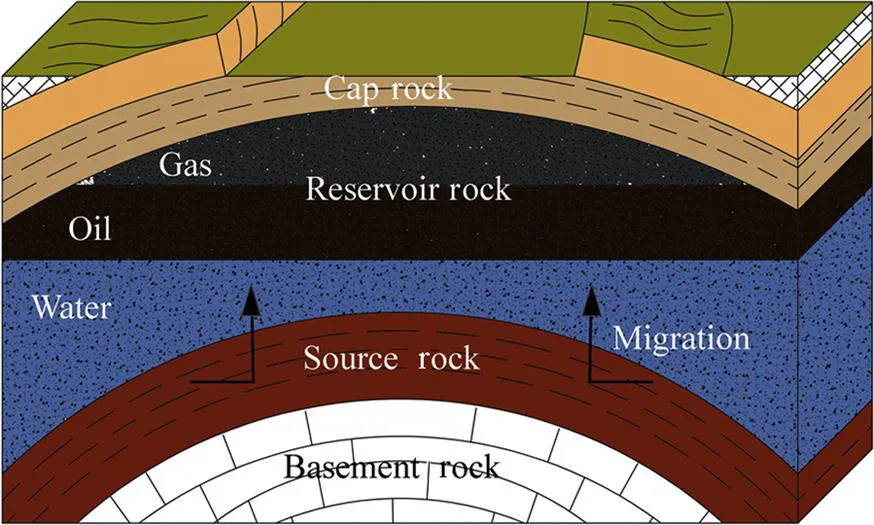
Occasionally, the cap rock has an effective seal on the reservoir. When the Oil & Gas industry comes along and drills a well and stimulates the reservoir, the flow path becomes a commercial transaction—this is the reason that the Oil & Gas industry exists.
1.1.2 Biotic hydrocarbons
The total amount of carbon that is tied up within living biological material on the earth is about 4 trillion metric tons (tonne, 4.4 trillion US tons). Something like 105 billion tonne of carbon are discarded by their living host each year (Wikipedia, 1, 2016)—the leaves of deciduous trees fall to the ground each autumn, some number of animals, plants, bacteria, and viruses die each year, all organisms emit some amount of solid, liquid, and gaseous waste, and so on.
This carbon will eventually become CO2 and water vapor in an aerobic environment and mostly CH4 in an anaerobic environment. The discarded biomass is approximately equally divided between land and sea.
Aerobic decomposition is exothermic and tends to be fairly rapid (i.e., from the onset of decomposition to a sterile, carbon-free mass takes weeks or months) and is largely free of the worst odors. Aerobic decomposition converts the carbon in the waste material to CO2 and H2O.
Anaerobic decomposition is endothermic, much slower and very smelly. It can take hundreds or thousands of years for an undisturbed anaerobic process to run to completion. The time required is largely a function of the energy input to the process. Anaerobic decomposition converts the carbon in the waste material to CH4 and amounts of CO2, and H2O limited by available oxygen.
It is common for decomposing organic material to accumulate on the seafloor away from thermal vents and begin the decomposition process at very low energy input. While the mass is decomposing it sometimes happens that a storm event or a seismic event will cover the biomass with sand. Above the sand over many years, more organic material will collect that can eventually turn into shale which is one of the most common cap rocks.
Now we have a source, a reservoir, and a containment. Over millions of years, the methane product of decomposition can be converted through the application of heat and pressure into heavier hydrocarbons. The sealed volume can move upward or downward or it can tip (usually allowing the hydrocarbons to spill out of the reservoir, but not always) due to tectonic and seismic activity.
There is no competent theory to allow prediction of the proportion of biomass that will be subject to anaerobic decomposition. We can make some (arbitrary, but conservative) assumptions about the proportions:
• At least 1% of the biomass on land undergoes anaerobic decomposition (this includes human sanitary landfills, lakes, and wetlands, and in the stomachs of many animals and insects). One percent of half of 105 billion tonne per year is 0.525 billion tonne of carbon per year subjected to anaerobic decompo...
Table of contents
- Cover image
- Title page
- Table of Contents
- Copyright
- Preface
- Chapter Zero. Introduction
- Chapter One. Gas Reservoirs
- Chapter Two. Well-Bore Construction (Drilling and Completions)
- Chapter Three. Well Dynamics
- Chapter Four. Surface Engineering Concepts
- Chapter Five. Well-Site Equipment
- Chapter Six. Gas Gathering Systems
- Chapter Seven. Water Collection and Disposal
- Chapter Eight. Gas Compression
- Chapter Nine. Interface to Plants
- Chapter Ten. Integration of Concepts
- Appendix A. Acronyms and Glossary
- Appendix B. Unit Conversions
- Appendix C. Valve Summary
- Index
Trusted by 375,005 students
Access to over 1.5 million titles for a fair monthly price.
Study more efficiently using our study tools.
Frequently asked questions
Yes, you can cancel anytime from the Subscription tab in your account settings on the Perlego website. Your subscription will stay active until the end of your current billing period. Learn how to cancel your subscription
No, books cannot be downloaded as external files, such as PDFs, for use outside of Perlego. However, you can download books within the Perlego app for offline reading on mobile or tablet. Learn how to download books offline
Perlego offers two plans: Essential and Complete
- Essential is ideal for learners and professionals who enjoy exploring a wide range of subjects. Access the Essential Library with 800,000+ trusted titles and best-sellers across business, personal growth, and the humanities. Includes unlimited reading time and Standard Read Aloud voice.
- Complete: Perfect for advanced learners and researchers needing full, unrestricted access. Unlock 1.5M+ books across hundreds of subjects, including academic and specialized titles. The Complete Plan also includes advanced features like Premium Read Aloud and Research Assistant.
We are an online textbook subscription service, where you can get access to an entire online library for less than the price of a single book per month. With over 1.5 million books across 990+ topics, we’ve got you covered! Learn about our mission
Look out for the read-aloud symbol on your next book to see if you can listen to it. The read-aloud tool reads text aloud for you, highlighting the text as it is being read. You can pause it, speed it up and slow it down. Learn more about Read Aloud
Yes! You can use the Perlego app on both iOS and Android devices to read anytime, anywhere — even offline. Perfect for commutes or when you’re on the go.
Please note we cannot support devices running on iOS 13 and Android 7 or earlier. Learn more about using the app
Please note we cannot support devices running on iOS 13 and Android 7 or earlier. Learn more about using the app
Yes, you can access Practical Onshore Gas Field Engineering by David Simpson in PDF and/or ePUB format, as well as other popular books in Tecnologia e ingegneria & Energia. We have over 1.5 million books available in our catalogue for you to explore.