- 632 pages
- English
- ePUB (mobile friendly)
- Available on iOS & Android
eBook - ePub
Polyesters and Polyamides
About this book
Polyesters and polyamides remain the most used group of synthetic fibres. This authoritative book reviews methods of their production, ways of improving their functionality and their wide range of applications.The first part of the book describes raw materials and manufacturing processes, including environmental issues. Part two considers ways of improving the functionality of polyester and polyamide fibres, including blending, weaving, coloration and other finishing techniques as well as new techniques such as nanotechnology. The final part of the book reviews the range of uses of these important fibres, from apparel and sportswear to automotive, medical and civil engineering applications.With its distinguished editors and international team of contributors, Polyesters and polyamides is a standard reference for all those using this important group of fibres.
- Reviews the chemical and physical properties of each fibre and their manufacture
- Analyses how the functionality of polyester and polyamides can be improved
- Provides examples of how the fibres are used in applications
Information
Part I
Polyester and polyamide fundamentals
1
Polyester resins
P. SANTHANA GOPALA KRISHNAN and S.T. KULKARNI, Futura Polyesters Ltd, Chennai, India
Publisher Summary
This chapter explains that among the polycondensation polymers, the most important and widely used today is polyesters, and equally important is polyamides. Polyesters can be processed by melt spinning, injection and/or blow molding, and film extrusion whereas polyamides can be processed by melt spinning and injection molding and extrusion. Polyesters are broadly classified into two types, namely: (i) thermoplastic polyesters and (ii) unsaturated polyesters, which upon curing form highly cross-linked thermosets. Polyesters were initially developed for coating applications and are commonly known as ‘alkyd resins’. The term ‘alkyd’ was coined by combining the first part of the word ‘alcohol’ and the last part of the word ‘acid’. Among polyesters, Polyethylene Terephthalate (PET) would continue to be in the leading position for applications in packaging and textiles with more applications in ‘Technical Textiles’ in sectors of agriculture, building, geo, home, medical, packaging, etc. The future of the polyester industry, in particular commodity resin, depends on how effectively the industry recycles polyester scrap and how quickly the industry moves from oil-based resources to renewable resources. The effective recycling of polyester resin will also reduce carbon dioxide emission, which in turn would minimize global warming.
1.1 Introduction
Among the polycondensation polymers, the most important and widely used today is polyesters; and equally important is polyamides. Polyesters can be processed by melt spinning, injection and/or blow moulding and film extrusion whereas polyamides can be processed by melt spinning and injection moulding and extrusion. More details on polyamides are given in Chapter 2. Polyesters are widely used as packaging materials such as bottles/containers, film, and so on, and also as a fibre, filament, fabrics in textiles and as a base material for photographic film and recording tape applications. The term ‘polyester’ is used for polymeric materials containing ester groups in the polymeric main chains of macromolecules and not to the ester groups in the side chains of the macromolecules, as in the case of poly(vinyl acetate) (or) poly(methyl methacrylate), etc. The term ‘polyester’ is applicable to products derived from dicarboxylic acids and diols. However, the term is not restricted to derivatives of dicarboxylic acids but also to other types of acids such as phosphonic (or) sulphonic (or) phosphoric acids. This chapter is restricted to polyesters derived from dicarboxylic acids and diols alone. Chemical structures of various dicarboxylic acids and diols that are used to make polyesters or copolyesters are given in Table 1.1. Even though large number of polyesters and copolyesters can be prepared by varying dicarboxylic acids and diols and by varying the content of comonomers, only some of them are commercialised and trade names of these polyesters are listed in Table 1.2. Some of the major polyester manufacturers and their capacity are listed in Table 1.3. Even though polyesters have many useful properties, they are blended or alloyed with other polymers to overcome some of the polyester shortcomings. Table 1.4 shows the list of trade names of some of the commercialised polyester blends or alloys.
Table 1.1
Chemical structure of various dicarboxylic acids/diols
| Dicarboxylic acid/Diol | Structure |
| Terephthalic acid | 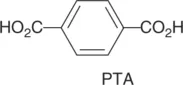 |
| Isophthalic acid | 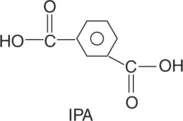 |
| 2,6-Naphthalene dicarboxylic acid | 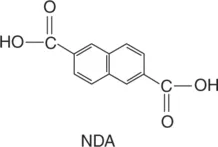 |
| Lactic acid | 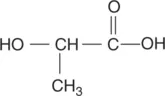 |
| Monoethylene glycol | 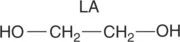 |
| 1,3-Propane diol |  |
| 1,4-Butane diol |  |
| 1,4-Cyclohexane dimethanol | 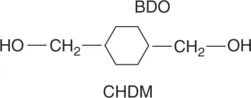 |
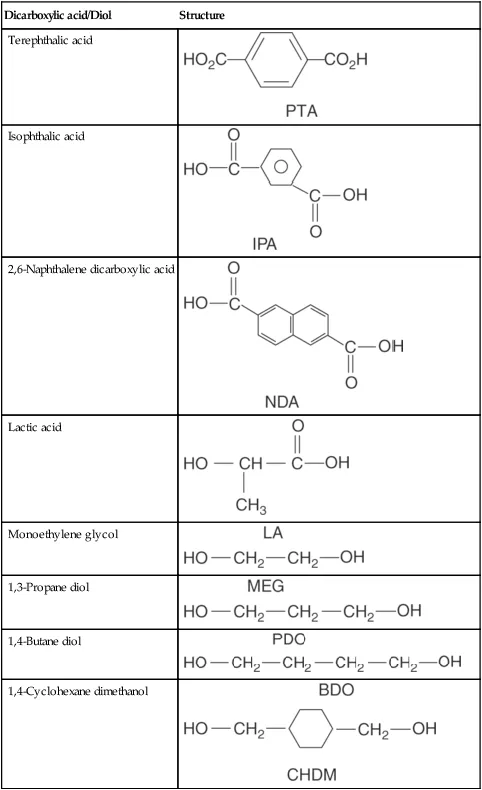
Table 1.2
List of trade names of polyesters
| Polyester | Trade name | Company | Form |
| PET | Amilar | ||
| Blue C | Monsanto Co. | Fibre | |
| PET | Dacron | DuPont | Fibre |
| PET | Daiya foil | ||
| PET | Diolen | Glanzstoff AG | Fibre |
| PET | Dowlex | ||
| Encron | American Enka Corp | Fibre | |
| PET | Fiber V | Fibre | |
| Fortrel | Fiber Industries Inc | Fibre | |
| PET | Grisuten | VEB Chemiefaserwerk | Fibre |
| PET | Hostadur | ||
| PET | Hostphan | Hoechst | Film |
| Kodel | Eastman Chemical Products, Inc | Fibre | |
| PET | Kuraray | Kurashiki Rayon KK | Fibre |
| PET | Lavsan | ||
| PET | Lawsonite | ||
| PET | Melinex | ICI | Film |
| PET | Mersilene | ||
| PET | Nitiray | Nippon Ester Co. Ltd | Fibre |
| PET | Nitron lavsan | ||
| PET | Eastapak | Eastman | |
| PET | Melinar | ICI | |
| PET | Impet | Ticona (Hoechst) | Engg. Glass filled |
| Toyobo | Toyobo Co. Ltd | Fibre | |
| PET | Caripak | Shell | |
| Lavsan | USSR Government | Fibre | |
| PET | Mylar | DuPont | Film |
| Okson | USSR Government | Fibre | |
| Quintess | Phillips Fibers Co... |
Table of contents
- Cover image
- Title page
- Table of Contents
- The Textile Institute and Woodhead Publishing
- Copyright
- Contributor contact details
- Woodhead Publishing in Textiles
- Part I: Polyester and polyamide fundamentals
- Part II: Improving functionality of polyesters and polyamides
- Part III: Applications of fibrous polyesters and polyamides
- Index
Trusted by 375,005 students
Access to over 1.5 million titles for a fair monthly price.
Study more efficiently using our study tools.
Frequently asked questions
Yes, you can cancel anytime from the Subscription tab in your account settings on the Perlego website. Your subscription will stay active until the end of your current billing period. Learn how to cancel your subscription
No, books cannot be downloaded as external files, such as PDFs, for use outside of Perlego. However, you can download books within the Perlego app for offline reading on mobile or tablet. Learn how to download books offline
Perlego offers two plans: Essential and Complete
- Essential is ideal for learners and professionals who enjoy exploring a wide range of subjects. Access the Essential Library with 800,000+ trusted titles and best-sellers across business, personal growth, and the humanities. Includes unlimited reading time and Standard Read Aloud voice.
- Complete: Perfect for advanced learners and researchers needing full, unrestricted access. Unlock 1.5M+ books across hundreds of subjects, including academic and specialized titles. The Complete Plan also includes advanced features like Premium Read Aloud and Research Assistant.
We are an online textbook subscription service, where you can get access to an entire online library for less than the price of a single book per month. With over 1.5 million books across 990+ topics, we’ve got you covered! Learn about our mission
Look out for the read-aloud symbol on your next book to see if you can listen to it. The read-aloud tool reads text aloud for you, highlighting the text as it is being read. You can pause it, speed it up and slow it down. Learn more about Read Aloud
Yes! You can use the Perlego app on both iOS and Android devices to read anytime, anywhere — even offline. Perfect for commutes or when you’re on the go.
Please note we cannot support devices running on iOS 13 and Android 7 or earlier. Learn more about using the app
Please note we cannot support devices running on iOS 13 and Android 7 or earlier. Learn more about using the app
Yes, you can access Polyesters and Polyamides by B L Deopura,R Alagirusamy,M Joshi,B Gupta in PDF and/or ePUB format, as well as other popular books in Technology & Engineering & Materials Science. We have over 1.5 million books available in our catalogue for you to explore.