- 332 pages
- English
- ePUB (mobile friendly)
- Available on iOS & Android
eBook - ePub
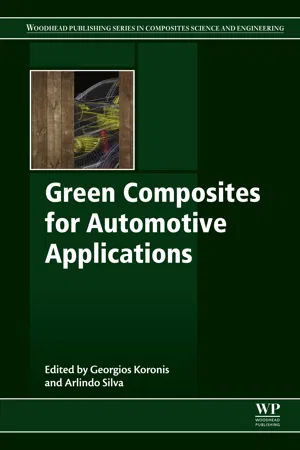
Green Composites for Automotive Applications
About this book
Green Composites for Automotive Applications presents cutting-edge, comprehensive reviews on the industrial applications of green composites. The book provides an elaborative assessment of both academic and industrial research on eco-design, durability issues, environmental performance, and future trends. Particular emphasis is placed on the processing and characterization of green composites, specific types of materials, such as thermoset and thermoplastic, nanocomposites, sandwich, and polymer biofoams. Additional sections cover lifecycle and risk analysis. As such, this book is an essential reference resource for R&D specialists working in materials science, automotive, chemical, and environmental engineering, as well as R&D managers in industry.
- Contains contributions from leading experts in the field
- Covers experimental, analytical and numerical analysis
- Deals with most important automotive aspects
- Provides a special section dedicated to lifecycle assessment
Information
Part I
Processing and characterization of green composites
Chapter 1
Surface modification of natural fibers in polymer composites
Diana P. Ferreiraa, Juliana Cruz, and Raul Fangueiro Centre for Textile Science and Technology (2C2T), University of Minho, Guimarães, Portugal
Abstract
Over the past few years, fibrous materials have found widespread applications in different technological areas including the automotive industry due to their versatile properties. Natural fibers, in particular, are cheap, abundant, biocompatible, and biodegradable, which has motivated many researchers worldwide to explore their potential applications in various industrial sectors. Nevertheless, these types of fibers show some limitations such as high moisture absorption and subsequent swelling and degradation, poor fire resistance, nonhomogeneity of their mechanical properties and poor interfacial interactions with polymeric or cementitious matrices.
The fibers surface functionalization using different approaches like physical, chemical, or biological could be the solution to overcome most of the drawbacks related to the use of natural fibers, especially the compatibility between the fiber and the polymeric matrix. Herein, a detailed description of the techniques commonly employed in the modification of natural cellulose fibers will be presented. Several examples will also be shown regarding the application of these natural fibers in polymer composites for possible use in automotive applications.
Keywords
Automotive applications; Chemical and biological treatments; Green composites; Nanoparticles; Natural fibers; Physical; Polymers
1.1. Introduction
Fibers are the basic building block of many materials and despite the fact that, for years, these structures have been mainly applied in textiles manufacturing, they have strong potential for widespread applications. The most common areas of applications are: in the automotive industry, medical field, civil engineering, aerospace industries, among others [1–5]. In the last few years, the development of new materials based on fibers revealed the huge potential of these materials to improve the quality of human life. The constituents of these fibrous materials may be of natural or synthetic origin. Natural fibers, including cellulosic, protein, and mineral fibers are collected directly from nature and are considered environmentally friendly materials. On the other hand, synthetic fibers are man-made and despite being the most used fiber for new materials development, they raise several environmental issues. These nonrenewable resources generate large amounts of waste at the end of the product lifecycle and require a long time for their complete degradation [6,7]. In the last few years, there is a great deal of concern about the replacement of synthetic materials by natural ones in order to reduce the cost, the production of CO2 and oil dependence, as well as problems related to materials recycling. It is estimated that 20%–25% of the total greenhouse gas emissions in industrialized countries come from the transportation industry. Therefore, the challenge is to develop lightweight and low price composites based on natural fibers to be used in the automotive industry in order to turn automobiles more fuel efficient and environmentally friendly [8]. Many automotive components are already produced with natural composites based on fibers like flax, hemp, and sisal. Table 1.1 presents several automotive industries that are already using natural fibers in the automobile components [8].
Natural fibers have high strength, high modulus of elasticity, high moisture absorption, and low elongation and elasticity when compared to non-natural fibers [11,12]. Natural fibers can be classified according to their origin into animal, vegetable, or mineral. Animal fibers include fibers such as silk, hair, wool, and feather and are proteinaceous in nature [13]. Vegetable fibers, on the other hand, are generally based on arrangements of cellulose with lignin including cotton, hemp, jute, flax, kenaf,...
Table of contents
- Cover image
- Title page
- Table of Contents
- Copyright
- Contributors
- Preface
- Part I. Processing and characterization of green composites
- Part II. Thermosetting and thermoplastic materials for structural applications
- Part III. Nanomaterials and additive manufacturing composites
- Part IV. Life cycle assessment and risk analysis
- Index
Trusted by 375,005 students
Access to over 1.5 million titles for a fair monthly price.
Study more efficiently using our study tools.
Frequently asked questions
Yes, you can cancel anytime from the Subscription tab in your account settings on the Perlego website. Your subscription will stay active until the end of your current billing period. Learn how to cancel your subscription
No, books cannot be downloaded as external files, such as PDFs, for use outside of Perlego. However, you can download books within the Perlego app for offline reading on mobile or tablet. Learn how to download books offline
Perlego offers two plans: Essential and Complete
- Essential is ideal for learners and professionals who enjoy exploring a wide range of subjects. Access the Essential Library with 800,000+ trusted titles and best-sellers across business, personal growth, and the humanities. Includes unlimited reading time and Standard Read Aloud voice.
- Complete: Perfect for advanced learners and researchers needing full, unrestricted access. Unlock 1.5M+ books across hundreds of subjects, including academic and specialized titles. The Complete Plan also includes advanced features like Premium Read Aloud and Research Assistant.
We are an online textbook subscription service, where you can get access to an entire online library for less than the price of a single book per month. With over 1.5 million books across 990+ topics, we’ve got you covered! Learn about our mission
Look out for the read-aloud symbol on your next book to see if you can listen to it. The read-aloud tool reads text aloud for you, highlighting the text as it is being read. You can pause it, speed it up and slow it down. Learn more about Read Aloud
Yes! You can use the Perlego app on both iOS and Android devices to read anytime, anywhere — even offline. Perfect for commutes or when you’re on the go.
Please note we cannot support devices running on iOS 13 and Android 7 or earlier. Learn more about using the app
Please note we cannot support devices running on iOS 13 and Android 7 or earlier. Learn more about using the app
Yes, you can access Green Composites for Automotive Applications by Georgios Koronis,Arlindo Silva in PDF and/or ePUB format, as well as other popular books in Technology & Engineering & Materials Science. We have over 1.5 million books available in our catalogue for you to explore.