- 386 pages
- English
- ePUB (mobile friendly)
- Available on iOS & Android
eBook - ePub
Mechanochemical Organic Synthesis
About this book
Mechanochemical Organic Synthesis is a comprehensive reference that not only synthesizes the current literature but also offers practical protocols that industrial and academic scientists can immediately put to use in their daily work. Increasing interest in green chemistry has led to the development of numerous environmentally-friendly methodologies for the synthesis of organic molecules of interest. Amongst the green methodologies drawing attention, mechanochemistry is emerging as a promising method to circumvent the use of toxic solvents and reagents as well as to increase energy efficiency.
The development of synthetic strategies that require less, or the minimal, amount of energy to carry out a specific reaction with optimum productivity is of vital importance for large-scale industrial production. Experimental procedures at room temperature are the mildest reaction conditions (essentially required for many temperature-sensitive organic substrates as a key step in multi-step sequence reactions) and are the core of mechanochemical organic synthesis. This green synthetic method is now emerging in a very progressive manner and until now, there is no book that reviews the recent developments in this area.
- Features cutting-edge research in the field of mechanochemical organic synthesis for more sustainable reactions
- Integrates advances in green chemistry research into industrial applications and process development
- Focuses on designing techniques in organic synthesis directed toward mild reaction conditions
- Includes global coverage of mechanochemical synthetic protocols for the generation of organic compounds
Information
Topic
Physical SciencesSubtopic
Organic ChemistryChapter 1
Practical Considerations in Mechanochemical Organic Synthesis
Abstract
The first section of this chapter aims to provide the reader a chronology of development of mechanochemistry and mechanochemical methodologies from ancient times to the latest discoveries in solid-state reactivity. The subsequent section is devoted to modern milling instrumentation and optimization of reaction parameters. With respect to organic synthesis, contamination from wear during milling is also discussed as an important variable. In the later section, solid-state analytical methods, such as powder X-ray diffraction (PXRD) and solid-state nuclear magnetic resonance, that are typically utilized to analyze the products of mechanochemical reactions are introduced. Finally, an overview of classical ex situ reaction monitoring methods is given with special emphasis on the recent advancements in in situ monitoring of mechanochemical reactions using PXRD and Raman spectroscopy.
Keywords
Ball mill; Contamination from wear; Ex situ and in situ reaction monitoring; Mechanochemistry; Milling parameters; Organic synthesis; Solid-state analysis1.1. A Historical Perspective
From the beginnings of mankind, mechanical treatment and processing of grains and seeds emerged as the first engineering technology in food preparation [1]. Later on, treating raw materials like minerals and ores in the same way, allowed the production of finely powdered paints and medicines. Prototypical mortars differing in material, shape, size, and decorations, found at many archaeological sites throughout the world, testify to early developments of tools that were intended to make use of mechanical force exerted by a hand. In those primitive grindstones, a stone ball was devised as a substitute to what later would become a pestle. Following the advancement of technology, simple grindstones eventually evolved into a variety of stylized mortars. Beautiful pieces named molcajete made of basalt stone, typical for pre-Hispanic Mesoamerican cultures, represent one such addition. Dating back to several thousand years, the Aztec and Maya people extensively used them for crushing and grinding spices and for preparation of salsas and guacamole. Even today, molcajete is a must-have kitchen utensil in traditional Mexican cuisine. Another example is a metate or mealing stone, traditionally used by Mesoamerican cultures to grind lime-treated maize and to prepare food. However, mealing stones are not tied with Mexico only since variations are found all over the world (Fig. 1.1).
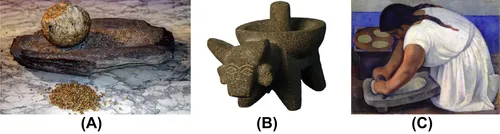
Figure 1.1 (A) A primitive grindstone, (B) Molcajete, a traditional Mexican tool for crushing and grinding spices, (C) Diego Rivera’s La Molendera (The Woman Grinder, 1924) showing traditional use of metate in making tortillas.
In his booklet De Lapidibus (On Stones), Theophrastus of Eresus described what is believed to be the first surviving testimony on relationship between grinding, as a means to introduce a mechanical force, and a chemical change as a consequence thereof [2]. It was a reduction of native cinnabar to the liquid mercury metal in the presence of vinegar, carried out in a copper mortar with a copper pestle:
HgS(s) + Cu(s) → Hg(l) + CuS(s)
In this, according to today’s standards, mechanochemical reaction, vinegar was used to eliminate side-reactions that often take place during milling in air. Interestingly, it would take another 2000 years for scientists to rediscover the effects of added liquid on the course of mechanochemically promoted reactions in what has come to be known as solvent-drop grinding (SDG), kneading, or liquid-assisted grinding (LAG) [3].
By entering the middle ages, much of the knowledge collected during the ancient times was lost or forgotten. However, mortar and pestle continued to be the primary tool for mechanical treatment of substances, and an alchemist laboratory could not be imagined without this grinding equipment, as nicely illustrated in Jan Van der Straet’s painting The Alchemist’s Studio (Fig. 1.2). While the medieval awakened interest in unraveling the mysteries of nature and new revolutionary ideas of renaissance have greatly contributed to the development of all fields of science, a systematic approach in studying mechanochemical reactions was left out until the second half of the 19th century.
Although Michael Faraday performed reduction of silver chloride with zinc, copper, tin, and iron by manual grinding demonstrating that chemical changes induced by means of mechanical agitation was a common knowledge [4], it was only with Walthère Spring and Matthew Carey Lea stepping up on the stage when mechanochemical phenomena started to be investigated in a systematic fashion [5]. While Spring, led by an aspiration to grasp the formation of minerals inside the earth’s crust, focused his research on the effect of high pressure on phase transformations and chemical reactions, M. C. Lea explored the behavior of silver, gold, mercury, and platinum halides (Cl, Br, and I) under the conditions of static pressure and shearing forces during manual agitation. He found that the potential of large static pressure to bring about a chemical reaction is much less pronounced compared to weak shearing forces exerted on the system as a result of manual grinding. Notably, the most important and cited result of Lea’s research on mechanochemistry, which earned him the title of “father of mechanochemistry,” is the observation that mechanical grinding leads to effects different from those induced by heat in thermochemical reactions. The two examples that illustrate this were mechanochemical decomposition of silver and mercury chlorides to silver, liquid mercury, and chlorine gas, as opposed to melting (AgCl) and sublimation (HgCl2) without decomposition upon exposure to heat:
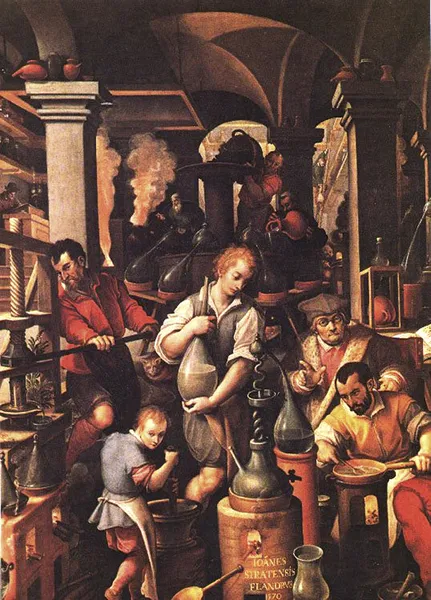
Figure 1.2 Jan Van der Straet’s “The Alchemist’s Studio” (1571).
2AgCl(s) → 2Ag(s) + Cl2(g)
HgCl2(s) → Hg(l) + Cl2(g)
As far as the mechanochemical synthesis involving organic molecules goes, the earliest documented example dates back in 1893 in a paper published by Ling and Baker [6]. In their contribution, an equimolar mixture of metadichloroquinol 1 and metadichloroquinone 2 was ground in a mortar to yield tetrachloroquinhydrone co-crystal 3 (Scheme 1.1A). It took nearly 100 years for chemists to again engage in mechanochemically promoted organic reactions. The work published by Paul in the early 1980s dealt with syntheses of quinhydrone charge–transfer complexes in the solid state by means of gri...
Table of contents
- Cover image
- Title page
- Table of Contents
- Copyright
- Preface
- List of Abbreviations
- Chapter 1. Practical Considerations in Mechanochemical Organic Synthesis
- Chapter 2. Carbon–Carbon Bond- Forming Reactions
- Chapter 3. Carbon–Nitrogen Bond-Formation Reactions
- Chapter 4. Carbon—Oxygen and Other Bond-Formation Reactions
- Chapter 5. Cycloaddition Reactions
- Chapter 6. Oxidations and Reductions
- Chapter 7. Applications of Ball Milling in Nanocarbon Material Synthesis
- Chapter 8. Applications of Ball Milling in Supramolecular Chemistry
- Chapter 9. Experiments for Introduction of Mechanochemistry in the Undergraduate Curriculum
- Author Index
- Subject Index
Trusted by 375,005 students
Access to over 1.5 million titles for a fair monthly price.
Study more efficiently using our study tools.
Frequently asked questions
Yes, you can cancel anytime from the Subscription tab in your account settings on the Perlego website. Your subscription will stay active until the end of your current billing period. Learn how to cancel your subscription
No, books cannot be downloaded as external files, such as PDFs, for use outside of Perlego. However, you can download books within the Perlego app for offline reading on mobile or tablet. Learn how to download books offline
Perlego offers two plans: Essential and Complete
- Essential is ideal for learners and professionals who enjoy exploring a wide range of subjects. Access the Essential Library with 800,000+ trusted titles and best-sellers across business, personal growth, and the humanities. Includes unlimited reading time and Standard Read Aloud voice.
- Complete: Perfect for advanced learners and researchers needing full, unrestricted access. Unlock 1.5M+ books across hundreds of subjects, including academic and specialized titles. The Complete Plan also includes advanced features like Premium Read Aloud and Research Assistant.
We are an online textbook subscription service, where you can get access to an entire online library for less than the price of a single book per month. With over 1.5 million books across 990+ topics, we’ve got you covered! Learn about our mission
Look out for the read-aloud symbol on your next book to see if you can listen to it. The read-aloud tool reads text aloud for you, highlighting the text as it is being read. You can pause it, speed it up and slow it down. Learn more about Read Aloud
Yes! You can use the Perlego app on both iOS and Android devices to read anytime, anywhere — even offline. Perfect for commutes or when you’re on the go.
Please note we cannot support devices running on iOS 13 and Android 7 or earlier. Learn more about using the app
Please note we cannot support devices running on iOS 13 and Android 7 or earlier. Learn more about using the app
Yes, you can access Mechanochemical Organic Synthesis by Davor Margetic,Vjekoslav Štrukil in PDF and/or ePUB format, as well as other popular books in Physical Sciences & Organic Chemistry. We have over 1.5 million books available in our catalogue for you to explore.