eBook - ePub
A Quick Guide to API 570 Certified Pipework Inspector Syllabus
Example Questions and Worked Answers
- 232 pages
- English
- ePUB (mobile friendly)
- Available on iOS & Android
eBook - ePub
A Quick Guide to API 570 Certified Pipework Inspector Syllabus
Example Questions and Worked Answers
About this book
The API Individual Certification Programs (ICPs) are well established worldwide in the oil, gas, and petroleum industries. This Quick Guide is unique in providing simple, accessible and well-structured guidance for anyone studying the API 570 Certified Pipework Inspector syllabus by:
- Summarising and helping them through the syllabus
- Providing multiple example questions and worked answers
Technical standards covered include the full API 'body of knowledge' for the examination, i.e. API570 Piping inspection code; API RP 571 Damage mechanisms affecting fixed equipment in the refining industry; API RP 574 Inspection practices for piping system components; API RP 577 Welding and metallurgy; API RP 578 Material verification program for new and existing alloy piping systems; ASME V Non-destructive examination; ASME IX Welding qualifications; ASME B16.5 Pipe flanges and flanged fittings; and ASME B 31.3 Process piping.
- Provides simple, accessible and well-structured guidance for anyone studying the API 570 Certified Pipework Inspector syllabus
- Summarizes the syllabus and provides the user with multiple example questions and worked answers
- Technical standards covered include the full API 'body of knowledge' for the examination
Information
Section II
Welding
Chapter 7
Introduction to Welding/API 577
7.1 Introduction
The purpose of this chapter is to ensure you can recognize the main welding processes that may be specified by the welding documentation requirements of ASME IX. The API exam will include questions in which you have to assess a Weld Procedure Specification (WPS) and its corresponding Procedure Qualification Record (PQR). As the codes used for API certification are all American you need to get into the habit of using American terminology for the welding processes and the process parameters.
This module will also introduce you to the API RP 577: Welding inspection and metallurgy in your code document package. This document has only recently been added to the API examination syllabus. As a Recommended Practice (RP) document, it contains technical descriptions and instruction, rather than truly prescriptive requirements.
7.2 Welding processes
There are four main welding processes that you have to learn about:
• Shielded metal arc welding (SMAW)
• Gas tungsten arc welding (GTAW)
• Gas metal arc welding (GMAW)
• Submerged arc welding (SAW)
The process(es) that will form the basis of the WPS and PQR questions in the API exam will almost certainly be chosen from these.
The sample WPS and PQR forms given in the non-mandatory appendix B of ASME IX (the form layout is not strictly within the API 570 examination syllabus, but we will discuss it later) only contains the information for qualifying these processes.
7.2.1 Shielded metal arc (SMAW)
This is the most commonly used technique. There is a wide choice of electrodes, metal and fluxes, allowing application to different welding conditions. The gas shield is evolved from the flux, preventing oxidation of the molten metal pool (Fig. 7.1). An electric arc is then struck between a coated electrode and the workpiece. SMAW is a manual process as the electrode voltage and travel speed is controlled by the welder. It has a constant current characteristic.

Figure 7.1 SMAW process
7.2.2 Metal inert gas (GMAW)
In this process, electrode metal is fused directly into the molten pool. The electrode is therefore consumed, being fed from a motorized reel down the centre of the welding torch (Fig. 7.2). GMAW is known as a semi-automatic process as the welding electrode voltage is controlled by the machine.
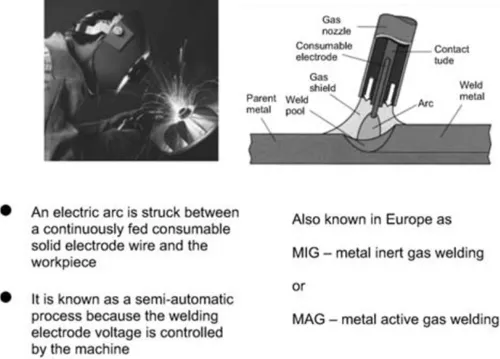
Figure 7.2 GMAW process
Tungsten ine...
Table of contents
- Cover image
- Title page
- Table of Contents
- Copyright page
- The Quick Guide Series
- How to Use This Book
- Section I: The Main Principles
- Section II: Welding
- Section III: NDE and Other Testing
- Section IV: Pressure Design
- Section V: Example Questions
- Appendix: Publications Effectivity Sheet For API 570 Exam Administration: 4th June 2008
- Index
Trusted by 375,005 students
Access to over 1.5 million titles for a fair monthly price.
Study more efficiently using our study tools.
Frequently asked questions
Yes, you can cancel anytime from the Subscription tab in your account settings on the Perlego website. Your subscription will stay active until the end of your current billing period. Learn how to cancel your subscription
No, books cannot be downloaded as external files, such as PDFs, for use outside of Perlego. However, you can download books within the Perlego app for offline reading on mobile or tablet. Learn how to download books offline
Perlego offers two plans: Essential and Complete
- Essential is ideal for learners and professionals who enjoy exploring a wide range of subjects. Access the Essential Library with 800,000+ trusted titles and best-sellers across business, personal growth, and the humanities. Includes unlimited reading time and Standard Read Aloud voice.
- Complete: Perfect for advanced learners and researchers needing full, unrestricted access. Unlock 1.5M+ books across hundreds of subjects, including academic and specialized titles. The Complete Plan also includes advanced features like Premium Read Aloud and Research Assistant.
We are an online textbook subscription service, where you can get access to an entire online library for less than the price of a single book per month. With over 1.5 million books across 990+ topics, we’ve got you covered! Learn about our mission
Look out for the read-aloud symbol on your next book to see if you can listen to it. The read-aloud tool reads text aloud for you, highlighting the text as it is being read. You can pause it, speed it up and slow it down. Learn more about Read Aloud
Yes! You can use the Perlego app on both iOS and Android devices to read anytime, anywhere — even offline. Perfect for commutes or when you’re on the go.
Please note we cannot support devices running on iOS 13 and Android 7 or earlier. Learn more about using the app
Please note we cannot support devices running on iOS 13 and Android 7 or earlier. Learn more about using the app
Yes, you can access A Quick Guide to API 570 Certified Pipework Inspector Syllabus by Clifford Matthews in PDF and/or ePUB format, as well as other popular books in Technology & Engineering & Operations. We have over 1.5 million books available in our catalogue for you to explore.