- 576 pages
- English
- ePUB (mobile friendly)
- Available on iOS & Android
eBook - ePub
Emerging Nanotechnologies for Manufacturing
About this book
In the second edition of Emerging Nanotechnologies for Manufacturing, an unrivalled team of international experts explores existing and emerging nanotechnologies as they transform large-scale manufacturing contexts in key sectors such as medicine, advanced materials, energy, and electronics. From their different perspectives, the contributors explore technologies and techniques as well as applications and how they transform those sectors.
With updated chapters and expanded coverage, the new edition of Emerging Nanotechnologies for Manufacturing reflects the latest developments in nanotechnologies for manufacturing and covers additional nanotechnologies applied in the medical fields, such as drug delivery systems. New chapters on graphene and smart precursors for novel nanomaterials are also added.
This important and in-depth guide will benefit a broad readership, from R&D scientists and engineers to venture capitalists.
- Covers nanotechnology for manufacturing techniques and applications across a variety of industries
- Explores the latest developments such as nanosuspensions and nanocarriers in drug delivery systems, graphene applications, and usage of smart precursors to develop nanomaterials
- Proven reference guide written by leading experts in the field
Information
Chapter 1
Nanotechnology to Nanomanufacturing
W. Ahmed1, M.J. Jackson2 and I. Ul Hassan3, 1School of Medicine and Dentistry, Institute of Nanotechnology and Bioengineering, University of Central Lancashire, Preston, UK, 2Micro Machinists Corporation, Cambridge, Massachusetts, 3Dhofar University, College of Arts and Applied Sciences, Department of Mathematics and Sciences, Salalah, Sultanate of Oman
Nanotechnology is a term that is used to describe the science and technology related to the control and manipulation of matter and devices on a scale less than 100 nm in dimension. It involves a multidisciplinary approach involving fields such as applied physics, materials science, chemistry, biology, surface science, robotics, engineering, electrical engineering and biomedical engineering. At this scale the properties of matter is dictated and there are few boundaries between scientific disciplines. Generally, two main approaches have been used in nanotechnology. These are known as the ‘bottom-up’ and ‘top-down’ approaches. The former involves building up from atoms into molecules to assemble nanostructures, materials and devices. The latter involves making structures and devices from larger entities without specific control at the atomic level. Progress in both approaches has been accelerated in recent years with the development and application of highly sensitive equipment. For example, instruments such as atomic force microscope (AFM), scanning tunnelling microscope (STM), electron beam lithography, molecular beam epitaxy, etc., have become available to push forward development in this exciting new field. These instruments allow observation and manipulation of novel nanostructures. Considerable research is being carried throughout the world in developing nanotechnology, and many new applications have emerged. However, a related term is nanomanufacturing, used to describe industrial scale manufacture of nanotechnology-based objects at high rate, low cost and reliability. In this paper we discuss the opportunities and challenges facing the transition from nanotechnology to nanomanufacturing. Tools, templates and processes are currently being developed that will enable high volume manufacturing of components and structures on a nanoscale and these are reviewed. These advancements will accelerate the development of commercial products and enable the creations of a new generation of applications in various different commercial sectors including drug delivery, cosmetics, biomedical implants, electronics, optical components, automotive and aerospace parts.
Keywords
nanomanufacturing; bottom-up; top-down; 3-D structures; nanolithography; scanning tunnelling microscope (STM); integrated circuits
1.1 Introduction
Although nanotechnology has been around since the beginning of time, the discovery of nanotechnology has been attributed to Richard Feynman [1] who presented a paper called ‘There is Plenty of Room at the Bottom’ on 29 December 1959 at the annual meeting of the American Physical Society. Feynman talked about the storage of information on a very small scale, writing and reading in atoms, miniaturization of the computer, building tiny machines, tiny factories and electronic circuits with atoms. He stated that ‘In the year 2000, when they look back at this age, they will wonder why it was not until the year 1960 that anybody began seriously to move in this direction’. However, he did not specifically use the term ‘nanotechnology’. The first use of the term ‘nanotechnology’ has been attributed to Norio Taniguchi [2] in a paper published in 1974 ‘On the Basic Concept of “NanoTechnology” ’.
Since then several definitions [3] of nanotechnology have evolved. For example, the dictionary definition states that nanotechnology is ‘the art of manipulating materials on an atomic or molecular scale especially to build microscopic devices’. Other definitions include the one by US government which state that ‘Nanotechnology is research and technology development at the atomic, molecular or macromolecular level in the length scale of approximately 1–100 nm range, to provide a fundamental understanding of phenomena and materials at the nanoscale and to create and use structures, devices and systems that have novel properties and functions because of their small and/or intermediate size’. The Japanese have come up with a more focused and succinct definition for ‘True Nano’ as nanotechnology which is expected to cause scientific or technological quantum jumps, or to provide great industrial applications by using phenomena and characteristics peculiar to nano-level.
Regardless of the definition that is used, it is evident that the properties of matter are controlled at a scale between 1 and 100 nm. For example, chemical properties take advantage of large surface-to-volume ratio for catalysis and interfacial and surface chemistry is important in many applications. Mechanical properties involve improved strength hardness in light-weight nanocomposites and nanomaterials, altered bending, compression properties, and nanomechanics of molecular structures. Optical properties involve absorption and fluorescence of nanocrystals, single photon phenomena, and photonic bandgap engineering. Fluidic properties give rise to enhanced flow using nanoparticles, and nanoscale-adsorbed films are also important. Thermal properties give increased thermoelectric performance of nanoscale materials and interfacial thermal resistance is important.
1.2 Approaches to Nanotechnology
Numerous approaches have been utilized successfully in nanotechnology, and as the technology develops further approaches may emerge. The approaches employed thus far have generally been dictated by the technology available and the background experience of the researchers involved. Nanotechnology is a truly multidisciplinary field [4] involving chemistry, physics, biology, engineering, electronics, social sciences, etc., which need to be integrated together in order to generate the next level of development (Figure 1.1). Fuel cells, mechanically stronger materials, nanobiological devices, molecular electronics, quantum devices, carbon nanotubes, etc. have been made using nanotechnology. Even social scientists are debating ethical use of nanotechnology.
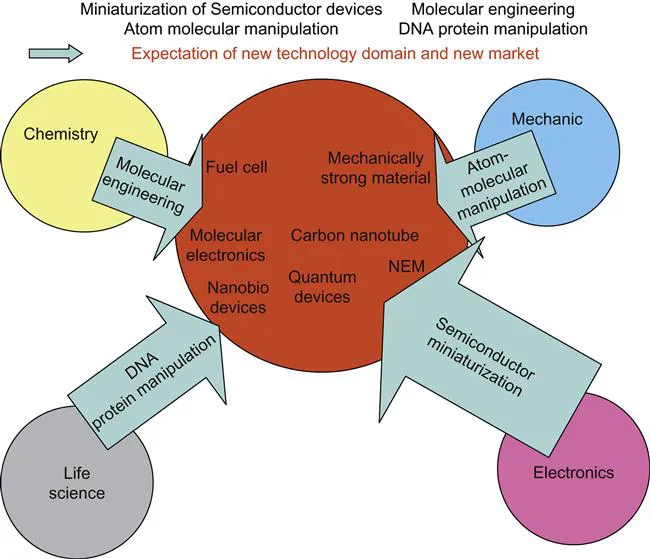
The two main approaches to explain nanotechnology to the general public have been oversimplified and have become known as the ‘top-down’ approach and the ‘bottom-up’ approach. The top-down approach involves fabrication of device structures via monolithic processing on the nanoscale. This approach has been used with spectacular success in the semiconductor devices used in consumer electronics. The bottom-up approach involves the fabrication of device structures via systematic assembly of atoms, molecules or other basic units of matter. This is the approach nature uses to repair cells, tissues, organs of living and organ systems in living things, and indeed for life processes such as protein synthesis. Tools are evolving which will give scientists more control over the synthesis and characterization of novel nanostructures and yield a range of new products in the near future.
1.3 Transition from Nanotechnology to Nanomanufacturing
Throughout the world a huge amount of research is being carried out, and governments and research organizations are spending large amounts of mo...
Table of contents
- Cover image
- Title page
- Table of Contents
- Copyright
- Preface
- List of Contributors
- Chapter 1. Nanotechnology to Nanomanufacturing
- Chapter 2. Gas phase nanofication: A strategy to impart fast response in sensors
- Chapter 3. Advanced characterization techniques for nanostructures
- Chapter 4. Non-lithographic techniques for nanostructuring of thin films and bulk surfaces
- Chapter 5. Engineered carbon nanotube field emission devices
- Chapter 6. Upconverting fluorescent nanoparticles for biological applications
- Chapter 7. Micro- and nanomachining
- Chapter 8. Design of experiments: A key to innovation in nanotechnology
- Chapter 9. Environmental and occupational health issues with nanoparticles
- Chapter 10. Commercialization of nanotechnologies: Technology transfer from university research laboratories
- Chapter 11. Fabrication of hydrogel micropatterns by soft photolithography
- Chapter 12. Nanocrystalline diamond for RF-MEMS applications
- Chapter 13. Analysis of the effects of micromachining using nanostructured cutting tools
- Chapter 14. Metal oxide nanopowder
- Chapter 15. Some approaches to large-scale manufacturing of liposomes
- Chapter 16. Nanocoatings in medicine: Antiquity and modern times
- Chapter 17. Smart precursors for smart nanoparticles
- Index
Trusted by 375,005 students
Access to over 1.5 million titles for a fair monthly price.
Study more efficiently using our study tools.
Frequently asked questions
Yes, you can cancel anytime from the Subscription tab in your account settings on the Perlego website. Your subscription will stay active until the end of your current billing period. Learn how to cancel your subscription
No, books cannot be downloaded as external files, such as PDFs, for use outside of Perlego. However, you can download books within the Perlego app for offline reading on mobile or tablet. Learn how to download books offline
Perlego offers two plans: Essential and Complete
- Essential is ideal for learners and professionals who enjoy exploring a wide range of subjects. Access the Essential Library with 800,000+ trusted titles and best-sellers across business, personal growth, and the humanities. Includes unlimited reading time and Standard Read Aloud voice.
- Complete: Perfect for advanced learners and researchers needing full, unrestricted access. Unlock 1.5M+ books across hundreds of subjects, including academic and specialized titles. The Complete Plan also includes advanced features like Premium Read Aloud and Research Assistant.
We are an online textbook subscription service, where you can get access to an entire online library for less than the price of a single book per month. With over 1.5 million books across 990+ topics, we’ve got you covered! Learn about our mission
Look out for the read-aloud symbol on your next book to see if you can listen to it. The read-aloud tool reads text aloud for you, highlighting the text as it is being read. You can pause it, speed it up and slow it down. Learn more about Read Aloud
Yes! You can use the Perlego app on both iOS and Android devices to read anytime, anywhere — even offline. Perfect for commutes or when you’re on the go.
Please note we cannot support devices running on iOS 13 and Android 7 or earlier. Learn more about using the app
Please note we cannot support devices running on iOS 13 and Android 7 or earlier. Learn more about using the app
Yes, you can access Emerging Nanotechnologies for Manufacturing by Waqar Ahmed,Mark J Jackson in PDF and/or ePUB format, as well as other popular books in Technology & Engineering & Materials Science. We have over 1.5 million books available in our catalogue for you to explore.