eBook - ePub
Fabrication and Self-Assembly of Nanobiomaterials
Applications of Nanobiomaterials
- 528 pages
- English
- ePUB (mobile friendly)
- Available on iOS & Android
eBook - ePub
Fabrication and Self-Assembly of Nanobiomaterials
Applications of Nanobiomaterials
About this book
Fabrication and Self-Assembly of Nanobiomaterials presents the most recent findings regarding the fabrication and self-assembly of nanomaterials for different biomedical applications. Respected authors from around the world offer a comprehensive look at how nanobiomaterials are made, enabling knowledge from current research to be used in an applied setting.
Recent applications of nanotechnology in the biomedical field have developed in response to an increased demand for innovative approaches to diagnosis, exploratory procedures and therapy. The book provides the reader with a strong grounding in emerging biomedical nanofabrication technologies, covering numerous fabrication routes for specific applications are described in detail and discussing synthesis, characterization and current or potential future use.
This book will be of interest to professors, postdoctoral researchers and students engaged in the fields of materials science, biotechnology and applied chemistry. It will also be highly valuable to those working in industry, including pharmaceutics and biotechnology companies, medical researchers, biomedical engineers and advanced clinicians.
- An up-to-date and highly structured reference source for practitioners, researchers and students working in biomedical, biotechnological and engineering fields
- A valuable guide to recent scientific progress, covering major and emerging applications of nanomaterials in the biomedical field
- Proposes novel opportunities and ideas for developing or improving technologies in fabrication and self-assembly
Information
Chapter 1
Synthesis, characterization and applications of nanoparticles
Jiafu Chen, Hoda Javaheri, Basel Al-Chikh Sulaiman and Yaser Dahman, Department of Chemical Engineering, Ryerson University, Toronto, ON, Canada
Abstract
The present chapter reviews the rapid development in the fabrication of nanoparticles during the past few decades that has led to a wide range of advances in the field. Although utilization of nanoparticles as fillers in polymer materials to enhance physical and mechanical properties has attracted major attention, there has been special interest in researching and developing the structures of nanoparticles in polymers. This includes but is not limited to their assembly in arrays and along interfacial boundaries. Understanding the organic chemistry of nanoparticle materials contributed to the major developments of the compositions of the nanoparticle surfaces. This allowed one to tailor the properties of the particles by the choice of polymer matrix and surface compositions. Mainly, evolvements in the polymeric-based nanoparticle composite materials are generating interest in several applications. These applications include utilizing nanoparticles in electronic and optical materials according to the properties of the metallic and semiconductor particles used. Furthermore, other applications include nanostructured catalysis in addition to utilizing nanoparticles in polymer-based scaffolds.
Keywords
Nanoparticles; polymer composites; fabrications routes; scaffolds
1.1 Introduction
The terms nanotechnology, nanostructure, nanoscience, and nanoparticles have recently been used widely in scientific and engineering literatures. It was found that nanostructured materials are very applicable and useful in regenerative medicine to repair and augment damaged or lost organs or tissues. This can be explained by their ability to travel through the human body. Furthermore, other applications include their applications in biological detection, controlled drug delivery, low-threshold laser, optical filters, and also sensors, among others (Fredy, 2008).
1.2 Synthesis and Characteristics
Researching in to the different fabrication techniques of nanoparticles makes it possible to have some level of control over their shape and stability. Aggregation of nanoparticles can be a major drawback that requires precaution and knowledge during the synthesis stages. This highlights the importance of utilizing stabilizing agents, which conjugate with the surface of the particle and provides charge or stability properties that keep the nanoparticles suspended, and thereby prevents their aggregation (Fredy, 2008).
1.2.1 Magnetic Nanoparticles
1.2.1.1 Characteristics of magnetic nanoparticles
Among all kinds of nanomaterials, magnetic nanoparticles earn their position by their special features and widely used applications. Compared to regular magnetic materials, nanoparticles differ from the domain structure to the classic quantum theory. Thus, they have a more advanced technology and more applications due to different physical and chemical properties. The physical properties of magnetic nanoparticles can be determined by the chemical compositions, the type and the degree of defectiveness of the domain structure including the particle size and shape, and the interaction of the atoms among the molecular structure. However, due to the limitations of present technology, the above factors cannot be controlled all the time during the synthesis. Furthermore, the relationship between the properties and the structure are unknown, so the same type of material with different concentrations could have large differences. Even though magnetic nanoparticles are basically metals with magnetism, living creatures also have magnetic nanoparticles within their bodies. For example, migratory birds and fish have magnetic nanoparticles inside their sense systems to guide them during their migration between south and north every year. Even human beings have magnetic nanoparticles inside their brains. It is estimated that the human brain includes about 100 million magnetic nanoparticles per gram of tissue. So magnetic nanoparticles are not just a science, but are related to our daily life and affect it in many different ways.
There are many kinds of magnetic nanoparticles due to different chemical properties: metals, rare earth metals, oxidation of metallic nanoparticles, and magnetic alloys. Since the metal nanoparticles include most of the metal magnetic materials and oxidation of metallic nanoparticles, the following section will focus on the different magnetic alloys (Gubin, 2009).
• Fe–Co Alloys: Since Co and Fe are body-centered cubic structures in a nanoparticle, the allied order of both metals is very soft and very suitable to be raw material for nanoparticles. The maximum concentration of Co in the alloy is 35%. This is the saturation concentration of Co. The related magnetic properties also increase with the mixing level (Gubin, 2009).
• Fe–Ni Alloys: Samples of Fe and Ni in experiments can have nonmagnetic or magnetic soft ferro magnets. For the alloy compound of iron and nickel, they have a much lower saturation magnetization compared to pure samples of each metal. For example, when we have 37% of Ni, it has a low curie point and an FCC structure. Theoretical calculations estimate a more complicated magnetic structure for these types of alloys due to the different combinations.
• Fe–Pt Alloys: Because of the wide application on the information recording density of materials, these types of alloys are being studied a lot recently. They have the face-centered tetragonal structure and thus obtain a unique property of recording advantage of large coercivity when in room temperature, no matter how small the particles are. Prepared by joint thermolysis in the presence of oleic acid and oleylamine, FE–Pt nanoparticles have a narrow size distribution. After further heating, a protective film is formed on the surface of alloys, which remain about the same size.
• Co–Pt Alloys: In a high-density information storage field, nanoparticles of Co–Pt have a lot of advantages due to their form, size, and crystal structure, which makes them chemically stable and magnetically crystalline. One of the many methods is the polyol method that does not use organ metallic precursors. Even though the same solution is processed, sometimes two different concentrations of alloys are formed with different structures, in this case, the different concentration can be studied.
Since most of magnetic materials are metal or metal oxides, the raw material is straightforward and can be easily found. However, the technology difficulties remain in the purity section. As mentioned above, the different chemical properties are based on the structure and the concentration of the alloys, so the synthesis process has to be controlled very carefully. Furthermore, when it comes to the nanoscale, many of the classic physics laws are not applicable and quantum physics is required. The synthesis of ferrofluid consists of synthetic procedures. Basically, it is the thermal decomposition of metal organic compounds or the thermal decomposition of monometallic metal organic compounds. Figure 1.1 shows examples of magnetic nanoparticles for one simple structure and for metal alloy compounds.
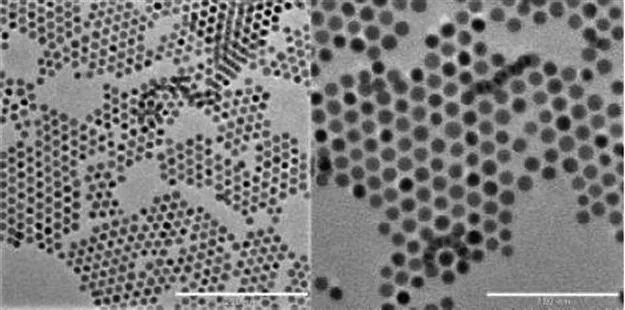
From Figure 1.1, we can see the Co particles prepared by thermal decomposition; the raw materials are octacarbonyldicobalt and dichlorobenzene. Twenty years ago, Massart developed a method to synthesize magnetic ferrofluids based on the coprecipitation of Fe salts in aqueous solutions using repulsive electrostatic forces. The image of Fe oxidation product is slightly different from the Co product, as is shown in Figure 1.2.
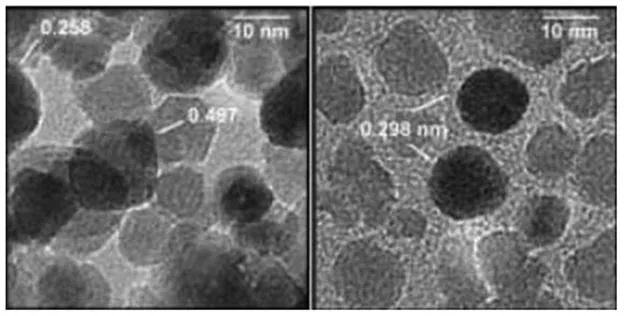
As we can see from Figure 1.2, the left side is the iron oxide product prepared in aqueous solution and the right side is the product formed from the toluene solution, which has oleic acid on the surface.
1.2.1.2 Synthesis method of magnetic nanoparticles
The synthesis of magnetic nanoparticles has been developed over 30 years. The raw materials have been used from metal to nonmetal and from gas to liquid phases. The most commonly used metal oxides are the Fe, Co, Mg, and Mn with their alloy compounds. In recent years, many experiments have been done on the control of shape, crystalline, and stable surfaces of magnetic nanoparticles. As mentioned earlier, the shape and orientation affect the chemical properties greatly. The most common way is coprecipitation, thermal synthesis, and microemulsion. The following section will focus on each of the techniques.
• Coprecipitation: For most of the iron oxides, this is a very convenient way to process aqueous Fe salt solutions. By adding a base on normal temperature and pressure, the process could be controlled to obtain the ideal shape and size of the magnetic nanoparticles. However, there are also other factors to consider with this kind of method: the Fe ratio, the reaction rate and temperature, and the pH value of the solution. These will also affect the smoothness of the reaction. After the preparations are done, the experiment will proceed to a point where the solution reaches magnetic saturation (Lu et al., 2007).
• Thermal decomposition: In order to control shape and size more p...
Table of contents
- Cover image
- Title page
- Table of Contents
- Copyright
- List of contributors
- Preface of the series
- Fabrication and self-assembly of nanobiomaterials: applications of nanobiomaterials
- Chapter 1. Synthesis, characterization and applications of nanoparticles
- Chapter 2. Preparation and applications of self-assembled natural and synthetic nanostructures
- Chapter 3. Self-assembly of nanobiomaterials
- Chapter 4. Self-nanoemulsifying systems for oral bioavailability enhancement: Recent paradigms
- Chapter 5. Sensing of reactive oxygen species by self-aggregating gold nanoparticle assemblies
- Chapter 6. Plant mediated green synthesis of metallic nanoparticles: Challenges and opportunities
- Chapter 7. Exosomes: Smart nanospheres for drug delivery naturally produced by stem cells
- Chapter 8. Controllable synthesis of lanthanide upconversion nanomaterials through impurity doping
- Chapter 9. Nanocellulose—fabrication, structure, properties, and application in the area of care and cure
- Chapter 10. Magnetosensitive nanocomposites with hierarchical nanoarchitecture as biomedical nanorobots: Synthesis, properties, and application
- Chapter 11. Designing and testing single tablet for tuberculosis treatment through electrospinning
- Chapter 12. Synthesis, characteristics, and biocidal activity of silver nanoparticles
- Chapter 13. Nanobiomaterials: Applications in biomedicine and biotechnology
- Chapter 14. Control, design, and understanding of molecular self-assembly
- Chapter 15. Self-assembly of transition metal nanoparticles using marine sources
- Index
Trusted by 375,005 students
Access to over 1.5 million titles for a fair monthly price.
Study more efficiently using our study tools.
Frequently asked questions
Yes, you can cancel anytime from the Subscription tab in your account settings on the Perlego website. Your subscription will stay active until the end of your current billing period. Learn how to cancel your subscription
No, books cannot be downloaded as external files, such as PDFs, for use outside of Perlego. However, you can download books within the Perlego app for offline reading on mobile or tablet. Learn how to download books offline
Perlego offers two plans: Essential and Complete
- Essential is ideal for learners and professionals who enjoy exploring a wide range of subjects. Access the Essential Library with 800,000+ trusted titles and best-sellers across business, personal growth, and the humanities. Includes unlimited reading time and Standard Read Aloud voice.
- Complete: Perfect for advanced learners and researchers needing full, unrestricted access. Unlock 1.5M+ books across hundreds of subjects, including academic and specialized titles. The Complete Plan also includes advanced features like Premium Read Aloud and Research Assistant.
We are an online textbook subscription service, where you can get access to an entire online library for less than the price of a single book per month. With over 1.5 million books across 990+ topics, we’ve got you covered! Learn about our mission
Look out for the read-aloud symbol on your next book to see if you can listen to it. The read-aloud tool reads text aloud for you, highlighting the text as it is being read. You can pause it, speed it up and slow it down. Learn more about Read Aloud
Yes! You can use the Perlego app on both iOS and Android devices to read anytime, anywhere — even offline. Perfect for commutes or when you’re on the go.
Please note we cannot support devices running on iOS 13 and Android 7 or earlier. Learn more about using the app
Please note we cannot support devices running on iOS 13 and Android 7 or earlier. Learn more about using the app
Yes, you can access Fabrication and Self-Assembly of Nanobiomaterials by Alexandru Grumezescu in PDF and/or ePUB format, as well as other popular books in Technology & Engineering & Biotechnology in Medicine. We have over 1.5 million books available in our catalogue for you to explore.