eBook - ePub
Handbook of Materials Failure Analysis With Case Studies from the Construction Industries
- 372 pages
- English
- ePUB (mobile friendly)
- Available on iOS & Android
eBook - ePub
Handbook of Materials Failure Analysis With Case Studies from the Construction Industries
About this book
Handbook of Materials Failure Analysis: With Case Studies from the Construction Industry provides a thorough understanding of the reasons materials fail in certain situations, covering important scenarios including material defects, mechanical failure due to various causes, and improper material selection and/or corrosive environment. The book begins with a general overview of materials failure analysis and its importance, and then logically proceeds from a discussion of the failure analysis process, types of failure analysis, and specific tools and techniques, to chapters on analysis of materials failure from various causes.
Failure can occur for several reasons, including: materials defects-related failure, materials design-related failure, or corrosion-related failures. The suitability of the materials to work in a definite environment is an important issue. The results of these failures can be catastrophic in the worst case scenarios, causing loss of life. This important reference covers the most common types of materials failure, and provides possible solutions.
- Provides the most up-to-date and balanced coverage of failure analysis, combining foundational knowledge and current research on the latest developments and innovations in the field
- Offers an ideal accompaniment for those interested in materials forensic investigation, failure of materials, static failure analysis, dynamic failure analysis, and fatigue life prediction
- Presents compelling new case studies from key industries to demonstrate concepts and to assist users in avoiding costly errors that could result in catastrophic events
Information
Subtopic
Scienza dei materialiChapter 1
Failure of the metallic structures due to microbiologically induced corrosion and the techniques for protection
Abdel Salam H. Makhlouf*
Martin A. Botello**
* Central Metallurgical Research and Development Institute, Cairo, Egypt
** University of Texas Rio Grande Valley, Edinburg, TX, United States
* Central Metallurgical Research and Development Institute, Cairo, Egypt
** University of Texas Rio Grande Valley, Edinburg, TX, United States
Abstract
Microbiologically induced corrosion (MIC) is a corrosion type that is harmful to most engineering materials. MIC deteriorates the metal surface through the metabolic activity of microorganisms. Since the 19th century, scientists have been trying to explain the role of microorganisms in corrosion. The damage due to MIC is broken down into a three-step process: creation of biofilm, change of environment at the metal surface, and deterioration of the metal. The common bacteria associated with MIC are sulfate-reducing bacteria, acid-producing bacteria, and iron-reducing bacteria. The most common forms of corrosion influenced by MIC are pitting corrosion, crevice corrosion, and stress corrosion cracking. This chapter discusses the types of MIC, the mechanisms of corrosion damage due to MIC, the common methods used for detecting and monitoring MIC, and the methods of materials protection from MIC attack.
Keywords
acid-producing bacteria
iron-reducing bacteria
materials failure
microbiologically induced corrosion
pitting corrosion
sulfate-reducing bacteria
1. Introduction
One type of corrosion that is very harmful to most engineering construction materials is microbiologically induced corrosion (MIC). MIC can be defined as the deterioration of metals due to the metabolic activity of microorganisms, such as bacteria and fungi. MIC is not a new corrosion mechanism but influences other corrosion by the biological effect of the microorganisms. These microorganisms create a biofilm that changes the environment in contact with the material thus inducing an electrochemical reaction between the microorganisms and the material. In 2007, MIC accounted for about 20% of the total damage caused by corrosion [1]. MIC is often ignored when another corrosion mechanism can be invoked to explain the observed case [2]. This is why scientists consider MIC to be a “joker” where there is no plausible explanation for the given corrosion case [2]. MIC damage has been documented for metals, alloys, and composites exposed to seawater, freshwater, demineralized water, process chemicals, foodstuffs, soils, aircraft fuels, human plasma, and sewage [3]. This versatility allows MIC to be observed in multiple corrosion cases but may not be the root cause of corrosion. On the contrary, the name “microbiological” is not subject to only microorganisms but also macroorganisms, which are capable of influencing corrosion. There is a vast number of microorganisms that attack different metallic structures in different environments. For simplicity, this chapter focuses on the bacteria aspect. Fig. 1.1 is an example of MIC in a pipe.
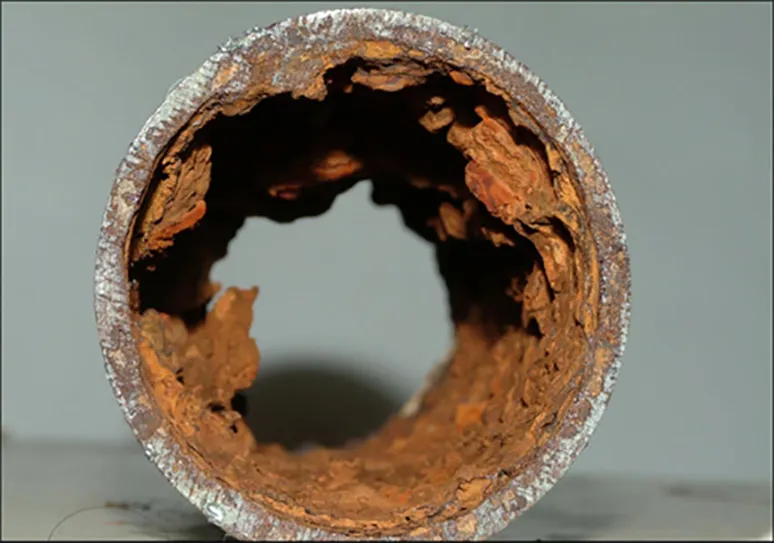
Figure 1.1 MIC in a pipeline [4].
1.1. History of MIC
The role of microorganisms in corrosion was not investigated until the late 19th century [1]. In 1910, MIC was considered as an explanation for the very high sulfur content of corrosion products from the Castgill aqueduct in the United States [1]. This was the first time sulfur content was linked to bacterial corrosion. In 1934, von Wolzogen Kuhr and va der Flugt were pioneers in interpreting the electrochemical process of MIC [5]. They came up with the “Cathodic Depolarization Theor...
Table of contents
- Cover
- Title page
- Table of Contents
- Copyright
- List of Contributors
- Chapter 1: Failure of the metallic structures due to microbiologically induced corrosion and the techniques for protection
- Chapter 2: Failure analysis of welded constructional steel components
- Chapter 3: Failure analysis of buried steel pipe under common geological disasters
- Chapter 4: Construction failures due to improper materials, manufacturing, and design
- Chapter 5: Failures of construction equipment and accessories: metallurgical root-cause analysis
- Chapter 6: Corrosion and protection of the metallic structures in the petroleum industry due to corrosion and the techniques for protection
- Chapter 7: Failure of timber constructions
- Chapter 8: Structural failures in cast-in-place reinforced concrete building structures under construction
- Chapter 9: Reliability design of the drawer system in French refrigerator subject to repetitive stresses
- Chapter 10: Failure analysis of a crusher jaw
- Chapter 11: Bearing failure issues and corrective measures through surface engineering
- Chapter 12: Consolidation works on sandstone monuments: A new approach
- Chapter 13: Nondestructive testing methodology to assess the conservation of historic stone buildings and monuments
- Chapter 14: Introduction to hopper-attached belt-wagon system and component strength analysis method
- Chapter 15: Assessment of the vulnerability index of small dams to natural hazards: case study
- Index
Trusted by 375,005 students
Access to over 1.5 million titles for a fair monthly price.
Study more efficiently using our study tools.
Frequently asked questions
Yes, you can cancel anytime from the Subscription tab in your account settings on the Perlego website. Your subscription will stay active until the end of your current billing period. Learn how to cancel your subscription
No, books cannot be downloaded as external files, such as PDFs, for use outside of Perlego. However, you can download books within the Perlego app for offline reading on mobile or tablet. Learn how to download books offline
We are an online textbook subscription service, where you can get access to an entire online library for less than the price of a single book per month. With over 1.5 million books across 990+ topics, we’ve got you covered! Learn about our mission
Look out for the read-aloud symbol on your next book to see if you can listen to it. The read-aloud tool reads text aloud for you, highlighting the text as it is being read. You can pause it, speed it up and slow it down. Learn more about Read Aloud
Yes! You can use the Perlego app on both iOS and Android devices to read anytime, anywhere — even offline. Perfect for commutes or when you’re on the go.
Please note we cannot support devices running on iOS 13 and Android 7 or earlier. Learn more about using the app
Please note we cannot support devices running on iOS 13 and Android 7 or earlier. Learn more about using the app
Yes, you can access Handbook of Materials Failure Analysis With Case Studies from the Construction Industries by Abdel Salam Hamdy Makhlouf,Mahmood Aliofkhazraei in PDF and/or ePUB format, as well as other popular books in Tecnologia e ingegneria & Scienza dei materiali. We have over 1.5 million books available in our catalogue for you to explore.