eBook - ePub
World Seas: An Environmental Evaluation
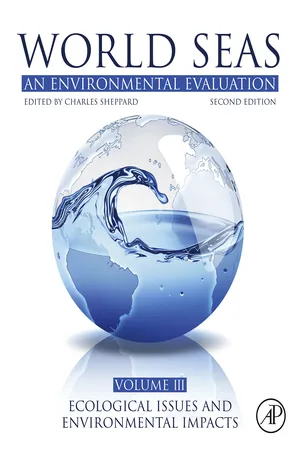
Volume III: Ecological Issues and Environmental Impacts
- 666 pages
- English
- ePUB (mobile friendly)
- Available on iOS & Android
eBook - ePub
World Seas: An Environmental Evaluation
Volume III: Ecological Issues and Environmental Impacts
About this book
World Seas: An Environmental Evaluation, Second Edition, Volume Three: Ecological Issues and Environmental Impacts covers global issues relating to our seas, including a biological description of the coast and continental shelf waters, the development and use of the coast, landfills and their effects, pollutant discharges over time, the effects of over-fishing, and the management methods and techniques used to ensure continued ecosystem functioning. The relative importance of water-borne and airborne routes differ in different parts of the world is explored, along with extensive coverage of major habitats and species groups, governmental, education and legal issues, fisheries effects, remote sensing, climate change and management.
This book is an invaluable, worldwide reference source for students and researchers concerned with marine environmental science, fisheries, oceanography and engineering and coastal zone development.
- Provides scientific reviews of regional issues, empowering managers and policymakers to make progress in under-resourced countries and regions
- Covers environmental issues arising from the human use of both the sea and its watershed
- Presents informed commentary on major trends, problems and successes, and recommendations for the future
Information
Table of contents
- Cover image
- Title page
- Table of Contents
- Copyright
- Contributors
- Introduction to World Seas: An Environmental Evaluation
- Chapter 1: The Mangrove Ecosystem
- Chapter 2: Global Status of Coral Reefs: In Combination, Disturbances and Stressors Become Ratchets
- Chapter 3: Status and Trends for the World’s Kelp Forests
- Chapter 4: Salt Marshes: Their Role in Our Society and Threats Posed to Their Existence
- Chapter 5: Remote Sensing for Marine Management
- Chapter 6: New Advances in Benthic Monitoring Technology and Methodology
- Chapter 7: Seabirds
- Chapter 8: Blooms of the Moon Jellyfish Aurelia: Causes, Consequences and Controls
- Chapter 9: European Protection of Fisheries in the North East Atlantic
- Chapter 10: Ghost Fishing
- Chapter 11: Far-Field and Near-Field Effects of Marine Aquaculture
- Chapter 12: The Making of a Global Marine Fisheries Catch Database for Policy Development
- Chapter 13: Ballast Water: Problems and Management
- Chapter 14: Debris in Deep Water
- Chapter 15: Polychlorinated Biphenyls in the Global Ocean
- Chapter 16: Microbial Remediation of Organic Pollutants
- Chapter 17: Macroplastics Pollution in the Marine Environment
- Chapter 18: Microplastics Pollution in the Marine Environment
- Chapter 19: International Instruments for the Prevention of Marine Alien Invasive Species
- Chapter 20: Underwater Noise: Sources and Effects on Marine Life
- Chapter 21: Marine Oil Spills—Oil Pollution, Sources and Effects
- Chapter 22: Marine Oil Spills—Preparedness and Countermeasures
- Chapter 23: Threats to Seamount Ecosystems and Their Management
- Chapter 24: Dead Zones: Oxygen Depletion in Coastal Ecosystems
- Chapter 25: Marine Protected Areas: Attempting the Sustainability of the Seas
- Chapter 26: Shoreline Defenses
- Chapter 27: Environmental Effects of Marine Transportation
- Chapter 28: Collisions of Vessels With Cetaceans—The Underestimated Threat
- Chapter 29: Marine Protected Areas
- Chapter 30: Marine Spatial Planning
- Chapter 31: The Role of Ports in a Global Economy, Issues of Relevance and Environmental Initiatives
- Chapter 32: Molecular Approaches for an Operational Marine Biodiversity Observation Network
- Index
Trusted by 375,005 students
Access to over 1.5 million titles for a fair monthly price.
Study more efficiently using our study tools.
Frequently asked questions
Yes, you can cancel anytime from the Subscription tab in your account settings on the Perlego website. Your subscription will stay active until the end of your current billing period. Learn how to cancel your subscription
No, books cannot be downloaded as external files, such as PDFs, for use outside of Perlego. However, you can download books within the Perlego app for offline reading on mobile or tablet. Learn how to download books offline
Perlego offers two plans: Essential and Complete
- Essential is ideal for learners and professionals who enjoy exploring a wide range of subjects. Access the Essential Library with 800,000+ trusted titles and best-sellers across business, personal growth, and the humanities. Includes unlimited reading time and Standard Read Aloud voice.
- Complete: Perfect for advanced learners and researchers needing full, unrestricted access. Unlock 1.5M+ books across hundreds of subjects, including academic and specialized titles. The Complete Plan also includes advanced features like Premium Read Aloud and Research Assistant.
We are an online textbook subscription service, where you can get access to an entire online library for less than the price of a single book per month. With over 1.5 million books across 990+ topics, we’ve got you covered! Learn about our mission
Look out for the read-aloud symbol on your next book to see if you can listen to it. The read-aloud tool reads text aloud for you, highlighting the text as it is being read. You can pause it, speed it up and slow it down. Learn more about Read Aloud
Yes! You can use the Perlego app on both iOS and Android devices to read anytime, anywhere — even offline. Perfect for commutes or when you’re on the go.
Please note we cannot support devices running on iOS 13 and Android 7 or earlier. Learn more about using the app
Please note we cannot support devices running on iOS 13 and Android 7 or earlier. Learn more about using the app
Yes, you can access World Seas: An Environmental Evaluation by Jean-Francois Hamel,Charles Sheppard in PDF and/or ePUB format, as well as other popular books in Sciences biologiques & Science environnementale. We have over 1.5 million books available in our catalogue for you to explore.