eBook - ePub
Energy and Climate Change
An Introduction to Geological Controls, Interventions and Mitigations
- 206 pages
- English
- ePUB (mobile friendly)
- Available on iOS & Android
eBook - ePub
Energy and Climate Change
An Introduction to Geological Controls, Interventions and Mitigations
About this book
Energy and Climate Change: An Introduction to Geological Controls, Interventions and Mitigations examines the Earth system science context of the formation and use of fossil fuel resources, and the implications for climate change. It also examines the historical and economic trends of fossil fuel usage and the ways in which these have begun to affect the natural system (i.e., the start of the Anthropocene). Finally, the book examines the effects we might expect in the future looking at evidence from the "deep time" past, and looks at ways to mitigate climate change by using negative emissions technology (e.g. bioenergy and carbon capture and storage, BECCS), but also by adapting to perhaps a higher than "two degree world," particularly in the most vulnerable, developing countries. Energy and Climate Change is an essential resource for geoscientists, climate scientists, environmental scientists, and students; as well as policy makers, energy professionals, energy statisticians, energy historians and economists.
- Provides an overarching narrative linking Earth system science with an integrated approach to energy and climate change
- Includes a unique breadth of coverage from modern to "deep time" climate change; from resource geology to economics; from climate change mitigation to adaptation; and from the industrial revolution to the Anthropocene
- Readable, accessible, and well-illustrated, giving the reader a clear overview of the topic
Information
Topic
Physical SciencesSubtopic
Environmental ScienceChapter 1
The Carbon Cycle, Fossil Fuels and Climate Change
Abstract
Geological science offers a unique way of looking at the relationship between energy and climate change. The neatest way to see this connection is through the carbon cycle—the path that carbon takes through the atmosphere, biosphere and geosphere—and to see the limits to that cycle, and the controls on its rate and character that are subject to natural fundamental laws. These laws can be modelled through the new discipline of Earth system science, revealing the extent to which life in all its forms interacts with other big forces to change the world. This is best illustrated in how the carbon cycle is at the centre of the tension between our use of energy and the atmosphere, and the geological generation of much of the fossil fuels we use to generate power. Carbon leaves the atmosphere largely through the engine of life, including biological pumps operating in the ocean. In a permanent form below the surface of the Earth, essentially as fossil fuels like coal, gas and oil, this carbon can do no harm. Of course, carbon can also leave the rocks and get back into the atmosphere. For example, carbon dioxide is released during the metamorphism of carbonate rocks when they are subducted into the Earth's mantle, or by volcanoes. But it is humankind's intervention in the carbon cycle, a short cut within this large geological part of the carbon cycle, which is causing the problem: the burning of fossil fuels.
Keywords
Carbon cycle; Carbon sequestration; Climate change; Earth system science; fossil fuel combustion; fossil fuel formation
A lot of us are now familiar with the famous photograph taken of the Earth on February 14, 1990 by the Voyager 1 space probe from a distance of 6 billion kilometres. In the photograph, the Earth appears as a pale blue dot against the blackness of space. During a lecture at Cornell University in 1994, the cosmologist Carl Sagan showed the image to the audience and contemplated the deeper meaning of the pale blue dot, in relation to the ultimate negligibility of humankind against the vastness of space. But the pale blue dot also helps us to realise the physical, chemical and biological boundaries that limit our planet. Most of the processes that I talk about in this book have limits, rates and thresholds that are governed by a system. The science of this is called Earth system science. It is fairly new and it is very interdisciplinary, using elements of geology, physics, chemistry, biology and mathematics.
One of the most interesting early findings of Earth system science is the extent to which life in all its forms interacts with other big forces to change the world. In a sense, the tension between our use of energy and the atmosphere and the geological generation of much of the fossil fuels we use is one of the best demonstrations of the way in which life interacts with other big forces, as I hope you will see. This is a unique geological way of looking at the problem of energy and climate change.
The Carbon Cycle
Geologists were amongst the first to recognise that life has had a powerful role in shaping the Earth. James Hutton, one of the founders of geology, described the Earth as ‘…not just a machine but also an organised body, as it has a regenerative power…’ The Russian geologist Vladimir Ivanovich Vernadsky was one of the first geologists to hypothesise that life is a geological force that shapes the Earth, suggesting that the oxygen, nitrogen and carbon dioxide in the Earth's atmosphere result from biological processes. During the 1920s he published works arguing that living organisms could reshape the planets as surely as any physical force.
At the heart of climate change and energy is the carbon cycle, which involves exchange of carbon between ‘stores’ or accumulations in the atmosphere, terrestrial biosphere, oceans, and the subsurface of the Earth (Fig. 1.1). The rates of exchange and the sizes of the stores are instrumental in the ability of the Earth to sustain life. The carbon cycle also interacts with other very large cycles of oxygen, water, phosphorous and nitrogen in complicated ways that are difficult to model and predict.

In a book purely about climate change, the main parts of the carbon cycle story would be concerned with the first three of the stores: the atmosphere, terrestrial biosphere, and oceans, but in this book the addition of energy means we need to look at one in detail: the deep Earth, which supplies human society with most of its energy and fuel.
Broadly this last part of the carbon cycle is geological rather than atmospheric or biological. It is distinct in that it operates over very long periods—millions or tens of millions of years. These time periods may seem academic to human society, but in fact are the periods that are needed to accumulate carbon such as coal, gas or oil—and in the long run also affect the amount of carbon dioxide in the atmosphere and therefore climate.
Though the immediate non-geological exchange of carbon is most important to climate change on human timescales, most of the Earth's carbon is actually stored below the surface (Table 1.1); and a lot of this resulted from living things at the surface, either directly or indirectly. Eighty percent of this is limestone (sedimentary carbonate), from sedimentation from seawater of calcium carbonate or shells, and the rest is organic matter from buried dead organisms. We will look at the way that carbon makes its way from the ‘living world’ into the rock in the next section.
Table 1.1
| Pool | Quantity (gigatons) |
|---|---|
| Atmosphere | 720 |
| Oceans (total) | 38,400 |
| Total inorganic | 37,400 |
| Total organic | 1000 |
| Surface layer | 670 |
| Deep layer | 36,730 |
| Lithosphere | |
| Sedimentary carbonates | > 60,000,000 |
| Kerogens | 15,000,000 |
| Terrestrial biosphere (total) | 2000 |
| Living biomass | 600–1000 |
| Dead biomass | 1200 |
| Aquatic biosphere | 1–2 |
| Fossil fuels (total) | 4130 |
| Coal | 3510 |
| Oil | 230 |
| Gas | 140 |
| Other (peat) | 250 |
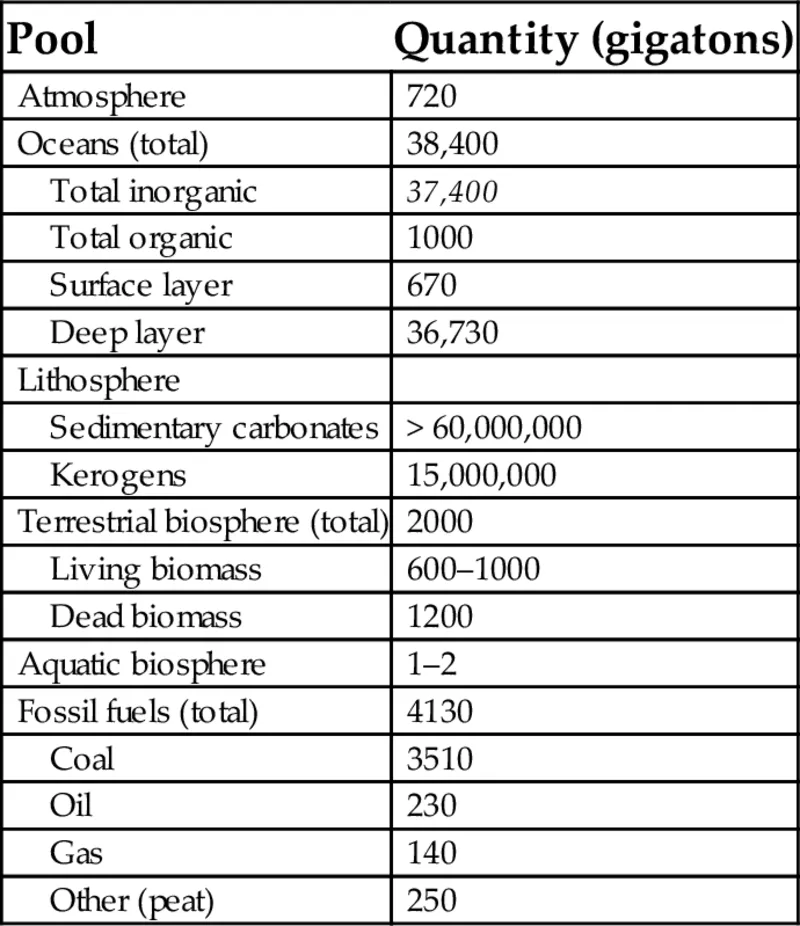
Source: Wikipedia retrieved July 2017.
But before that we need to investigate the surface parts of the carbon cycle. The exchange of carbon between the atmosphere and the land is largely a biological process with plants photosynthesising to make carbon compounds, and aerobic respiration releasing it again—though fires can also do this. The exchange between the atmosphere and the sea involves chemical processes such as dissolution and marine photosynthesis working as solubility and biological ‘pumps’ that take carbon from the atmosphere mostly to the deep ocean. Marine animals that produce shells also extract carbon from seawater to allow calcium carbonate to lock up carbon in the long term. Also long term is the process of silicate weathering on land where rocks containing silicates take up carbon dioxide to produce calcium carbonate and SiO2.
Carbon can leave the rocks in several ways. Carbon dioxide is released during the metamorphosis of carbonate rocks when they are subducted into the Earth's mantle. This carbon dioxide can be released into the atmosphere and ocean through volcanoes. It can also be removed from rocks by humans through the burning of fossil fuels.
How Fossil Fuels are Formed
As I have already indicated, fossil fuels are forms of organic carbon in sedimentary rocks, mainly coal, oil and natural gas.
It is hard to overemphasise the importance of fossil fuels in modern energy. A quick eyeball of Fig. 1.2 shows the dominance of fossil fuels (coal, oil, natural gas) in primary energy consumption in the world, mainly in transport, heating homes and for generating electricity. Fig. 1.3 shows the importance of fossil fuels in electricity generation alone worldwide. The right-hand side shows that, though t...
Table of contents
- Cover image
- Title page
- Table of Contents
- Copyright
- Dedication
- Quotation
- Preface
- Acknowledgements
- Note to the Reader
- Chapter 1: The Carbon Cycle, Fossil Fuels and Climate Change
- Chapter 2: Natural Global Warming: Climate Change in ‘Deep Time’
- Chapter 3: Artificial Global Warming: The ‘Fossil Economy’
- Chapter 4: The Coming Industrial Revolution? Fossil Fuels and Developing Countries
- Chapter 5: Geology and the Reduction of Emissions
- Chapter 6: Climate Change Adaptation: Geological Aspects
- Chapter 7: Feedbacks and Tipping Points
- Chapter 8: The Geological Macroscope
- Chapter 9: Energy and Climate Change: Geological Controls, Interventions, and Mitigations
- Glossary
- Conversion Table
- Index
Trusted by 375,005 students
Access to over 1.5 million titles for a fair monthly price.
Study more efficiently using our study tools.
Frequently asked questions
Yes, you can cancel anytime from the Subscription tab in your account settings on the Perlego website. Your subscription will stay active until the end of your current billing period. Learn how to cancel your subscription
No, books cannot be downloaded as external files, such as PDFs, for use outside of Perlego. However, you can download books within the Perlego app for offline reading on mobile or tablet. Learn how to download books offline
Perlego offers two plans: Essential and Complete
- Essential is ideal for learners and professionals who enjoy exploring a wide range of subjects. Access the Essential Library with 800,000+ trusted titles and best-sellers across business, personal growth, and the humanities. Includes unlimited reading time and Standard Read Aloud voice.
- Complete: Perfect for advanced learners and researchers needing full, unrestricted access. Unlock 1.5M+ books across hundreds of subjects, including academic and specialized titles. The Complete Plan also includes advanced features like Premium Read Aloud and Research Assistant.
We are an online textbook subscription service, where you can get access to an entire online library for less than the price of a single book per month. With over 1.5 million books across 990+ topics, we’ve got you covered! Learn about our mission
Look out for the read-aloud symbol on your next book to see if you can listen to it. The read-aloud tool reads text aloud for you, highlighting the text as it is being read. You can pause it, speed it up and slow it down. Learn more about Read Aloud
Yes! You can use the Perlego app on both iOS and Android devices to read anytime, anywhere — even offline. Perfect for commutes or when you’re on the go.
Please note we cannot support devices running on iOS 13 and Android 7 or earlier. Learn more about using the app
Please note we cannot support devices running on iOS 13 and Android 7 or earlier. Learn more about using the app
Yes, you can access Energy and Climate Change by Michael Stephenson in PDF and/or ePUB format, as well as other popular books in Physical Sciences & Environmental Science. We have over 1.5 million books available in our catalogue for you to explore.