eBook - ePub
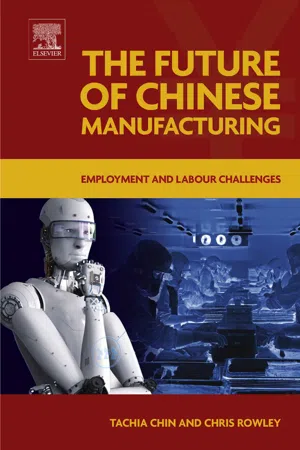
The Future of Chinese Manufacturing
Employment and Labour Challenges
- 256 pages
- English
- ePUB (mobile friendly)
- Available on iOS & Android
eBook - ePub
About this book
The Future of Chinese Manufacturing: Employment and Labour Challenges gives context and analysis on employment and labor issues in contemporary China, specifically relating to manufacturing industries. With one fifth of the world's workforce, China has taken advantage of its cheap labor to serve as the world's factory, achieving stunning growth for two decades. This book covers the appreciation of RMB, constant increases in minimum wage, shortages of skilled workers in China's labor-intensive manufacturing sector, and the fact that many large multinational corporations (MNCs) must cut costs, and are thus shifting their main production bases to other developing countries.
Under such a tough situation, and coupled with the global economic slowdown, manufacturing employment in China confronts severe labor-related challenges, such as high turnover rates, recruitment difficulties for workers, and a series of high profile labor strikes and publicity concerning working conditions.
- Integrates human capital and cultural theories
- Analyzes looming labor unrest and related workforce issues in China through a unique context-specific lens
- Explores the roles that Chinese institutions and culture play in resolving problems related to these issues
Information
Chapter One
Introduction: China's Manufacturing: Labour Challenges Ahead
Abstract
Along with the 2008 financial crisis, the 2010 Euro zone debt crisis, and the 2015 Brexit ‘yes’ vote, the world's economic and political situation has become more volatile and unpredictable, while global manufacturing industries are facing a new round of restructuring. Given that a viable manufacturing sector constitutes the cornerstone for a nation's social and economic growth, to sustain national competitiveness in this new era riddled with uncertainties, several of the top manufacturing countries have proposed strategies at the state level: the United States proclaimed a reindustrialization and manufacturing renaissance strategy in 2010; Germany advocated a new concept of Industry 4.0 in 2013; and the United Kingdom called for economic ‘rebalancing’ with the resurgence of manufacturing.
Keywords
Crisis; Economic; Financial; Global; Growth; Manufacturing
1.1 Introduction
Along with the 2008 financial crisis, the 2010 Euro zone debt crisis, and the 2015 Brexit ‘yes’ vote, the world's economic and political situation has become more volatile and unpredictable, while global manufacturing industries are facing a new round of restructuring. Given that a viable manufacturing sector constitutes the cornerstone for a nation's social and economic growth, to sustain national competitiveness in this new era riddled with uncertainties, several of the top manufacturing countries have proposed strategies at the state level: the United States proclaimed a reindustrialization and manufacturing renaissance strategy in 2010; Germany advocated a new concept of Industry 4.0 in 2013; and the United Kingdom called for economic ‘rebalancing’ with the resurgence of manufacturing.
China is no exception to this developmental trend. The government has also proclaimed the Made in China 2025 initiative, encouraging local manufacturing firms to upgrade themselves from the traditional labour-intensive to a modern high-tech, innovation-driven, and service-oriented manufacturing industry. In other words, moving towards higher value-added domains is the guiding direction of China's manufacturing transition.
However, this upgrading and transformation process has and will inevitably bring forth new and complex labour- and employment-related challenges for China's manufacturing as traditional jobs requiring low pay, manual dexterity, and physical skills are disappearing, coinciding with the appearance of more labour shortages, high-tech, and knowledge-intensive job opportunities. Yet the current manufacturing workforce in China is mainly composed of poorly educated migrant workers, many of whom come from poverty-stricken rural areas. Hence, it is not easy for these workers to upgrade their skills in adaptation to new job specifications and qualifications, particularly for those who are aged or have spent more than 10 years in similar positions. This situation sometimes creates a dilemma for companies. Old staff need retraining to meet new work standards while young migrant workers do not see manufacturing jobs as a good career choice as more and more such jobs will be replaced by machines.
In this vein, in recent years, manufacturing employment in China has been confronted with severe labour-related issues, such as high turnover rates, difficulties in recruiting young people, and shortages of skilled workers. While labour strikes, mass layoffs, and downsizing are deemed as a common business practice in Chinese manufacturing, the conflicts between production workers and management have become one of the major concerns that requires greater attention and deeper investigation (Chin & Liu, 2015). Hence, our book aims to elucidate the employment and human resource (HR)-related challenges that the Chinese manufacturing industry is facing in the new era of economic transformation.
1.2 Structure of the Book
In Chapter 2, using the auto manufacturing industry as an example, our book begins with an overview of the historical development of the Chinese manufacturing industry over the past three decades. It then introduces an empirical study that illustrates the role of the government as the most crucial ‘invisible hand’ in influencing goal orientation towards the creation of own brands among manufacturing firms in China.
In Chapter 3, three cases that focus on Singapore-, Taiwan-, and British-invested companies in China demonstrate how foreign manufacturers from different home countries cope with changes in the Chinese market and make strategic options when carrying out upgrading along global value chains (GVCs). In addition to addressing the contributions of foreign investment to the growth of Chinese manufacturing, this chapter also highlights the importance of acquiring institutional resources to compete in China.
In Chapter 4, two empirical studies are presented to introduce a typical, yet still under-researched, type of global start-up manufacturer emerging from China. Facing the recent global industrial and economic restructuring, such firms could not continue to rely on the export-oriented growth model of the past three decades to sustain profits. Hence, this chapter addresses a prominent ‘reverse internationalization phenomenon’, delineating why and how these Chinese entrepreneurial manufacturers are striving to transform their focus from international competition to local markets.
In Chapter 5, two studies are introduced to elucidate how Chinese harmonious culture—which is decoded and interpreted by Yijing’s eight-trigram model (Fung, 1997)—affects manufacturing employees’ attitude and behaviour at work. While China to date still has more than 100 million production workers, many of whom are recruited by the foreign-invested enterprises (FIEs), this chapter explores what fosters an attitude of openness to see the wisdom ingrained in Chinese harmonious culture and, most importantly, to link it with HR practices during the transition from a transitional labour-intensive and export-driven system to a modern service-oriented and innovation-driven manufacturing system.
In Chapter 6, from an emic Yin–Yang harmony perspective, we present a unique, indigenous circled 5C (conflict–clash–communication–compromise–consensus) model for helping to possibly resolve labour conflicts in China's manufacturing sector. While more and more Chinese manufacturers shut down their local factories and shift production lines to other regions with cheap labour, it is expected that the number of labour dispute cases and work activism will possibly continue to increase. This chapter helps to deepen our understanding of how to tackle labour conflicts in China's socialist market economy system.
In Chapter 7, considering the ongoing trend to build geographically dispersed manufacturing bases for cost advantages, cross-cultural management and corresponding language and translation-related issues are raising harsh challenges for Chinese manufacturers. To better describe this phenomenon, we introduce a research that proposes a novel, indigenous model delineating the dynamic and vital role of translation as a boundary-spanning tool in cross-border knowledge transfer within the intra-organizational networks of Chinese manufacturing firms.
In Chapter 8, we first make a brief summary of this book and then examine the prospect of future employment in China's manufacturing.
1.3 Conclusion
Overall, the overarching aim of our book is to delve into the root causes of relevant issues in China's economy today in a more comprehensive and contextualized way. We present several studies built upon the Chinese context to elucidate the distinctive growth patterns and models of Chinese manufacturing relative to those of the developed economies in the West.
In addition, it is worth noting that owing to the uniqueness of China's socialist market system, culture, and rich history, its manufacturing-led economic miracle and the above-mentioned labour-related issues cannot be fully explained or solved by the rationales underpinning Western business theories and practices (Chin & Liu, 2017; Redding, 2016; Rowley & Oh, 2016). Hence, in our book, to truly embody the cultural idiosyncrasy of Chinese employees, we employ a unique ‘Yin–Yang Harmony’ perspective to discuss labour–management relations that could better make sense, decode, and contextualize the phenomena that may be indigenous to China's manufacturing industry.
In sum, we aim to provide relevant theory, research, evidence, and practical insight and impacts for twin audiences: first, for academics globally to both expand and teach with; and second, for business and management practitioners and policymakers. Too often, for both ‘camps’, these domains are seen and treated as somewhat irrelevant to each other and sealed. We hope to break that seal.
Chapter Two
Challenges for Manufacturing in China
Abstract
With one-fifth of the world's workforce, China has taken advantage of its cheap labour to become the world's factory—such as providing low-end, labour-intensive production services, that is, original equipment manufacturing to mature-market clients. This has helped to achieve stunning growth in the past three decades. The manufacturing sector has attracted huge foreign direct investment, making tremendous contributions to the gross domestic product (GDP), still accounting for 40.9% of total GDP (US$ 10.4 trillion) in 2015.
Keywords
Challenges; Employment; Investment; Labour; Manufacturing; Policy
2.1 Introduction
2.1.1 Labour Challenges of China's Manufacturing Industry
With one-fifth of the world's workforce (Chin, 2015), China has taken advantage of its cheap labour to become the world's factory—such as providing low-end, labour-intensive production services, that is, original equipment manufactur...
Table of contents
- Cover image
- Title page
- Table of Contents
- Copyright
- Foreword
- Chapter One: Introduction: China's Manufacturing: Labour Challenges Ahead
- Chapter Two: Challenges for Manufacturing in China
- Chapter Three: FDI Manufacturers and Their Upgrading Strategies
- Chapter Four: Branding in Reverse Internationalization: Evidence From Local Entrepreneurial OEMs
- Chapter Five: A Yin–Yang Harmony Cognition to Employer–Employee Relationships
- Chapter Six: Labour Dispute and Conflict Resolution: A Yin–Yang Harmony View
- Chapter Seven: Cross-Cultural Management: A Globalized Production Network
- Chapter Eight: Conclusion: Reflection
- References
- Index
Trusted by 375,005 students
Access to over 1.5 million titles for a fair monthly price.
Study more efficiently using our study tools.
Frequently asked questions
Yes, you can cancel anytime from the Subscription tab in your account settings on the Perlego website. Your subscription will stay active until the end of your current billing period. Learn how to cancel your subscription
No, books cannot be downloaded as external files, such as PDFs, for use outside of Perlego. However, you can download books within the Perlego app for offline reading on mobile or tablet. Learn how to download books offline
Perlego offers two plans: Essential and Complete
- Essential is ideal for learners and professionals who enjoy exploring a wide range of subjects. Access the Essential Library with 800,000+ trusted titles and best-sellers across business, personal growth, and the humanities. Includes unlimited reading time and Standard Read Aloud voice.
- Complete: Perfect for advanced learners and researchers needing full, unrestricted access. Unlock 1.5M+ books across hundreds of subjects, including academic and specialized titles. The Complete Plan also includes advanced features like Premium Read Aloud and Research Assistant.
We are an online textbook subscription service, where you can get access to an entire online library for less than the price of a single book per month. With over 1.5 million books across 990+ topics, we’ve got you covered! Learn about our mission
Look out for the read-aloud symbol on your next book to see if you can listen to it. The read-aloud tool reads text aloud for you, highlighting the text as it is being read. You can pause it, speed it up and slow it down. Learn more about Read Aloud
Yes! You can use the Perlego app on both iOS and Android devices to read anytime, anywhere — even offline. Perfect for commutes or when you’re on the go.
Please note we cannot support devices running on iOS 13 and Android 7 or earlier. Learn more about using the app
Please note we cannot support devices running on iOS 13 and Android 7 or earlier. Learn more about using the app
Yes, you can access The Future of Chinese Manufacturing by TACHIA Chin,Chris Rowley in PDF and/or ePUB format, as well as other popular books in Business & Manufacturing. We have over 1.5 million books available in our catalogue for you to explore.