- 612 pages
- English
- ePUB (mobile friendly)
- Available on iOS & Android
eBook - ePub
Biochemistry of Lipids, Lipoproteins and Membranes
About this book
Biochemistry of Lipids: Lipoproteins and Membranes, Volume Six, contains concise chapters that cover a wide spectrum of topics in the field of lipid biochemistry and cell biology. It provides an important bridge between broad-based biochemistry textbooks and more technical research publications, offering cohesive, foundational information.
It is a valuable tool for advanced graduate students and researchers who are interested in exploring lipid biology in more detail, and includes overviews of lipid biology in both prokaryotes and eukaryotes, while also providing fundamental background on the subsequent descriptions of fatty acid synthesis, desaturation and elongation, and the pathways that lead the synthesis of complex phospholipids, sphingolipids, and their structural variants. Also covered are sections on how bioactive lipids are involved in cell signaling with an emphasis on disease implications and pathological consequences.
- Serves as a general reference book for scientists studying lipids, lipoproteins and membranes and as an advanced and up-to-date textbook for teachers and students who are familiar with the basic concepts of lipid biochemistry
- References from current literature will be included in each chapter to facilitate more in-depth study
- Key concepts are supported by figures and models to improve reader understanding
- Chapters provide historical perspective and current analysis of each topic
Information
Chapter 1
Functional Roles of Lipids in Membranes
William Dowhan, Mikhail Bogdanov, and Eugenia Mileykovskaya Department of Biochemistry and Molecular Biology, University of Texas–Houston, Medical School, Houston, TX, USA
Abstract
Biological membranes define the outer limits of cells and organelles and are composed of phospholipids, glycolipids, sphingolipids, sterols and proteins. Each lipid class is composed of numerous variants within their respective polar and apolar domains. The apolar and polar nature of these amphipathic lipids is the basis for forming biological membranes with which membrane proteins associate either as integral proteins that span the membrane bilayer or as peripheral proteins that associate with the membrane surface. Individual lipids, once thought mainly to provide cell barrier function and a solvent for membrane proteins, are now recognised as critical components that directly influence an array of cellular functions. Physical and chemical properties of lipids that determine the properties of biological membranes, genetic approaches used to alter cellular lipid composition and examples of how lipid–protein interactions define specific roles for lipids in cell function are discussed.
Keywords
Charge balance rule; Hydrophobic effect; Lipid diversity; Lipid–protein interactions; Membrane structureAbbreviations
CL
Cardiolipin
DAG
Diacylglycerol
EMD
Extramembrane domain
GlcDAG
Monoglucosyl diacylglycerol
GlcGlcDAG
DIglucosyl diacylglycerol
NAO
10-N-nonyl acridine orange
PA
Phosphatidic acid
PC
Phosphatidylcholine
PE
Phosphatidylethanolamine
PG
Phosphatidylglycerol
PI
Phosphatidylinositol
PS
Phosphatidylserine
Tm
Midpoint temperature
TMD
Transmembrane domain
1. Introduction and Overview
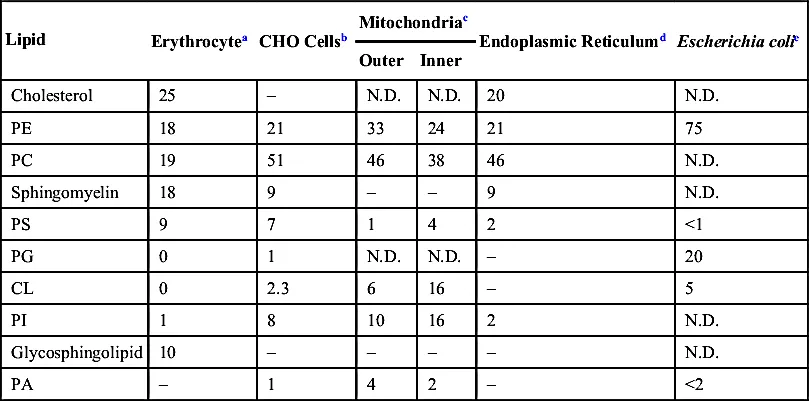
Lipids as a class of molecules display a wide diversity in structure and biological function. A primary role of lipids is to form the membrane bilayer permeability barrier of cells and organelles (Figure 1). Glycerophospholipids (termed phospholipids hereafter) make up about 75% of total membrane lipids of prokaryotic and eukaryotic cells, but other lipids are important components. Table 1 shows the major lipids found in the membranes of various cells and organelles but does not include the minor lipids, many of which are functionally important. Sterols are present in all eukaryotic cells and in a few bacterial membranes. The major sterol of mammalian cells is cholesterol whereas yeast contain ergosterol. Bacteria do not make sterols but some species incorporate sterols from the growth medium. Interestingly Drosophila also must acquire cholesterol from exogenous sources. The ceramide-based sphingolipids are present in the membranes of all eukaryotes. Neutral diacylglycerol (DAG) glycans are major membrane-forming components in many Gram-positive bacteria and in the membranes of plants, while Gram-negative bacteria utilise a saccharolipid (Lipid A) as a major structural component of the outer leaflet of the outer membrane. The variety of hydrophobic domains of lipids results in additional diversity. In eukaryotes and eubacteria these domains are saturated and unsaturated fatty acids or lesser amounts of fatty alcohols; many Gram-positive bacteria also contain branched chain fatty acids. Instead of esterified fatty acids, Archaea contain long chain reduced polyisoprene moieties in ether linkage to glycerol. Such hydrophobic domains are highly resistant to the harsh environment of these organisms. Further stability of the lipid bilayer of Archaea comes from many of the hydrocarbon chains spanning the membrane with covalently linked head groups at each end. If one considers a simple organism such as Escherichia coli with three major phospholipids and several different fatty acids along with many minor precursors and modified lipid products, the number of individual phospholipid species ranges in the hundreds. In more complex eukaryotic organisms with greater diversity in both phospholipids and fatty acids, the number of individual species is in the thousands. Sphingolipids also show a similar degree of diversity and when added to the steroids the size of the eukaryotic lipidome dwarfs that of the proteome.
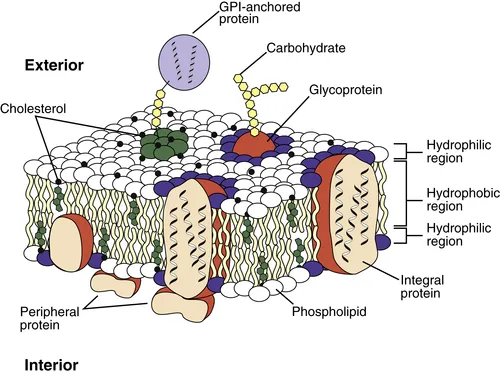
Figure 1 Model for membrane structure. This model of the plasma membrane of a eukaryotic cell is an adaptation of the original model proposed by Singer and Nicholson (1972). The phospholipid bilayer is shown with integral membrane proteins largely containing α-helical transmembrane domains (TMDs). Peripheral membrane proteins associate either with the lipid surface or with other membrane proteins. Lipid rafts (dark green head groups) are enriched in cholesterol and contain a PI glycan-linked (GPI) protein. The purple head groups depict lipids in close association with protein. The irregular surface and wavy acyl chains denote the fluid nature of the bilayer.
Table 1
Lipid Composition of Various Biological Membranes
| Lipid | Erythrocytea | CHO Cellsb | Mitochondriac | Endoplasmic Reticulumd | Escherichia colie | |
| Outer | Inner | |||||
| Cholesterol | 25 | – | N.D. | N.D. | 20 | N.D. |
| PE | 18 | 21 | 33 | 24 | 21 | 75 |
| PC | 19 | 51 | 46 | 38 | 46 | N.D. |
| Sphingomyelin | 18 | 9 | – | – | 9 | N.D. |
| PS | 9 | 7 | 1 | 4 | 2 | <1 |
| PG | 0 | 1 | N.D. | N.D. | – | 20 |
| CL | 0 | 2.3 | 6 | 16 | – | 5 |
| PI | 1 | 8 | 10 | 16 | 2 | N.D. |
| Glycosphingolipid | 10 | – | – | – | – | N.D. |
| PA | – | 1 | 4 | 2 | – | <2 |
Lipids provide the solvent within which integral membrane proteins (those whose transmembrane domains (TMDs) span the bilayer) are integrated. Peripheral proteins also interact with the membrane surface and are even found partially inserted into the lipid bilayer. These amphitropic proteins are found in the aqueous compartments of cells and interact with the membrane surface in a reversible manner. The lipid bilayer provides a rich and varied environment for proteins, which includes a highly hydrophobic interior bounded by the hydrophilic and/or charged lipid head groups. The latter organises water and counterions in a manner significantly differently from that of the cell aqueous phase, which imparts distinct properties to the aqueous layer in close contact with the membrane surface. Each lipid molecular class is made up of a wide spectrum of chemical and structural variants, which as an ensemble determine membrane fluidity, lateral pressure, permeability and surface charge. The lipid and protein components of the membrane are not held together by covalent interactions and therefore are in dynamic equilibrium undergoing transient interactions organised into the supermolecular structure of the lipid bilayer.
In this chapter, the diversity in structure, chemical properties and physical properties of lipids will be outlined. The various genetic approaches available for studying lipid function in vivo will be summarised. Finally, how the physical and chemical properties of lipids relate to their multiple functions in living systems will be reviewed to provide a molecular basis for the diversity of lipid structures in natural membranes. Due to space limitations, recent review articles and research articles, which contain the primary background references supporting the summaries in the text, are cited.
2. Diversity in Lipid Structure
Lipids are defined as those biological molecules readily soluble in organic solvents such as chloroform, ether or toluene. However, many peptides and some very hydrophobic proteins are soluble in organic solvents, and lipids with large hydrophilic domains such as saccharolipids are not soluble in these solvents. Here we will consider those lipids that contribute significantly to membrane structure or have a role in determining protein structure or function. The LIPID MAPS consortium (http://www.lipidmaps.org) in the United States, Lipid Bank (http://www.lipidbank.jp) in Japan and the LipidomicNet (http://www.lipidomicnet.org) in Europe have cooperated to devise classification systems, methodology and forums for the benefit of researchers.
2.1. Glycerolipids
The DAG backbone in eubacteria and eukaryotes is sn-3-glycerol (L-glycerol) esterified at the 1- and 2-position with long chain fatty acids (Figure 2) (Chapters 3 and 7). In Archae (Figure 3) sn-1-glycerol (D-glycerol) forms the backbone and the hydrophobic domain is composed of phytanyl (saturated isoprenyl) groups in ether linkage at the 2- and 3-positions (an archaeol) (Koga and Morii, 2007). In addition, two sn-1-glycerol groups are connected in ether linkage by two biphytanyl groups (dibiphytanyldiglycerophosphatetetraether) to form a covalently linked bilayer. Some eubacteria (mainly hyperthermophiles) have dialkyl (long chain alcohols in ether linkage) phospholipids and similar ether linkages are found in the plasmalogens of eukaryotes. The head groups of the phospholipids (boxed area of Figure 2) extend the diversity of lipids defining phosphatidic acid (PA, with OH), phosphatidylcholine (PC), phosphatidylserine (PS), phosphatidylglycerol (PG), phosphatidylinositol (PI) and cardiolipin (CL). Archae analogues exist with head groups of glycerol and glyceromethylphosphate as well as all of the above except PC. Archae also have neutral glycan lipid derivatives in which mono- and disaccharides (glucose or galactose) are directly linked to the sn-1 position of archaeol (Figure 3). Plants (mainly in the thylakoid membrane) and many Gram-positive bacteria also have high levels of neutral DAG glycans with mono- or disaccharides linked to the 3-carbon of sn-3-glycerol (Chapter 4). In addition to head group diversity, a range of alkyl chains are attached to the glycerol moiety. In eubacteria, fatty acid chain lengths vary from 12 to 18 carbons and can be fully saturated or contain double bonds. Some Gram-positive bacteria contain odd-numbered, b...
Table of contents
- Cover image
- Title page
- Table of Contents
- Copyright
- Contributors
- Preface
- Chapter 1. Functional Roles of Lipids in Membranes
- Chapter 2. Approaches to Lipid Analysis
- Chapter 3. Fatty Acid and Phospholipid Biosynthesis in Prokaryotes
- Chapter 4. Lipid Metabolism in Plants
- Chapter 5. Fatty Acid Handling in Mammalian Cells
- Chapter 6. Fatty Acid Desaturation and Elongation in Mammals
- Chapter 7. Phospholipid Synthesis in Mammalian Cells
- Chapter 8. Phospholipid Catabolism
- Chapter 9. The Eicosanoids: Cyclooxygenase, Lipoxygenase and Epoxygenase Pathways
- Chapter 10. Sphingolipids
- Chapter 11. Cholesterol Synthesis
- Chapter 12. Bile Acid Metabolism
- Chapter 13. Lipid Modification of Proteins
- Chapter 14. Intramembrane and Intermembrane Lipid Transport
- Chapter 15. High-Density Lipoproteins: Metabolism and Protective Roles Against Atherosclerosis
- Chapter 16. Assembly and Secretion of Triglyceride-Rich Lipoproteins
- Chapter 17. Lipoprotein Receptors
- Chapter 18. Atherosclerosis
- Chapter 19. Diabetic Dyslipidaemia
- Index
Trusted by 375,005 students
Access to over 1.5 million titles for a fair monthly price.
Study more efficiently using our study tools.
Frequently asked questions
Yes, you can cancel anytime from the Subscription tab in your account settings on the Perlego website. Your subscription will stay active until the end of your current billing period. Learn how to cancel your subscription
No, books cannot be downloaded as external files, such as PDFs, for use outside of Perlego. However, you can download books within the Perlego app for offline reading on mobile or tablet. Learn how to download books offline
Perlego offers two plans: Essential and Complete
- Essential is ideal for learners and professionals who enjoy exploring a wide range of subjects. Access the Essential Library with 800,000+ trusted titles and best-sellers across business, personal growth, and the humanities. Includes unlimited reading time and Standard Read Aloud voice.
- Complete: Perfect for advanced learners and researchers needing full, unrestricted access. Unlock 1.5M+ books across hundreds of subjects, including academic and specialized titles. The Complete Plan also includes advanced features like Premium Read Aloud and Research Assistant.
We are an online textbook subscription service, where you can get access to an entire online library for less than the price of a single book per month. With over 1.5 million books across 990+ topics, we’ve got you covered! Learn about our mission
Look out for the read-aloud symbol on your next book to see if you can listen to it. The read-aloud tool reads text aloud for you, highlighting the text as it is being read. You can pause it, speed it up and slow it down. Learn more about Read Aloud
Yes! You can use the Perlego app on both iOS and Android devices to read anytime, anywhere — even offline. Perfect for commutes or when you’re on the go.
Please note we cannot support devices running on iOS 13 and Android 7 or earlier. Learn more about using the app
Please note we cannot support devices running on iOS 13 and Android 7 or earlier. Learn more about using the app
Yes, you can access Biochemistry of Lipids, Lipoproteins and Membranes by Neale Ridgway,Roger McLeod in PDF and/or ePUB format, as well as other popular books in Biological Sciences & Biochemistry. We have over 1.5 million books available in our catalogue for you to explore.