- 336 pages
- English
- ePUB (mobile friendly)
- Available on iOS & Android
eBook - ePub
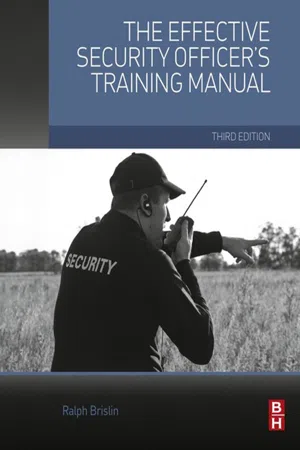
The Effective Security Officer's Training Manual
About this book
The Effective Security Officer's Training Manual, Third Edition teaches today's security officers the most important aspects of performing the job of a security officer professionally and effectively. Training is the most important element in becoming a professional security officer, but it is also often overlooked or underutilized. This straightforward, easy-to-follow, and well-organized text covers the essentials that security officers need as they face issues of growing technology and an emphasis on proactiveness and vigilance. The Effective Security Officer's Training Manual, Third Edition also covers many topics of current concern such as sexual harassment, crowd control, cultural diversity, persons with special needs, new technologies, and much more. With discussion questions at the end of every chapter and a full ancillary package accompanying the text, this manual is a comprehensive tool for developing a career as a successful and trusted professional security officer.
- Meets ASIS International's guidelines for Private Security Officer Selection and Training
- Addresses the latest technological advancements that impact how today's security officers do their jobs
- Discusses the increased role security officers have in observing and reporting suspicious activities and events
- Includes end-of-chapter discussion questions to enhance understanding
Information
Chapter 1
Introduction to Security
Abstract
The history of security is presented in this chapter by highlighting common laws developed in England. Private security in the United States began in 1857, when the Pinkerton Detective Agency was formed. Definitions that pertain to the various aspects of security are reviewed. Lastly, it is emphasized that security should be considered as more service oriented rather than approaching it from a “tough-guy” perspective.
Keywords
Al Qaeda; ASIS; Bow Street Runners; Common law; John Wayne syndrome; King's PeaceAs you read and study this security officer training manual, you should be aware that you are in one of the fastest growing industries in the United States. The purpose of this course is to familiarize you with the most important aspects of the duties of a security officer. We believe you will find this manual to be easy to read, as well as interesting and challenging.
What is private security?
Private security is made up of self-employed individuals and privately funded businesses that provide security and related services to other persons and businesses for a fee. Security is intended to protect and preserve activities and property without loss or disruption. Most security officers have no more legal power than the average citizen. However, some security officers possess police/arrest powers because they have been commissioned by a local, state, or federal government agency.
Security has existed since people began to inhabit the earth. Archaeologists have discovered drawings attributed to “cavemen” that describe how early inhabitants hunted and went to war against other tribes or groups of people. The early inhabitants of the earth needed to protect themselves not only from invaders but from wild animals as well.
The first recognized set of laws is attributed to King Hammurabi of Babylon, who lived about 2000 B.C. Hammurabi devised a legal code that was designed to regulate the behavior of people to one another and to society as a whole. The Code of Hammurabi described what punishment would be enforced against a person who violated the code. The old saying “an eye for an eye, and a tooth for a tooth” is generally accepted to have been initiated in this code. Ancient customs and traditions that sanctioned improper behavior were legitimized in the code of Hammurabi.
During 500–600 B.C., the Greeks developed procedures and implemented systems to protect strategic roads leading to and from their cities, thus protecting their vital interests from potential enemies.
Around the time the modern calendar began, the Roman Empire ruled much of the known world. The Roman army was well-organized and highly trained. Military units were used to protect their cities. The development of the first quasi-police department was considered to be that of the Praetorian Guard.
Laws in the United States are based on ancient common laws that were developed in England. In late 800 A.D., King Albert established the “King’s Peace,” which was an attempt to stop the private wars and battles that occurred between English noblemen who maintain private armies. The King’s Peace called for certain punishments to be inflicted for violations of the law.
The development of law and the original criminal justice system continued in England for the next several hundred years. In 1750, the first plainclothes detective unit was formed; the detectives were known as the Bow Street Runners. The members of this unit were responsible for running to the scene of a crime in an attempt to capture the criminal. In 1829, what is considered the first police department was formed by Sir Robert Peel, who was Home Secretary of England. Sir Peel was responsible for the establishment of this uniformed, full-time police force. The English term “Bobbie” for police officers was the nickname derived from Sir Robert Peel. In the United States, police departments were formed in several large cities during the 1800s.
Development of private security in the United States
Allan Pinkerton (Figure 1.1) is recognized as the father of private security in the United States. In 1857, he formed the Pinkerton Detective Agency. He worked primarily for the railroads; thus, most of Pinkerton’s early work involved catching train robbers. The Pinkerton Company served as an intelligence-gathering (spy) service for the Union army during the Civil War. In 1874, American District Telegraph (ADT) was formed to provide alarm detection services.
In 1859, William Brink founded a truck and package delivery service in Chicago. When Brink’s carried its first payroll in 1891, it became the first armored car and courier service. In 1909, William Burns founded the Burns Detective Agency, which provided security during labor strikes.
At the beginning of World War I, the security industry began to grow because of concerns about sabotage and espionage, but the growth slowed considerably during the Depression. During the 1940s, with the outbreak of World War II, the industry began to grow again.

Before awarding defense contracts, the government required that munitions suppliers begin security measures to protect classified materials and defense secrets from sabotage and spying. The Federal Bureau of Investigation (FBI) assisted defense contractors in ensuring their security was adequate. The government also granted the status of auxiliary military police to more than 200,000 plant security officers. For the most part, the jobs were to protect war goods, equipment, and personnel. As a result of World War II, manufacturing companies became aware of the need for plant security and its value. After the war, George R. Wackenhut and three other former FBI agents formed the Wackenhut Security Corporation. In 1955, the American Society for Industrial Security (ASIS) was formed. Today, there are over 38,000 members of ASIS what is known now as ASIS International. In 1968, the federal government required increased security for federal banks when Congress passed the Federal Bank Protection Act. In January 1973, the Federal Aviation Administration began to require the screening of all air passengers and carry-on baggage due to the number of air hijackings that were occurring.
Security development and the future
Security, like most professions, has continued to change amid rapid growth. More and more organizations are examining the training criteria security companies use to ensure that a satisfactory level of knowledge and professionalism exists.
Many terms are often used interchangeably to describe security.
• Private police
• Security police
• Plant protection
• Facility or plant security
• Loss prevention
• Risk management
• Loss control
• Fire protection
• Asset protection
• Safety
• Hazardous material control
Security encompasses all of these areas to a greater or lesser extent, depending on the facility and industry where security officers are employed. This is not meant to imply that the term security is the same as all of the above terms. Rather, in the twenty-first century, security responsibility will continue to increase as long as the training of security personnel is considered to be a good value and return on investment to corporations. The terms can be generally defined as follows:
• Security generally refers to the protection of people and/or property in an effort to maintain what is considered normal conditions.
• Loss prevention refers to a management philosophy that invests money in the hope of preventing losses from occurring.
• Risk management involves recognizing risks that could result in losses and evaluating how to best reduce risk and loss (usually relating to insurance).
• Loss control refers to a management philosophy that recognizes that losses will occur but attempts to minimize or control losses at a predetermined level.
• Law enforcement refers to the actual enforcement of legal requirements that, if violated, will result in punishment to the offender.
Safety refers to ensuring that the workplace or conditions in the workplace are not inherently dangerous to people or, if they are dangerous, ensuring that proper protection devices or procedures are implemented to guarantee the continued well-being of people.
Fire protection simply incorporates the equipment, devices, policies, and procedures that are in place to protect life and property from fire loss.
As you study the material in this manual in an effort to learn as much as possible with regard to security training, ask yourself, “What type of career or profession have I entered into?” Various studies have been highly critical of the security industry, citing training inadequacies, poor selection and hiring practices, low pay, high turnover, and intense competition. If these studies are true, why would a person want to work as a security officer? This is a question that each individual employed in the security field must answer.
In their book, Principles of Security, Ricks, Tillet, and VanMeter stated that it is well accepted that many people enter the private security indus...
Table of contents
- Cover image
- Title page
- Table of Contents
- Copyright
- Dedication
- Chapter 1. Introduction to Security
- Chapter 2. Security Personnel
- Chapter 3. Company Policies and Procedures
- Chapter 4. Ethics
- Chapter 5. Professionalism
- Chapter 6. Public Relations
- Chapter 7. Cultural Diversity
- Chapter 8. Persons with Special Needs
- Chapter 9. Interpersonal Communication
- Chapter 10. Communications Systems and the Importance of Communication in an Emergency
- Chapter 11. Physical Security
- Chapter 12. Electronic Alarm Systems
- Chapter 13. Camera Systems, Visual Observation, and Surveillance
- Chapter 14. Observe and Report
- Chapter 15. Report Writing and Notetaking
- Chapter 16. Patrols
- Chapter 17. Investigations
- Chapter 18. Sexual Harassment
- Chapter 19. Internal Threats to an Organization
- Chapter 20. Overview of the Legal System
- Chapter 21. Court Testimony, Depositions, and Administrative Hearings
- Chapter 22. Introduction to Fire Protection
- Chapter 23. Life Safety Code and Material Safety Data Sheets
- Chapter 24. Bloodborne Pathogens and Personal Safety
- Chapter 25. Emergency Preparedness
- Chapter 26. Crowd Control: Civil Disturbances and Labor Strikes
- Chapter 27. Driver Safety
- Chapter 28. Traffic Control
- Chapter 29. Substance Abuse
- Chapter 30. Handling Disruptive People
- Chapter 31. Workplace Violence
- Chapter 32. Private Security and Law Enforcement Cooperation
- Chapter 33. Nonsecurity Duties and Creating a Positive Impression
- Chapter 34. The Future of Security and Technology Enhancements
- Index
Trusted by 375,005 students
Access to over 1.5 million titles for a fair monthly price.
Study more efficiently using our study tools.
Frequently asked questions
Yes, you can cancel anytime from the Subscription tab in your account settings on the Perlego website. Your subscription will stay active until the end of your current billing period. Learn how to cancel your subscription
No, books cannot be downloaded as external files, such as PDFs, for use outside of Perlego. However, you can download books within the Perlego app for offline reading on mobile or tablet. Learn how to download books offline
We are an online textbook subscription service, where you can get access to an entire online library for less than the price of a single book per month. With over 1.5 million books across 990+ topics, we’ve got you covered! Learn about our mission
Look out for the read-aloud symbol on your next book to see if you can listen to it. The read-aloud tool reads text aloud for you, highlighting the text as it is being read. You can pause it, speed it up and slow it down. Learn more about Read Aloud
Yes! You can use the Perlego app on both iOS and Android devices to read anytime, anywhere — even offline. Perfect for commutes or when you’re on the go.
Please note we cannot support devices running on iOS 13 and Android 7 or earlier. Learn more about using the app
Please note we cannot support devices running on iOS 13 and Android 7 or earlier. Learn more about using the app
Yes, you can access The Effective Security Officer's Training Manual by Ralph Brislin in PDF and/or ePUB format, as well as other popular books in Business & Human Resource Management. We have over 1.5 million books available in our catalogue for you to explore.