- 368 pages
- English
- ePUB (mobile friendly)
- Available on iOS & Android
eBook - ePub
Advances in Wool Technology
About this book
Advanced research into wool science and technology is leading to a better understanding of the properties of wool. Wool is increasingly being seen as a high performance fibre, with new modifications and applications. Advances in wool technology presents a comprehensive account of these developments and innovations.Part one includes advances that have occurred in the production and processing of wool. Topics range from the progress in wool spinning, weaving and colouration, to environmental supply chain management and to the role of genetic engineering in improved wool production. Part two reviews new wool products and applications. Chapters include the production of brighter and whiter wool, high performance wool blends and wool for apparel.With its two distinguished editors and array of international contributors, this book is a valuable reference for producers, manufacturers, retailers and all those wishing to improve and understand developments in wool technology. It will also be suitable for researchers in industry or academia.
- Presents a comprehensive account of recent developments and innovation surrounding the high performance fibre
- Examines advances in wool production and processing from wool spinning to genetic engineering in improved production
- Considers environmental supply chain management
Information
Part I
Advances in wool fibre and fabric production
1
Improvement of wool production through genetic manipulation
G.E. Rogers The University of Adelaide, Australia;
C.S. Bawden South Australian Research and Development Institute, Australia
Abstract
This review describes the manipulation of the sheep genotype by genetic engineering, which is defined as the introduction or elimination of specific genes in the existing cells of an organism through modern biological techniques for the purpose of changing one or more of its phenotypic characteristics. This can be achieved by direct injection of a DNA sequence for a gene or gene-related function or by transfer of an intact nucleus from a somatic cell containing a set of desirable genes into an enucleated egg cell. The potential of transgenesis over conventional breeding is that single gene changes can be made for a particular phenotype without accompanying multiple gene effects that can be disadvantageous. Several examples of engineered sheep are described. The potential for making other transgenic changes are discussed but transgenic sheep research has virtually ceased because of high cost and the perceived low public acceptance of transgenic animals at the present time.
Key words
wool properties
genetic engineering
gene transfer
transgenesis
wool keratin
1.1 Introduction
Over many decades remarkable improvements in wool production in terms of quality (diameter, length, staple strength, crimp and colour) and yield (rate of wool growth) have been achieved through selective breeding and nutrition. Sheep breeding methodologies can be regarded as genetic engineering and will undoubtedly be of benefit in the future through the advent of genome characterisation and gene discovery that will provide molecular markers for more accurate selection of sheep and wool characters. The term genetic manipulation used in the present discussion is usually referred to as genetic engineering and is defined as the introduction or elimination of specific genes in the existing cells of an organism through modern molecular biology techniques for the purpose of changing one or more of the organism’s phenotypic characteristics. This can be achieved by direct injection of a DNA sequence characterised for a gene or gene-related function into a fertilised egg (transgenesis) or by transfer of an intact nucleus from a somatic cell containing a set of desirable genes into an enucleated egg cell, a process that yields an animal clone, or by variations of these. The potential advantage of transgenesis is that single gene changes can be made rather than selectively breeding sheep for a particular phenotype, in which case there are accompanying multiple gene effects that can be disadvantageous.
This review describes the manipulation of the sheep genotype by these procedures, utilising tested and prospective genes for improving aspects of wool growth and wool quality, and some of the problems to be confronted.
1.2 The techniques of genetic manipulation for animals
Genetic manipulation techniques enable the insertion of single genes as DNA into the genomes of farm animals and to obtain thereby new phenotypes with changes in production characters. A recent excellent review (Wheeler, 2007) covers the general field of production of transgenic livestock achieved to the present time. In the case of sheep, single gene variations can be targeted for wool growth and properties. There are two major strategies: one is to increase a particular character, a ‘gain of function’, and the other is to decrease or totally obliterate a production character or ‘loss of function’.
There are several methods for achieving transgenesis, the transference of selected genes into the genome. The major method used is microinjection of DNA containing the gene of interest into the pronucleus of a fertilised ovum. The injected one-cell embryo is then transferred to a recipient female (Wheeler, 2007). A mouse was the first transgenic animal to be produced by microinjection of the gene for human growth hormone, in the 1980s (Brinster et al., 1981). The result was an increased growth rate and a larger mouse. Since that time there have been extensive studies of transgenesis for animal production including many novel ideas as yet not investigated. Other methods that avoid microinjection for inserting genes into fertilised ova have been established including sperm-mediated DNA in which the DNA is adsorbed onto the sperm surface and transferred into the egg by fertilisation in vitro followed by implantation into a recipient female (Lavitrano et al., 2006). Similar procedures include liposome-mediated transfer into the ovum or electroporation of the transgene DNA into sperm or egg (Ogura, 2002). Retroviruses can be used as efficient carriers for gene transfer into ova. A development with potential for transgenic animal production is retroviral gene transduction into spermatogonia (the precursor cells of spermatozoa) stem cells and then transplantation to the animal’s testes (Nagano et al., 2001). Transgenic progeny have been successfully produced in mice by this method but application by whatever retroviral route in sheep is problematic in the present climate of opinion on acceptability of transgenic techniques in sheep production.
The ultimate in gene transfer is probably nuclear transfer in which the nucleus of a somatic or a stem cell is transferred into an enucleated ovum by microinjection or by cell–cell fusion. The result is a clone of the animal that donated the somatic or the stem cell nucleus. The technique of therapeutic cloning not only could lead to insertion of a nucleus from cells of a sheep carrying a gene or genes for a desirable phenotype but could be a nucleus from a cultured somatic or stem cell after insertion of a specific gene in a recombination process called ‘knock in’. Alternatively, a gene can be removed by recombination, so-called gene ‘knock out’. Such procedures in sheep would be expensive and difficult and have not been investigated, although a successful specific cloning would not then necessitate frequent repetition.
All transgenic procedures require the selected gene to be linked to DNA sequences that can control expression, in particular a promoter, an essential DNA sequence that can direct expression of the gene in an appropriate tissue or tissues. The examples for influencing wool growth to be discussed involve genetic manipulations that could enable genes to function systemically (in all or most tissues) including the wool follicle or to have expression of new or modified genes targeted directly to one or more of the seven cellular layers of the wool follicle (Fig. 1.1).
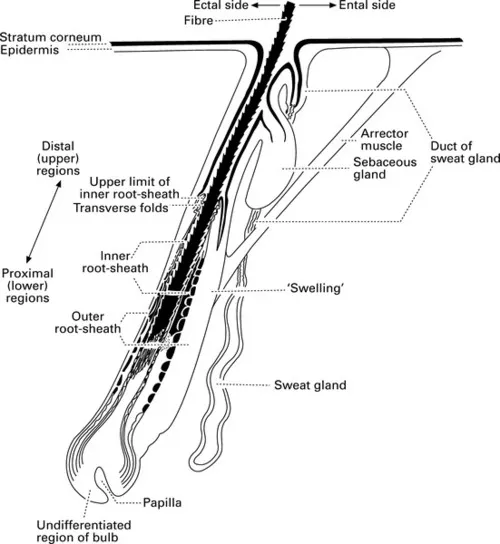
1.1 The wool follicle showing the main layers and associated sebaceous and sweat glands (Auber, 1951). Reproduced with permission.
In order to affect wool growth and wool properties by inserting novel genes and directing expression to the wool follicle, a promoter is needed that is follicle-specific, and one that can even target expression to particular cell lineage of the follicle. Six different cell layers that are formed in the follicle from different cell lineages, namely the outer root sheath, three layers of inner root sheath (IRS), the fibre cuticle and the fibre cortex, differentiate from the follicle bulb (Fig. 1.2). Each of the cell lineages expresses specific genes that are potential sources of gene promoters for targeting the different cell layers of the follicle.
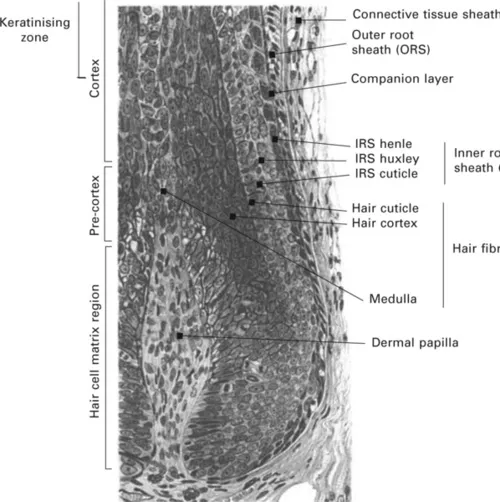
1.2 The human hair follicle showing the main layers with cellular detail of the seven cell lineages that differentiate from the bulb (Rogers et al., 2006). Reproduced with permission.
1.3 What aspects of wool production might be amenable to genetic manipulation?
Theoretically, genetic manipulation could change many aspects of wool growth and properties given the necessary knowledge of what genes are involved. The following list comprises phenotypic characteristics that are important for wool usage. Most of them could be judged from current knowledge to be within range of manipulation of wool follicle function by transgenesis or by specific gene-related molecular factors:
• increasing yield;
• improving fibre strength;
• decreasing the diameter;
• decrease fibre stiffness;
• altering crimp;
• increasing lustre;
• modifying surface properties for special uses;
• eradication of dark fibres from the fleece;
• prevention o...
Table of contents
- Cover image
- Title page
- Table of Contents
- Copyright page
- Contributor contact details
- Woodhead Publishing in Textiles
- Preface
- Part I: Advances in wool fibre and fabric production
- Part II: New wool products and applications
- Index
Trusted by 375,005 students
Access to over 1.5 million titles for a fair monthly price.
Study more efficiently using our study tools.
Frequently asked questions
Yes, you can cancel anytime from the Subscription tab in your account settings on the Perlego website. Your subscription will stay active until the end of your current billing period. Learn how to cancel your subscription
No, books cannot be downloaded as external files, such as PDFs, for use outside of Perlego. However, you can download books within the Perlego app for offline reading on mobile or tablet. Learn how to download books offline
Perlego offers two plans: Essential and Complete
- Essential is ideal for learners and professionals who enjoy exploring a wide range of subjects. Access the Essential Library with 800,000+ trusted titles and best-sellers across business, personal growth, and the humanities. Includes unlimited reading time and Standard Read Aloud voice.
- Complete: Perfect for advanced learners and researchers needing full, unrestricted access. Unlock 1.5M+ books across hundreds of subjects, including academic and specialized titles. The Complete Plan also includes advanced features like Premium Read Aloud and Research Assistant.
We are an online textbook subscription service, where you can get access to an entire online library for less than the price of a single book per month. With over 1.5 million books across 990+ topics, we’ve got you covered! Learn about our mission
Look out for the read-aloud symbol on your next book to see if you can listen to it. The read-aloud tool reads text aloud for you, highlighting the text as it is being read. You can pause it, speed it up and slow it down. Learn more about Read Aloud
Yes! You can use the Perlego app on both iOS and Android devices to read anytime, anywhere — even offline. Perfect for commutes or when you’re on the go.
Please note we cannot support devices running on iOS 13 and Android 7 or earlier. Learn more about using the app
Please note we cannot support devices running on iOS 13 and Android 7 or earlier. Learn more about using the app
Yes, you can access Advances in Wool Technology by N A G Johnson,I Russell in PDF and/or ePUB format, as well as other popular books in Technology & Engineering & Materials Science. We have over 1.5 million books available in our catalogue for you to explore.