eBook - ePub
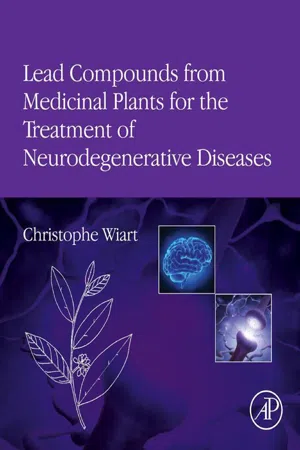
Lead Compounds from Medicinal Plants for the Treatment of Neurodegenerative Diseases
- 416 pages
- English
- ePUB (mobile friendly)
- Available on iOS & Android
eBook - ePub
Lead Compounds from Medicinal Plants for the Treatment of Neurodegenerative Diseases
About this book
Lead Compounds from Medicinal Plants for the Treatment of Neurodegenerative Diseases is the second volume in the series, Pharmaceutical Leads from Medicinal Plants. This book includes key pharmacological and chemical evidence to support the selection of promising pre-clinical candidates for the treatment of neurodegenerative diseases.
This important addition to the natural product and drug discovery literature contains the history, synonyms, medicinal uses, phytopharmacology, pre-clinical potential, and rationale for each plant selected. By providing critical evaluation of pharmacological data, mechanisms of action, and structural requirements for the development of future neuroprotective agents, this comprehensive reference is a beneficial resource for industry and academic scientists whose research focuses on neurodegenerative drug discovery and development.
- Incorporates compelling biological activity data and preclinical structure-activity relationships to help you choose promising lead molecules for further research
- Includes primary source references to the most recent natural product discoveries in the field of neuroprotection in order to promote new drug discovery in this area
- Contains detailed discussions of important neurodegenerative diseases, including Alzheimer's disease and Parkinson's disease
- Each plant section includes a critical evaluation of pharmacological, chemical, and toxicological evidence to support the use of the compound in drug discovery research in neurodegeneration
Information
Topic
MedicineSubtopic
PharmacologyChapter 1
Alkaloids
Introduction
Neurons convey information by synthesizing and secreting neurotransmitters which bind to cytoplasmic membrane proteins or receptors. The ability of a neurotransmitter to bind to a receptor depends biochemically on strict structural requirements which define several neuronal routes including the nicotinic, dopaminergic, adrenergic, and serotoninergic pathways, whereas acetylcholine, dopamine, noradrenaline, and serotonin bind to and activate cholinergic, dopaminergic, adrenergic, and serotoninergic receptors, respectively. The cholinergic system, for instance, encompasses the synthesis and secretion of acetylcholine, the depletion of which, as a result of cholinergic neuron progressive degeneration, results in cognitive decline, decrease in brain weight, and dementia as described by Alois Alzheimer in 1907 and known since as Alzheimer’s disease (AD). Since the pathophysiology of AD involves a steady decline in cholinergic neurotransmission in the cortex, alkaloids from plants able to bind to cholinergic receptors, namely nicotinic and muscarinic receptors, thus mimicking acetylcholine, can conceptually be viewed as agents or starting points for the synthesis of leads to fight senile dementia. Nicotinic receptors are the target of alkaloids, such as, notably, nicotine from Nicotiana tabacum L. (1.1.3), lobeline from Lobelia inflata L. (1.1.3), lupanine from Sophora flavescens Aiton (1.1.3), ibogaine from Tabernanthe iboga Baill. (1.2.6), pteleprenine from Ptelea trifoliata L. (1.4.1), and methyllycaconine from Aconitum L. (1.4.2), which in fact share structural similarities with acetylcholine, including the presence of a nitrogen atom. Other cholinergic types of receptors are the muscarinic receptors that are targeted, for instance, by scopolamine from Atropa belladonna L., arecoline from Areca catechu L. (1.1.3), 2-β-hydroxy-6β-acetoxy-nortropane from Erycibe obtusifolia Benth. (1.1.3), himbacine from Galbulimima baccata F.M. Bailey (1.1.3), cryptolepine from Cryptolepis sanguinolenta (Lindl.) Schltr. (1.2.4), and rhynchophylline from Uncaria sinensis (Oliv.) Havil. (1.2.6). The dopaminergic system involves the synthesis and secretion of dopamine, the depletion of which, as a result of dopaminergic neuron progressive degeneration, results in locomotor and cognitive decline, or paralysis agitens, as described by James Parkinson in 1817 and called Parkinson’s disease (PD) by Jean-Martin Charcot in 1888. Since the pathophysiology of PD involves a collapse in dopaminergic neurotransmission in the substantia nigra, alkaloids from plants able to bind to dopaminergic receptors, thus mimicking dopamine, can conceptually be viewed as agents or starting points for the synthesis of leads to fight this neurodegenerative disease. Of note, dopamine itself is a catecholamine which originates from the amino acid tyrosine, which in plants is the precursor of alkaloids that bind to dopaminergic receptors. Such alkaloids are, for instance, the isoquinolines norreticuline and reticuline from Papaver somniferum L. (family Papaveraceae Juss.) (1.2.6), stepholidine from Stephania intermedia H.S. Lo (1.3.1), boldine from Peumus boldus Molina (1.3.3), glaucine from Glaucium flavum Crantz (1.3.3), and nantenine Nandina domestica Thunb. (1.3.3). The adrenergic system in the brain includes the synthesis and secretion of noradrenaline from the locus coeruleus, which modulates cognition in the prefrontal cortex, and a decline and dysfunction of this system occur during AD and PD. Noradrenaline derives from dopamine, thus allowing alkaloids such as raubasine and corynanthine from Catharanthus roseus (L.) G. Don (1.2.6), tabersonine from Melodinus fusiformis Champ. ex Benth. (1.2.6), norreticuline and reticuline from Papaver somniferum L. (family Papaveraceae Juss.) (1.2.6), xylopine from Annona rugulosa (Schltdl.) H. Rainer (1.3.1), and dicentrine Lindera macrophylla Boerl. (family Lauraceae Juss.) (1.3.3). The serotoninergic system encompasses the synthesis and secretion of an indolic neurotransmitter known as serotonin, the levels of which decrease in the brain of patients with AD and PD, thus accounting for mood disorders. Serotoninergic receptors are the target of alkaloids and particularly indole alkaloids from plants, such as geissoschizine methyl ether from Uncaria sinensis (Oliv.) Havil. (1.1.3), 12-methoxy-1-methyl-aspidospermidine from Geissospermum vellosii Allemão (1.1.3), psychollatine from Psychotria umbellata Thonn. (1.1.3), or other types of alkaloids such as asimilobine from Nelumbo nucifera Gaertn. (1.3.3) and skimmianine from Adiscanthus fusciflorus Ducke (1.4.1). By docking into and stimulating receptors, alkaloids from plants not only mimic the agonistic properties of neurotransmitters, thus allowing the maintenance of neurotransmission withi...
Table of contents
- Cover image
- Title page
- Table of Contents
- Copyright
- Foreword
- Foreword
- Foreword
- Preface
- About the Author
- Chapter 1. Alkaloids
- Chapter 2. Terpenes
- Chapter 3. Phenolics
- Index of Natural Products
- Index of Pharmacological Terms
- Index of Plants
- Subject Index
Trusted by 375,005 students
Access to over 1.5 million titles for a fair monthly price.
Study more efficiently using our study tools.
Frequently asked questions
Yes, you can cancel anytime from the Subscription tab in your account settings on the Perlego website. Your subscription will stay active until the end of your current billing period. Learn how to cancel your subscription
No, books cannot be downloaded as external files, such as PDFs, for use outside of Perlego. However, you can download books within the Perlego app for offline reading on mobile or tablet. Learn how to download books offline
Perlego offers two plans: Essential and Complete
- Essential is ideal for learners and professionals who enjoy exploring a wide range of subjects. Access the Essential Library with 800,000+ trusted titles and best-sellers across business, personal growth, and the humanities. Includes unlimited reading time and Standard Read Aloud voice.
- Complete: Perfect for advanced learners and researchers needing full, unrestricted access. Unlock 1.5M+ books across hundreds of subjects, including academic and specialized titles. The Complete Plan also includes advanced features like Premium Read Aloud and Research Assistant.
We are an online textbook subscription service, where you can get access to an entire online library for less than the price of a single book per month. With over 1.5 million books across 990+ topics, we’ve got you covered! Learn about our mission
Look out for the read-aloud symbol on your next book to see if you can listen to it. The read-aloud tool reads text aloud for you, highlighting the text as it is being read. You can pause it, speed it up and slow it down. Learn more about Read Aloud
Yes! You can use the Perlego app on both iOS and Android devices to read anytime, anywhere — even offline. Perfect for commutes or when you’re on the go.
Please note we cannot support devices running on iOS 13 and Android 7 or earlier. Learn more about using the app
Please note we cannot support devices running on iOS 13 and Android 7 or earlier. Learn more about using the app
Yes, you can access Lead Compounds from Medicinal Plants for the Treatment of Neurodegenerative Diseases by Christophe Wiart in PDF and/or ePUB format, as well as other popular books in Medicine & Pharmacology. We have over 1.5 million books available in our catalogue for you to explore.