- 416 pages
- English
- ePUB (mobile friendly)
- Available on iOS & Android
eBook - ePub
Microstructure Evolution in Metal Forming Processes
About this book
Monitoring and control of microstructure evolution in metal processing is essential in developing the right properties in a metal. Microstructure evolution in metal forming processes summarises the wealth of recent research on the mechanisms, modelling and control of microstructure evolution during metal forming processes.Part one reviews the general principles involved in understanding and controlling microstructure evolution in metal forming. Techniques for modelling microstructure and optimising processes are explored, along with recrystallisation, grain growth, and severe plastic deformation. Microstructure evolution in the processing of steel is the focus of part two, which reviews the modelling of phase transformations in steel, unified constitutive equations and work hardening in microalloyed steels. Part three examines microstructure evolution in the processing of other metals, including ageing behaviour in the processing of aluminium and microstructure control in processing nickel, titanium and other special alloys.With its distinguished editors and international team of expert contributors, Microstructure evolution in metal forming processes is an invaluable reference tool for metal processors and those using steels and other metals, as well as an essential guide for academics and students involved in fundamental metal research.
- Summarises the wealth of recent research on the mechanisms, modelling and control of microstructure evolution during metal forming processes
- Comprehensively discusses microstructure evolution in the processing of steel and reviews the modelling of phase transformations in steel, unified constitutive equations and work hardening in microalloyed steels
- Examines microstructure evolution in the processing of other materials, including ageing behaviour in the processing of aluminium
Information
Part I
General principles
1
Understanding and controlling microstructural evolution in metal forming: an overview
T. Ishikawa, Nagoya University, Japan
Abstract:
This chapter describes the importance of microstructure control in metal forming. The physical metallurgy of the thermo-mechanical treatment used is dependent on the various metallurgical mechanisms involved in processing. The development of the structure by thermo-mechanical treatment is a result of the interrelation of recrystallization, grain growth, precipitation and transformation. A basic overview of these phenomena and their modeling is provided, along with an explanation of the strengthening mechanisms and the relation between microstructure and mechanical properties in metallic materials, especially steels. Basic techniques for the control of microstructure evolution are described and, finally, future trends are outlined.
Key words
thermo-mechanical control processing TMCP
recrystallization
recovery
grain growth
precipitation
transformation
controlled rolling
1.1 Introduction
Thermo-mechanical control processing (TMCP) is now a widely used method for controlling microstructure and the resultant (principally mechanical) properties in both the ferrous and the nonferrous industries.1–5 Correct control of the microstructure, in addition to the selection of appropriate alloying elements and a suitable composition, is therefore extremely important. There are many potential benefits offered by appropriate TMCP, particularly if the same properties can be achieved by optimizing the microstructure without the addition of alloying elements, especially rare earth elements and minor metals. Use of common metals rather than rare elements also contributes substantially to environmental conservation.
Previously, the prediction and control of microstructural evolution and mechanical properties relied on the knowledge and experience of the individual engineer. In steelmaking, where processing is complex and a dynamic microstructure evolves, these individual predictions are time-consuming, requiring a great deal of effort. Furthermore, consistent control is almost impossible. However, recent advancements in physical metallurgy, in rolling and metal forming technology, in thermo-mechanical processing, and in computer engineering have allowed microstructures and mechanical properties during production to be predicted. Computer-integrated manufacturing is leading to increased productivity, reduced manufacturing costs, savings in materials and improvements in product quality (Fig. 1.1).6 Changes in micro structures and mechanical properties can be predicted accurately using mathematical models based on physical metallurgy.
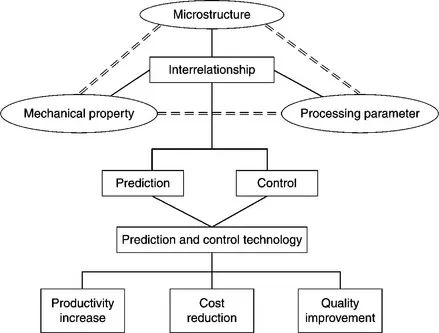
1.1 Diagram showing the concept and goal of prediction and control technology.6
1.2 How microstructure evolves in metal forming
A wide range of mechanisms are responsible for the evolution of microstructures in materials. Microstructural evolution, which also alters the macroscopic properties of materials, is driven by mechanical and thermal loading of the material, chemical transformations, and other conditions such as energetic-particle bombardment in nuclear reactors.7 The physical metallurgy of a thermo-mechanical treatment is dependent on the various metallurgical mechanisms that take place during processing. The interrelation of recrystallization, recovery, grain growth, precipitation and transformation, and so on, leads to the development of microstructure through thermo-mechanical treatment.
1.2.1 Recovery
Recovery is a process by which deformed grains can reduce their stored energy through the removal of strains in their crystals. These strains, principally due to dislocations, are introduced by plastic deformation and work to increase the yield strength of the material. Since recovery reduces the dislocation density, the process is normally accompanied by a reduction in the strength of the material and an immediate increase in its ductility.
1.2.2 Recrystallization
Recrystallization is a process by which deformed grains are replaced by a new set of nondeformed grains that nucleate and grow until the original grains have been entirely consumed. Recrystallization is usually accompanied by a reduction in the strength and hardness of the material and a simultaneous increase in its ductility. Recrystallization that occurs during hot forming is called dynamic recrystallization, while that which takes place in the interpass periods or after the forming passes, is known as static recrystallization.
1.2.3 Grain growth
Grain growth occurs at higher temperatures, when some of the recrystallized fine grains start to grow rapidly. Grain growth is inhibited by second-phase particles that pin the grain boundaries.
1.2.4 Transformation
The polymorphic transformation from high-temperature face-centered cubic iron (austenite, or γ) to low-temperature body-centered cubic iron (ferrite, or α) is a basic technology used in the thermal treatment of steels. Fe–C alloys with a concentration of carbon under about 2 wt% are defined as carbon steels. The carbon in a steel may be completely dissolved in austenite at high temperatures. Although the content of Si, Mn or other elements may be higher than that of carbon, the carbon can still have the greatest impact on the nature of the iron. Even a small amount of carbon may significantly affect the structure of the iron. The microstructure changes depending on the cooling rate are shown in Fig. 1.2.
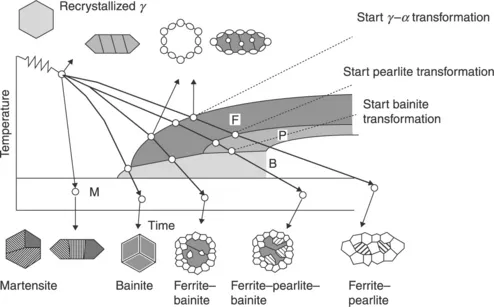
1.2 Dynamic continuous-cooling transform...
Table of contents
- Cover image
- Title page
- Table of Contents
- Copyright
- Contributor contact details
- Part I: General principles
- Part II: Microstructure evolution in the processing of steel
- Part III: Microstructure evolution in the processing of other metals
- Index
Trusted by 375,005 students
Access to over 1.5 million titles for a fair monthly price.
Study more efficiently using our study tools.
Frequently asked questions
Yes, you can cancel anytime from the Subscription tab in your account settings on the Perlego website. Your subscription will stay active until the end of your current billing period. Learn how to cancel your subscription
No, books cannot be downloaded as external files, such as PDFs, for use outside of Perlego. However, you can download books within the Perlego app for offline reading on mobile or tablet. Learn how to download books offline
Perlego offers two plans: Essential and Complete
- Essential is ideal for learners and professionals who enjoy exploring a wide range of subjects. Access the Essential Library with 800,000+ trusted titles and best-sellers across business, personal growth, and the humanities. Includes unlimited reading time and Standard Read Aloud voice.
- Complete: Perfect for advanced learners and researchers needing full, unrestricted access. Unlock 1.5M+ books across hundreds of subjects, including academic and specialized titles. The Complete Plan also includes advanced features like Premium Read Aloud and Research Assistant.
We are an online textbook subscription service, where you can get access to an entire online library for less than the price of a single book per month. With over 1.5 million books across 990+ topics, we’ve got you covered! Learn about our mission
Look out for the read-aloud symbol on your next book to see if you can listen to it. The read-aloud tool reads text aloud for you, highlighting the text as it is being read. You can pause it, speed it up and slow it down. Learn more about Read Aloud
Yes! You can use the Perlego app on both iOS and Android devices to read anytime, anywhere — even offline. Perfect for commutes or when you’re on the go.
Please note we cannot support devices running on iOS 13 and Android 7 or earlier. Learn more about using the app
Please note we cannot support devices running on iOS 13 and Android 7 or earlier. Learn more about using the app
Yes, you can access Microstructure Evolution in Metal Forming Processes by J Lin,D Balint,M Pietrzyk in PDF and/or ePUB format, as well as other popular books in Technology & Engineering & Mining Engineering. We have over 1.5 million books available in our catalogue for you to explore.