eBook - ePub
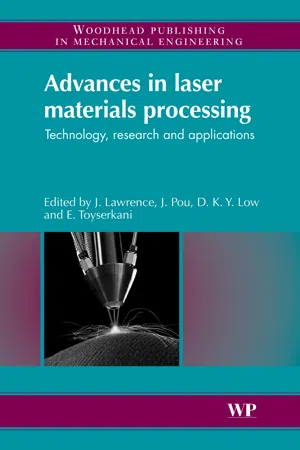
Advances in Laser Materials Processing
Technology, Research and Application
- 848 pages
- English
- ePUB (mobile friendly)
- Available on iOS & Android
eBook - ePub
About this book
Because of its capacity for continuous development and flexibility of use, the laser has become a mainstream manufacturing tool in many industrial sectors. This timely book relays the state-of-the-art in laser materials processing technology and applications and likely advances to be made from current research taking place around the world. The book also promotes appreciation for laser applications in a variety of industrial sectors.After two introductory chapters, the book reviews the main areas of laser processing. Starting with laser cutting and machining, the book discusses laser welding, annealing and hardening. It then considers surface treatment, coating and materials deposition as well as other engineering techniques such as peening and net-shape engineering, before discussing laser micro and nano-fabrication techniques. The book concludes by looking at modelling and process control.With its distinguished editorial team and contributions from renowned researchers working in every corner of the globe, Advances in laser materials processing provides a comprehensive yet detailed coverage of the many topics that comprise the field of laser materials processing. It provides a reference source for the scientists and engineers in such areas as metals processing and microelectronics, as well those conducting laser materials processing research in either academia or industry.
- A comprehensive practitioner guide and reference work explaining state-of-the-art laser processing technologies in manufacturing and other disciplines
- Explores the challenges, potential and future directions through the continuous development of new, application-specific lasers in materials processing
- Discusses coatings and material deposition with lasers with including the production of coatings by laser-assisted processes, laser direct metal deposition and laser induced forward transfer (LIFT)
Information
Subtopic
Ingegneria civilePart I
Overview and challenges for the future
1
‘Light’ industry: an introduction to laser processing and its industrial applications
W.M. Steen, University of Liverpool, UK
Abstract:
Life is dependent on light but it is only since the invention of the laser in 1960 that large and controllable quantities of electromagnetic radiation have been available as an industrial energy source. The application of this versatile form of energy has revolutionised industrial practice as described in this book. This chapter outlines the nature of optical energy and some of its advantages over other forms of industrial power as well as summarising the new applications of lasers in industry.
Key words
laser material processing
optical energy characteristics
laser drilling
cutting
welding
other processes
1.1 What is a laser?
A laser is an optical oscillator in which the oscillating radiation is amplified by a process of stimulated emission; hence the title ‘Light Amplification by the Stimulated emission of Radiation’. The ‘stimulation’ process, which is the heart of the lasing action, was predicted by Einstein (1916). It is a natural process that if a molecule or atom is in an excited state, i.e. a higher vibration state or electronic orbit, then it will give up that energy if acted on by a quantum of the same energy. It is similar to a form of resonance shaking the energy free from the excited species provided the shaking is done at precisely the correct frequency. Based on this principle if two parallel reflectors form an optical cavity, any radiation within the cavity travelling along the optic axis will oscillate back and forth for ever unless lost by absorption or diffraction out of the cavity. The initial radiation comes from the excited species within the cavity decaying spontaneously; this seed radiation will be amplified by the stimulated emission process along the optic axis of the cavity at the speed of light. The oscillating radiation rapidly builds up and if one of the reflectors is partially transparent then a laser beam will emerge. It will be parallel, due to the nature of the oscillating cavity and of a near single frequency due to the nature of the stimulated emission process. There may be some small Doppler variation around the main frequency (due to the varying velocity of the molecules or atoms of the excited species). Laser radiation is one of the purest frequency forms of radiation that we have available. As an aside, it is interesting to speculate whether this stimulated emission phenomenon could be harnessed to rapidly decay radio-active materials.
To obtain the excited species in the first place requires an energy input in the form of an electric discharge (CO2 and excimer lasers), electric current (diode lasers), radiation of a frequency that can be absorbed by the species to be excited (Nd: YAG, and other solid state lasers, dye lasers); the radiation coming from lamps or diode, or other lasers.
Thus the laser is essentially a simple device. The engineering of these machines is also becoming more mature with the size, external cooling requirements and maintenance requirements all becoming significantly less; particularly with the new designs of fibre, diode and disc lasers. But just as a dynamo is simple in that it is only a rotating conductor in a magnetic field, so too is a laser simple in that it is only an optical oscillator with an excited species in the optical cavity. In construction there are many subtleties; meaning that their construction is best left to the professional manufacturer. However, they do produce a beam of electromagnetic radiation which can be very powerful and controllable. It has given us a new form of industrial energy with consequences for manufacturing, which are discussed in the rest of this book and summarised in this chapter.
Huge strides have been made since the 1970s when robust industrial lasers were first available. Today the reliability and robustness have put the laser on a par with most other machine tools and the cost of ownership and operation has fallen significantly. The main industrial lasers are listed in Table 1.1.
Table 1.1
The main industrial lasers

Wall plug efficiency is the ratio of optical energy output divided by the electrical energy input.
1.2 Interaction of optical energy with matter
Before we discuss any particular process, it is helpful to consider what happens when electromagnetic radiation interacts with matter. This form of energy is a waveform travelling at the speed of light (300 000 km/s) in which the electric field oscillates 90° out of phase with the magnetic field; each field as it decays stimulates the other to rise. It is the electric field that is important in interactions with matter, since atoms and molecules tend to have an electric charge. Matter is composed of atoms and molecules. An atom has a nucleus composed of ‘who knows what’ but it occupies a small volume of the total atomic size and is surrounded by high speed electrons which form an ‘electric cloud’ around the charged nucleus. This cloud can interact and link adjacent nuclei forming a molecular structure. There is also electric bonding between separate molecules that plays a part in sound transfer, known as the ‘phonon structure’. The more detail that atomic physicists find in the structure of the atom, the more electric and magnetic field phenomena they identify. When a laser beam flows into this structure, the electric field of the radiation can interact with the electric field of the structure putting forces on the various parts concerned. In the case of the electrons, these can be made to alter course causing them to reradiate the same photon of energy, resulting in new phase fronts that we identify as transmitted or reflected radiation; in the case of the ‘phonon’ structure, the force may eventually cause the nuclei to oscillate which we identify as heat. There is a special interaction when the frequency of the in-coming radiation is equal to a quantum jump in the electronic state of the matter concerned, in which case selected excitation or stimulated emission may occur resulting in fluorescence, chemical bond breaking and other specific reactions. This latter effect is also observed with multi photon events when two or more photons arrive at precisely the same place and time to cause a reaction as though they were one. This has led to the new scientific study of non-linear optics, that has been opened up by high power laser radiation (Flytzanis 2004).
When the laser beam is strong enough, the heating may become extreme and the material will melt, boil or become plasma (a charged ‘cloud’). When the laser beam is very powerful but of a very short duration then the electric field that sweeps through the structure may be sufficient to cause many of the electrons, even some of the bound electrons, to move away from the nuclei, causing the nuclei that are positively charged to become mutually repellent and to fly apart under the resulting Coulomb forces – a form of solid state plasma. This is thought to occur with femto second processing (see Chapter 20 on laser ablation). In these circumstances the structure is thought to contain two temperatures: the ‘electron temperature’ and the ‘lattice temperature’ but only for an extremely short time (order of 10–13 s).
1.3 Characteristics of optical energy
Optical energy differs from electric energy, which is a flow of electrons that rattles the nuclei while flowing around the atoms, a process we describe as resistance heating; and from electric energy in the form of inductance heating in which eddy currents are stimulated to do the same job. It also differs from flames when heat is transferred by conduction of one set of vibrating atoms to another.
Optical energy has numerous and substantial advantages over other forms of energy as listed in table 1.2.
Table 1.2
The properties of a laser beam as an industrial power source
| Quality | Comment |
| Power intensity | The focused laser beam can be one of the most intense power sources available to industry today. A 2 kW laser focused to 0.2 mm spot size is around 10 000 times mo... |
Table of contents
- Cover image
- Title page
- Table of Contents
- Copyright
- Contributor contact details
- Preface
- Part I: Overview and challenges for the future
- Part II: Laser cutting and machining
- Part III: Laser welding
- Part IV: Laser annealing and hardening
- Part V: Surface treatment, coating and materials deposition using lasers
- Part VI: Laser rapid manufacturing and net-shape engineering
- Part VII: Laser micro- and nano-fabrication
- Part VIII: Mathematical modelling and control of laser processes
- Index
Trusted by 375,005 students
Access to over 1.5 million titles for a fair monthly price.
Study more efficiently using our study tools.
Frequently asked questions
Yes, you can cancel anytime from the Subscription tab in your account settings on the Perlego website. Your subscription will stay active until the end of your current billing period. Learn how to cancel your subscription
No, books cannot be downloaded as external files, such as PDFs, for use outside of Perlego. However, you can download books within the Perlego app for offline reading on mobile or tablet. Learn how to download books offline
Perlego offers two plans: Essential and Complete
- Essential is ideal for learners and professionals who enjoy exploring a wide range of subjects. Access the Essential Library with 800,000+ trusted titles and best-sellers across business, personal growth, and the humanities. Includes unlimited reading time and Standard Read Aloud voice.
- Complete: Perfect for advanced learners and researchers needing full, unrestricted access. Unlock 1.5M+ books across hundreds of subjects, including academic and specialized titles. The Complete Plan also includes advanced features like Premium Read Aloud and Research Assistant.
We are an online textbook subscription service, where you can get access to an entire online library for less than the price of a single book per month. With over 1.5 million books across 990+ topics, we’ve got you covered! Learn about our mission
Look out for the read-aloud symbol on your next book to see if you can listen to it. The read-aloud tool reads text aloud for you, highlighting the text as it is being read. You can pause it, speed it up and slow it down. Learn more about Read Aloud
Yes! You can use the Perlego app on both iOS and Android devices to read anytime, anywhere — even offline. Perfect for commutes or when you’re on the go.
Please note we cannot support devices running on iOS 13 and Android 7 or earlier. Learn more about using the app
Please note we cannot support devices running on iOS 13 and Android 7 or earlier. Learn more about using the app
Yes, you can access Advances in Laser Materials Processing by Jonathan R. Lawrence in PDF and/or ePUB format, as well as other popular books in Tecnologia e ingegneria & Ingegneria civile. We have over 1.5 million books available in our catalogue for you to explore.