- 338 pages
- English
- ePUB (mobile friendly)
- Available on iOS & Android
eBook - ePub
About this book
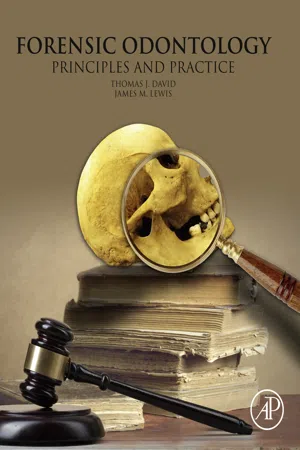
Forensic Odontology: Principles and Practice details the aspects necessary to become an accomplished forensic odontologist, including an illustration of the skills necessary to become an expert witness. The book is ideal for both the experienced and novice forensic odontologist, covering many fields of expertise, including civil and criminal matters. The civil side involves standard of care and personal injury matters, while the criminal side involves not only dental identification, but management of mass fatality incidents, age assessment, child and elder abuse, and bitemark analysis.
- Provides a comprehensive review of forensic odontology, including the skills necessary to become a competent expert witness
- Covers the fields of forensic odontology, the basic skills, legal aspects, legal precedents, report writing and expert witness testimony
- Includes numerous illustrations, including charts and graphs, along with B&W and color images
Information
Chapter 1
Forensic Sciences and Forensic Identification
Scott Hahn1,2, Melissa Mourges3, and Alexander Simpson4,5 1Federal Bureau of Investigation, Special Agent (Ret.) 2United States Navy, Dental Corps, Captain (Ret.) 3Chief, Forensic Sciences/Cold Case Unit, Manhattan DA’s Office, New York, NY, United States 4Associate Director, California Innocence Project, San Diego, CA, United States 5Adjunct Faculty, California Western School of Law, San Diego, CA, United States
Abstract
Thirty years ago, forensic investigation was spoken of almost religiously, a multibranched philosophy that could—with enough practice, enough patience, and enough attention to detail—positively identify who committed a crime beyond a reasonable doubt. The abilities of forensic experts to solve crimes were so strongly believed that they became the subject of countless television shows, both real and fictional. “CSI” alone has four spin-off series, each more spectacular than the last, all of them depicting dedicated and (more importantly) altogether unerring crime scene analysts who always found their man by the end of the hour. Forensic investigation was seen, in the eyes of the public at least, as nothing short of a miracle for police work. It could be used to solve cold cases, which had previously stymied law enforcement; it could completely destroy a defendant's alibi; it could definitively prove guilt by analyzing a piece of evidence invisible to the naked eye. This chapter will review the principles and practice of the forensic sciences from law enforcement, prosecution, and defense perspectives.
Keywords
Forensic identification; Forensic odontology; Forensic science
A Law Enforcement Perspective
Forensic Science entails the practical applications of specific, repeatable methodologies and analyses for use in investigative and legal processes. Specifically, forensic science constitutes many scientific analytical specialties by which physical evidence (or a physical derivative of testimonial evidence) is examined and exploited to ascertain and assimilate facts for ultimate prosecution or defense in legal cases and provide actionable intelligence in ongoing investigations. The analytical products of forensic science can be inculpatory, exculpatory, or neutral regarding ongoing investigations, yet equal investigative effort and scientific application of principles are required of involved practitioners to minimize potential bias.
Forensic analysis can be performed on body chemistry, weapons, projectiles, tire prints, vehicle paint, tool marks, broken glass, adhesive tape, ropes and lines, and chemicals (not an exhaustive list). While the products of these analyses can provide information that, along with cumulative use of other physical evidence, may assist with identification of subjects, victims, and/or decedents, these disciplines do not directly identify the corpus of specific human beings.
Forensic identification comprises this backbone of scientific methodology to assist the legal system (and society as a whole) with determining the name or individuality of human decedents, victims, perpetrators, and/or suspects. Scientific disciplines/analytical methodologies that can facilitate forensic identification include (but are not limited to): DNA analysis, forensic odontology, forensic pathology, forensic anthropology, forensic document examination of handwriting, and fingerprint examination. In this broader definition of forensic identification, the methodology does not rely on a direct examination of the human(s) in question, but can be accomplished via an intermediary event or substance, such as with handwriting comparison and analysis.
Forensic document examination/handwriting comparison and analysis, in this example, conducts an examination on the known, uncontested handwriting of an individual, as compared to that of a questioned document. If the two correspond in individualizing characteristics to such a degree that it could not occur by coincidence; while (at the same time) exhibiting no inexplicable variations or disparities, these findings would identify that individual as the source of the handwriting. This discipline could not, however, identify the deceased remains of that individual as the handwriting source.
Forensic identification based upon comparison of human anatomy and/or human chemistry is limited to the disciplines of DNA analysis, forensic odontology, forensic pathology, forensic anthropology, and fingerprint examination. Serialized implants recovered as a result of autopsy can also provide identification via comparison with device registrations completed by practitioners upon insertion/placement.
Anthropological and odontological examination and analysis of postmortem skeletal and dental tissue (wherein a positive identification is not possible) can provide information as to a human's approximate age, stature, sex, occupation, and/or ethnic group. Odontological and anthropological evaluation of living humans can provide information as to age estimation. This is particularly important regarding immigration status of minors versus “legal-aged” adults. Additional anthropological analysis of living humans can provide clues as to potential ethnic backgrounds or origins, environmental effects, and group or cadre likenesses to assist in such endeavors as refugee status and vetting.
Forensic identification of victims and/or subjects by bitemarks on the human corpus is another area of analysis conducted by forensic odontologists. These types of injuries can be inflicted by either the attacker, or the victim on the attacker (as a means of self-defense). There are also instances wherein bitemarks are self-inflicted. While it is not possible to obtain a positive identification from a bitemark in an open population of potential “biters,” information preserved from the injury/injuries in these situations can assist investigations and the legal system in the following ways:
1. The injury location can be used for targeted DNA collection and analysis.
2. The injury can be used by investigators as a discussion point during interview/interrogation.
3. The injury can give an indication as to the violence involved at the time of its infliction by nature of the amount of tissue damage.
4. Patterned injury analysis and bitemark comparison may lead to inclusion or exclusion of suspects.
From the law enforcement/practical perspective, the use of forensic science to analyze physical evidence collected from crime scenes is well established and an indispensable aspect of any criminal investigation. The products of the forensic analysis are utilized both actively during the investigative process and later during the courtroom proceedings to help ascertain guilt or innocence. The investigators and technicians, who recognize and collect evidence, cannot always analyze it for its intrinsic value in the field. The specialties and specialists performing the follow-up forensic analysis provide the scientific methodology, which allows evidence to be admitted in court, and the interpretive expertise to explain how the analysis of the evidence is relative to the case at hand.
Tactical forensic identification of nonhuman components of crime scenes/terrorist attacks is possible via the rapid forensic exploitation of a particular explosive or device in the field (or the nearest rear echelon evaluation area). This analysis can provide actionable intelligence that could give enough advanced warning (bomb maker's signature, appearance of IED containers, purchase of unique raw materials) to allow authorities in potential future attack zones to target/narrow their search and preventative activities to a more “known quantity,” thus possibly intercepting the device and rendering it safe.
From an operational perspective, the rapid employment of human forensic identification can not only enhance investigations but also help to prevent future adverse events by providing actionable intelligence to tactical elements pursuing perpetrators of a terrorist attack or other violent acts. The rapid identification of deceased terrorists on the battlefield (now capable through enhanced DNA techniques as well as battlefield forensic odontology) provides war fighters with unique battle damage assessments and intelligence personnel with adversarial connectivity information.
Forensic identification has limitations, which are known to practitioners and should be made known to all end users. For forensic identification to be useful in criminal investigations, and to stand up to challenges of the legal system, it must be applied dispassionately to ensure derived data/information are free from bias. Applicable statistical analysis and repeatability, in the end, is the measure of accuracy of any scientific method employed…and forensic identification must maintain the highest standards in this regard.
A “positive identification” through forensic analysis carries much weight, and should be able to stand up to scientific and legal scrutiny. Forensic identification often speaks for those who cannot speak for themselves: deceased victims of homicides, transportation mishaps, and terrorist attacks. A positive identification can bring closure to families, assist with the settling of estates, and provide additional information for substantive investigations.
A Prosecution Perspective
Forensic odontology has two main components, identification of human remains and bitemark analysis and comparison, typically for use in criminal cases. While identification of human remains, both in individual and mass disaster situations, generates little controversy, bitemark analysis and comparison is at the center of a heated debate over whether it is sufficiently reliable for use in court.
Bitemark analyses and comparisons have been accepted in state courts since at least 1954, see Doyle v. State, 159 Tex. Crim 310, 263 S.W. 2d 799. In that case, a defendant bit into a piece of cheese at the request of police, and those bitemarks were compared to bitemarks left in cheese at the scene of a grocery store burglary. A local dentist testified, based on plaster casts and photos of the two sets of bitemarks, that they were made by the same set of teeth. An appellate court upheld that conviction. A California court upheld a conviction in a murder case when a lodger in a rooming house strangled his landlady and knifed her in the vagina. She had deep bitemarks on her nose. Impressions from the wounds on her nose were taken after exhumation, and a dentist took impressions of the suspect's teeth. A team of three dentists working together concluded the defendant's teeth were a match to the bitemark. Finding that the trial court properly admitted the testimony under the Frye test for expert testimony, the Court took a very practical approach:
What is significantly different about the evidence in this case is this: the trier of fact, here the court, was shown models, photographs, X-rays and dozens of slides of the victim's wounds and defendant's teeth. It could see what we have seen in reviewing the exhibits to determine the admissibility of evidence. First, for example, the extent to which the appearance of wounds changed between the time that the autopsy was performed and the time that the body was exhumed in Dallas. Second, the extent to which the purported bitemarks appear to conform generally to obvious irregularities in defendant's teeth. Thus, the basic data on which the experts based their conclusions were verified by the court. Further, in making their painstaking comparisons and reaching their conclusions, the experts did not rely on untested methods, unproven hypothesis, intuition or revelation. Rather, they applied scientifically and professionally established techniques—X-rays, models, microscopy, photography—to the solution of a particular problem, which, though novel, was well within the capabilities of those techniques. In short, in admitting the evidence, the court did not have to sacrifice its independence and common sense in evaluating it.
People v. Marx, 54 Cal. App. 3d, 100, 126 Cal. Rptr.350 (December 29, 1975).
Bitemark analysis and comparison testimony is admissible in all 50 states and the federal court system. This common sense approach is typical of trial court judges, who must evaluate whether to admit expert testimony in scientific, medical, or technical fields. A basic question is this: what constitutes evidence? The basic answer is that evidence consists of information that is material and relevant to a particular issue a...
Table of contents
- Cover image
- Title page
- Table of Contents
- Copyright
- Dedication
- List of Contributors
- Biographies
- Foreword
- Chapter 1. Forensic Sciences and Forensic Identification
- Chapter 2. History and Scope of Forensic Odontology
- Chapter 3. Dental Identification & Radiographic Pitfalls
- Chapter 4. Forensic Dental Photography
- Chapter 5. Disaster Victim Identification
- Chapter 6. Missing and Unidentified Persons
- Chapter 7. Domestic Violence
- Chapter 8. Assessment of Dental Age
- Chapter 9. Patterned Injury Analysis and Bitemark Comparison
- Chapter 10. United States Jurisprudence
- Chapter 11. Expert Witness Guidelines & Testimony: Forensic Odontology Expertise Versus Expert Witness Expertise
- Chapter 12. Expert Witness Liability: An Attorney's Perspective
- Chapter 13. Ethical Issues in Forensic Science & Forensic Odontology
- Chapter 14. Forensic Odontology Related Specialties
- Educational Outcomes
- Index
Trusted by 375,005 students
Access to over 1.5 million titles for a fair monthly price.
Study more efficiently using our study tools.
Frequently asked questions
Yes, you can cancel anytime from the Subscription tab in your account settings on the Perlego website. Your subscription will stay active until the end of your current billing period. Learn how to cancel your subscription
No, books cannot be downloaded as external files, such as PDFs, for use outside of Perlego. However, you can download books within the Perlego app for offline reading on mobile or tablet. Learn how to download books offline
Perlego offers two plans: Essential and Complete
- Essential is ideal for learners and professionals who enjoy exploring a wide range of subjects. Access the Essential Library with 800,000+ trusted titles and best-sellers across business, personal growth, and the humanities. Includes unlimited reading time and Standard Read Aloud voice.
- Complete: Perfect for advanced learners and researchers needing full, unrestricted access. Unlock 1.5M+ books across hundreds of subjects, including academic and specialized titles. The Complete Plan also includes advanced features like Premium Read Aloud and Research Assistant.
We are an online textbook subscription service, where you can get access to an entire online library for less than the price of a single book per month. With over 1.5 million books across 990+ topics, we’ve got you covered! Learn about our mission
Look out for the read-aloud symbol on your next book to see if you can listen to it. The read-aloud tool reads text aloud for you, highlighting the text as it is being read. You can pause it, speed it up and slow it down. Learn more about Read Aloud
Yes! You can use the Perlego app on both iOS and Android devices to read anytime, anywhere — even offline. Perfect for commutes or when you’re on the go.
Please note we cannot support devices running on iOS 13 and Android 7 or earlier. Learn more about using the app
Please note we cannot support devices running on iOS 13 and Android 7 or earlier. Learn more about using the app
Yes, you can access Forensic Odontology by Thomas J. David,Jim Lewis in PDF and/or ePUB format, as well as other popular books in Social Sciences & Medical Theory, Practice & Reference. We have over 1.5 million books available in our catalogue for you to explore.