eBook - ePub
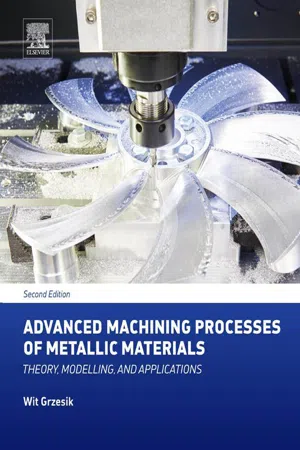
Advanced Machining Processes of Metallic Materials
Theory, Modelling, and Applications
- 608 pages
- English
- ePUB (mobile friendly)
- Available on iOS & Android
eBook - ePub
About this book
Advanced Machining Processes of Metallic Materials: Theory, Modelling and Applications, Second Edition, explores the metal cutting processes with regard to theory and industrial practice. Structured into three parts, the first section provides information on the fundamentals of machining, while the second and third parts include an overview of the effects of the theoretical and experimental considerations in high-level machining technology and a summary of production outputs related to part quality.
In particular, topics discussed include: modern tool materials, mechanical, thermal and tribological aspects of machining, computer simulation of various process phenomena, chip control, monitoring of the cutting state, progressive and hybrid machining operations, as well as practical ways for improving machinability and generation and modeling of surface integrity.
This new edition addresses the present state and future development of machining technologies, and includes expanded coverage on machining operations, such as turning, milling, drilling, and broaching, as well as a new chapter on sustainable machining processes. In addition, the book provides a comprehensive description of metal cutting theory and experimental and modeling techniques, along with basic machining processes and their effective use in a wide range of manufacturing applications.
The research covered here has contributed to a more generalized vision of machining technology, including not only traditional manufacturing tasks, but also potential (emerging) new applications, such as micro and nanotechnology.
- Includes new case studies illuminate experimental methods and outputs from different sectors of the manufacturing industry
- Presents metal cutting processes that would be applicable for various technical, engineering, and scientific levels
- Includes an updated knowledge of standards, cutting tool materials and tools, new machining technologies, relevant machinability records, optimization techniques, and surface integrity
Information
Subtopic
MaschinenbauChapter One
Introduction
The best way to predict the future is to create it.
Peter Drucker
During the decade since the manuscript of the first edition of Advanced Machining Processes of Metallic Materials was prepared and published, academia and industry have seen many visible changes. Scientists have developed modelling and simulation techniques of machining processes and, together with R&D centres, modern cutting tool materials, cutting tools, Computer numerical control (CNC) machine tools and new machining processes that substantially enhance the productivity and quality of machining processes have been implemented in the manufacturing sector. By providing state-of-the-art machining theory and practice, Advanced Machining Processes of Metallic Materials, Second Edition seems to be a good reference for all specialists who are working in the field of machining.
Manufacturing constitutes the economic backbone of an industrialized nation and, in general, the economic position of a country is based on the level of manufacturing activity. It is evident that the pressures of international competition serve as a catalyst for changes in manufacturing technologies and systems. The following definition of advanced manufacturing is proposed to meet all these challenges [1]:
Advanced 21st-century manufacturing is the creation of integrated solutions that require the production of physical artifacts coupled with value-added services and software, while exploiting custom-designed and recycled materials and using ultra-efficient processes.
Based on this definition, Fig. 1.1 presents several groups of leading technologies that create advanced manufacturing. First, there are technologies, such as additive or hybrid processes, that create manufacturing process innovations [2]. These innovations improve, enhance or replace existing processes. The second group identifies technologies that produce new materials and enable multi-scale manufacturing and are subsequently implemented into manufacturing processes. The third group covers technologies that improve the performance of measurement and testing during or after manufacturing. The fourth group of technologies increase the degree of automation and the precision of manufacturing improves through the combination of robotics and automation equipment. The fifth group involves innovations in the manufacturing systems including supply chain management and logistics, information technology for manufacturing and for manufacturing simulation and visualization. They are often referred to as intelligent or smart manufacturing systems because they integrate computational predictability and operational efficiency. In addition, technologies can be identified that which improve the environmental and economic sustainability of manufacturing due to more efficient consumption of energy and increased use of recycled materials.

During the past 10–20 years, new manufacturing technologies, automated systems and numerous system innovations have been implemented to improve CNC machine tool and operator efficiency and increase productivity to reduce the cost of manufacturing and improve productivity. Especially, manufacturing industry meets the current market challenge by continued development of machine tools with more advanced intelligence and digital control, higher speeds, better accuracy and greater flexibility. More recent developments include incorporated probes, sensors and adaptive and hybrid machining processes that represent the eyes and ears of an operator. Currently, highly sophisticated knowledge-based systems and virtual reality (VR) models are being developed and tested to support a completely automatic intelligent machining workstation. The trend towards mass customization in manufacturing has also inspired the adoption of various concepts and practices leading to the flexibility, agility and sustainability of manufacturing operations (basically to accommodate a family-of-parts). A number of other systems innovations are available, such as artificial intelligence, VR, computer-integrated manufacturing (CIM), material requirements planning, total quality management and others. However, it must be understood that they, either individually or collectively, cannot solve all current manufacturing problems. In these aspects, the book tries to help the manufacturing engineers to properly and effectively use a huge number of well-proven machining-based technological processes and equipment, as well as proprietary innovations in the manufacturing environment.
Parts manufactured by casting, forming and other shaping processes, or even additive/hybrid processes, often require further operations to be machined to its final shape and dimensions with one or more of the processes listed in Fig. 1.2. Machining is the most widespread metal-shaping process in mechanical manufacturing industry. Rapidly growing investments in metal-machining machine tools have continued despite perceived threats to machine volume, such as the replacement of metal by composite products in the consumer goods sector and material saving by near-net (casting or forging) process substitution in the metal products sector. One reason is that metal machining is capable of high precision: tight part tolerances of 50 µm and surface roughness of 1 µm are readily achievable. Moreover, machining is very versatile: complicated free-form shapes with many features, including those of micro- and nano-scale, can be made more cheaply, quickly and simply by CNC multi-axis machine tools. Parts may have external and internal profiles, as well as sharp corners and flatness, which cannot be produced by forming and shaping processes. Special surface characteristics, such as mirror surfaces with a very high reflectivity, can only be produced by machining with a single-crystal diamond tool. A third reason discussed above is that machining is able to sustain large changes, which guarantee the success on the market. In general, three types of changes are decisive: advances in machine tools (machine technology), in the organization of machining (manufacturing systems) and in the cutting tools (materials technology) [4,5]. It should be noted that each new improvement in one sector stimulates appropriate feedback from another.

In spite of some limitations related to mass-saving processes, such as material waste, more energy, capital and labour required, longer production time and adverse effects on the surface integrity, material-removal (mass-reducing) processes and machine tools are indispensable to modern manufacturing technology. As a result, today metal cutting is indeed a large segment of industrial activities. The automotive industry, precision engineering, electrical engineering, railways, shipbuilding, aircraft and aerospace industry, production of domestic equipment, and the machine tool and cutting tool industry itself–all these branches have large machine shops with many thousands of employees engaged in preparing and performing machining operations. The author’s primary intention is to address this book to all these people to be more active and creative in their common engineering practice. The book is essentially organized in three parts and 20 chapters, but several sections in Chapter 15, Advanced Machining Processes, could also be individual chapters.
Basic information generally needed for the proper utilization of basic science is provided in Chapter 2, Metal Cutting Operations and Terminology, Chapter 3, Trends in Metal Cutting Theory and Practice, and Chapter 4, Cutting Tool Materials. Chapter 2, Metal Cutting Operations and Terminology, generically describes metal cutting operations and provides recommended classification and terminology. Chapter 3, Trends in Metal Cutting Theory and Practice, discusses new trends emerging in metal cutting theory and practice. Chapter 4, Cutting Tool Materials, covers a range of cutting tool materials, their properties and optimal areas of application. Chapter 5, Modelling and Simulation of Machining Processes and Operations, contains a useful vade-mecum (guide) for modelling and simulation techniques and their practical utilization. Chapter 6, Orthogonal and Oblique Cutting Mechanics, focuses on mechanics of orthogonal and oblique cutting arrangements and the data characterizing the cutting process. Chapter 7, Chip Formation and Control, treats possible mechanisms of chip formation and practical methods of chip control. Chapter 8, Cutting Vibrations, deals with negative influences provided by cutting vibrations and effective methods of their control and prevention. Chapter 9, Heat in Metal Cutting, and Chapter 10, Cutting Fluids, touch on thermal problems and the removal of heat by cooling using different media. Chapter 11, Tribology in Metal Cutting, and Chapter 12, Tool Wear and Damage, concern overall tribological problems related to contact phenomenon and tool wear. Chapter 13, Machinability of Engineering Materials, provides machinability rating for a majority of engineering materials, and Chapter 14, Machining Economics and Optimization, includes both economic and optimization considerations. Chapter 15, Advanced Machining Processes, characterizes several advanced machining processes that revolutionized manufacturing industry. Chapter 16, Micro-Machining, and Chapter 17, Nanomanufacturing/Nanotechnology, relate machining to micro- and nano-scale, respectively. Chapter 18, Sensor-Assisted Machining, and Chapter 19, Virtual/Digital and Internet-Based Manufacturing, provide some modern IT and sensor-based technology and computer-based techniques. Finally, Chapter 20, Surface Integrity, covers cutting-edge measuring techn...
Table of contents
- Cover image
- Title page
- Table of Contents
- Copyright
- Preface
- Nomenclature
- Chapter One. Introduction
- Chapter Two. Metal Cutting Operations and Terminology
- Chapter Three. Trends in Metal Cutting Theory and Practice
- Chapter Four. Cutting Tool Materials
- Chapter Five. Modelling and Simulation of Machining Processes and Operations
- Chapter Six. Orthogonal and Oblique Cutting Mechanics
- Chapter Seven. Chip Formation and Control
- Chapter Eight. Cutting Vibrations
- Chapter Nine. Heat in Metal Cutting
- Chapter Ten. Cutting Fluids
- Chapter Eleven. Tribology of Metal Cutting
- Chapter Twelve. Tool Wear and Damage
- Chapter Thirteen. Machinability of Engineering Materials
- Chapter Fourteen. Machining Economics and Optimization
- Chapter Fifteen. Advanced Machining Processes
- Chapter Sixteen. Micro-Machining
- Chapter Seventeen. Nanomanufacturing/Nanotechnology
- Chapter Eighteen. Sensor-Assisted Machining
- Chapter Nineteen. Virtual/Digital and Internet-Based Machining
- Chapter Twenty. Surface Integrity
- Index
Trusted by 375,005 students
Access to over 1.5 million titles for a fair monthly price.
Study more efficiently using our study tools.
Frequently asked questions
Yes, you can cancel anytime from the Subscription tab in your account settings on the Perlego website. Your subscription will stay active until the end of your current billing period. Learn how to cancel your subscription
No, books cannot be downloaded as external files, such as PDFs, for use outside of Perlego. However, you can download books within the Perlego app for offline reading on mobile or tablet. Learn how to download books offline
Perlego offers two plans: Essential and Complete
- Essential is ideal for learners and professionals who enjoy exploring a wide range of subjects. Access the Essential Library with 800,000+ trusted titles and best-sellers across business, personal growth, and the humanities. Includes unlimited reading time and Standard Read Aloud voice.
- Complete: Perfect for advanced learners and researchers needing full, unrestricted access. Unlock 1.5M+ books across hundreds of subjects, including academic and specialized titles. The Complete Plan also includes advanced features like Premium Read Aloud and Research Assistant.
We are an online textbook subscription service, where you can get access to an entire online library for less than the price of a single book per month. With over 1.5 million books across 990+ topics, we’ve got you covered! Learn about our mission
Look out for the read-aloud symbol on your next book to see if you can listen to it. The read-aloud tool reads text aloud for you, highlighting the text as it is being read. You can pause it, speed it up and slow it down. Learn more about Read Aloud
Yes! You can use the Perlego app on both iOS and Android devices to read anytime, anywhere — even offline. Perfect for commutes or when you’re on the go.
Please note we cannot support devices running on iOS 13 and Android 7 or earlier. Learn more about using the app
Please note we cannot support devices running on iOS 13 and Android 7 or earlier. Learn more about using the app
Yes, you can access Advanced Machining Processes of Metallic Materials by Wit Grzesik in PDF and/or ePUB format, as well as other popular books in Technik & Maschinenbau & Maschinenbau. We have over 1.5 million books available in our catalogue for you to explore.