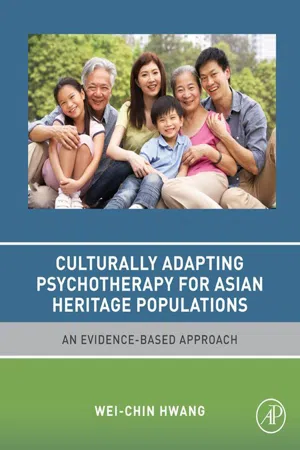
eBook - ePub
Culturally Adapting Psychotherapy for Asian Heritage Populations
An Evidence-Based Approach
- 360 pages
- English
- ePUB (mobile friendly)
- Available on iOS & Android
eBook - ePub
Culturally Adapting Psychotherapy for Asian Heritage Populations
An Evidence-Based Approach
About this book
Current census reports indicate that over half of the United States will be of ethnic minority background by 2050. Yet few published studies have examined or demonstrated the efficacy of currently established psychological treatments for ethnic minorities. Culturally Adapting Psychotherapy for Asian Heritage Populations: An Evidence-Based Approach identifies the need for culturally adapted psychotherapy and helps support the cultural competency movement by helping providers develop specific skillsets, rather than merely focusing on cultural self-awareness and knowledge of other groups. The book provides a top-down and bottom-up community-participatory framework for developing culturally adapted interventions that can be readily applied to many other groups. Areas targeted for adaptation are broken down into domains, principles, and the justifying rationales. This is one of the first books that provides concrete, practical, and specific advice for researchers and practitioners alike. It is also the first book that provides an actual culturally adapted treatment manual so that the reader can see cultural adaptations in action.
- Summarizes psychotherapy research indicating underrepresentation of ethnic minorities
- Describes the first evidence-based culturally adapted treatment for Asian heritage populations
- Provides concrete examples of adapted psychotherapy in practice
- Clarifies how this framework can be further used to adapt interventions for other ethnic groups
- Highlights how principles used to develop this depression-specific treatment can be applied to other disorders
- Includes the full treatment manual Improving Your Mood: A Culturally Responsive and Holistic Approach to Treating Depression in Chinese Americans
Information
Subtopic
EcologyIndex
Biological SciencesSection II
Learning how to effectively use the culturally adapted treatment manual
Outline
Chapter 5
Introduction to the Manual and Understanding Cultural Complexities
Abstract
The goal of the subsequent chapters is to introduce the culturally adapted cognitive-behavioral therapy (CBT) for the depressed Chinese Americans manual entitled, “Improving your mood: A culturally responsive and holistic approach to treating depression in Chinese Americans.” As previously mentioned, this manual was originally developed and funded by the National Institute of Mental Health (NIMH) grant to be the first study to culturally adapt an evidence-based treatment for an Asian American group. Specifically, the project compared the treatment effectiveness of CBT against Culturally Adapted CBT (CA-CBT). Both treatment manuals utilized in the randomized controlled trial consisted of 12 sessions of psychotherapy. The manual is intended to have flexibility in usage, and there is much more room for tailoring and adjusting the tempo of implementation when not used in a clinical trial format (eg, spending more time for each session, spending more than one meeting for each session, repeating various sessions, and utilizing select components from each session).
Keywords
Psychotherapy; mental health; depression; cognitive-behavioral therapy; cultural metaphors; culturally adapted treatment; cultural adaptation
Unless we know ourselves and our history, and other people and their history, there is really no way that we can really have a positive kind of interaction where there is real understanding.
—Yuri Kochiyama (Japanese American Human Rights Activist; 1921–2014)
The goal of the subsequent chapters is to introduce the culturally adapted cognitive-behavioral therapy (CBT) for depressed Chinese Americans manual entitled, “Improving your mood: A culturally responsive and holistic approach to treating depression in Chinese Americans” (Hwang, 2008a). As previously mentioned, this manual was originally developed and funded by the National Institute of Mental Health (NIMH) grant to be the first study to culturally adapt an evidence-based treatment (EBT) for an Asian American group. Specifically, the project compared the treatment effectiveness of CBT against Culturally Adapted CBT (CA-CBT). Both treatment manuals utilized in the randomized controlled trial consisted of 12 sessions of psychotherapy (Hwang et al., 2015). The manual is intended to have flexibility in usage, and there is much more room for tailoring and adjusting the tempo of implementation when not used in a clinical trial format (eg, spending more time for each session, spending more than one meeting for each session, repeating various sessions, and utilizing select components from each session).
The 12 sessions of the manual include: session 1 (Understanding how this program can help you take control of your emotions), session 2 (Understanding how depression can negatively influence your life), session 3 (Defining and visualizing your goals), session 4 (Practicing behavioral strengthening: Effective problem-solving), session 5 (Practicing behavioral strengthening: Improving your communication skills), session 6 (Practicing cognitive strengthening: Understanding unhealthy thinking patterns), session 7 (Practicing mental strengthening: Learning effective thinking strategies), session 8 (Practicing internal strengthening: Engaging in healthy activities), session 9 (Practicing internal strengthening: Managing your stress through relaxation training), session 10 (Practicing emotional strengthening: Principles of everyday healthy living), session 11 (Strengthening family relationships), and session 12 (Reflecting upon our journey and planning the road ahead).
In addition, there were originally client and therapist versions of the manual (Hwang, 2008a, 2008b). The therapist version of the manual was a brief overview of the program including a compilation of readings related to cultural mental health and adapting psychotherapy. This book replaces the therapist manual and all of the materials in the therapist version have already been reviewed and expanded upon in this book. This book also includes recommendations based on therapist discussions during the clinical trial and recommendations from my clinical experiences. The client manual is included with the purchase of this book. The client treatment manual includes an English version and two written Chinese versions (one in simplified and the other in traditional Chinese characters).
Utilizing the Manual for Research and Clinical Purposes
This treatment manual can be used by practitioners to engage clients who are clinically depressed. It can also be used by scientist-practitioners who want to conduct treatment outcome research with Asian heritage populations. Although the manual was written primarily with Chinese heritage populations in mind, it can potentially be used and modified for other Asian heritage populations. Many of the cultural adaptation strategies that were integrated in the manual are broader issues that are relevant to many Asian heritage groups. Moreover, principles from the manual can potentially be used with non-Asian heritage populations who are from collectivistic cultural backgrounds and who might have similar therapy experiences as Asian heritage populations.
Different sections or components of the manual can also be used with White or European Americans (eg, therapy orientations, various worksheets, and therapeutic metaphors). The rationale here is that treatments developed for White populations have been applied to many ethnocultural groups and have been assumed to be generalizable. Although I am not making the same assumption, I encourage practitioners to utilize and individualize components of the manual for their clients if they feel like they might be beneficial. I have used components of the manual in my private practice with clients from various backgrounds, and they have found them useful and effective. Treatment manuals developed for various populations can have cultural-universal and culture-specific therapeutic components. Expanding our research and tailoring mental health services for various populations can help us better identify what the cultural-universal components are, as well as tailor services for specific groups. For example, many traditions and healing practices are becoming more commonplace and popular because of their therapeutic value in the West (eg, yoga, Tai Chi, acupuncture, and Traditional Chinese Medicine).
If you are using the treatment manual for a clinical trial, you may want to refrain from altering the treatment so that the results can be compared to those of other clinical trials using the same 12-session format. Specifically, in evaluating the effectiveness for research purposes, it is important to keep the treatment intact and retain core elements. However, this does not mean that sessions should be implemented in a robotic manner, and therapist individuality and clinical instincts should not be ignored and incorporated when using the manual. It is important to note that when utilizing a treatment manual, therapists do not necessarily have to lose their individuality, clinical identity, or ability to tailor or modify treatments for the patient. Although there is not enough space to provide a general review on how to effectively use treatment manuals, it is important to maintain clinical flexibility when utilizing an EBT manual. At the same time, it is also important to retain the core therapeutic and session elements.
One potential modification that may be beneficial, which we learned after completing the clinical trial, is that it may be beneficial to have multiple meetings with clients to cover sessions that contain denser material or skills that may take longer to master (eg, session 5 of the treatment manual, which focuses on improving communication). One possibility is to take a less time pressured approach to completing the 12 sessions, and complete them in 16–20 sessions. As long as all 12 sessions are covered, the treatment may still be considered intact, but extended in length. Moreover, if the investigators have another manual that is 16 or 20 sessions in length, then the adapting CBT manual can also be flexibility extended to those lengths for a more equitable comparison.
In the adapting CBT for Chinese Americans clinical trial, therapists were trained on how to use the treatment manual during a 2-day 12-h workshop, and also provided weekly ongoing group supervision. Training times were equivalent for therapists in the CA-CBT condition as well as the CBT condition. However, as mentioned in chapter “What Do We Mean by Culturally Adapting Psychotherapy?” there are some methodological biases in taking this approach because those therapists who were trained for the CBT condition are likely to have received some nonadapted therapy training for their entire clinical careers (as well as even more training in CBT if that is their primary theoretical orientation). However, therapists in the CA-CBT condition were exposed to a culturally adapted treatment (ie, CA-CBT) for the first time. This may lead to an imbalance in level of experience and training associated with adapted versus nonadapted treatments. Because of these biases, and depending on whether the therapists in your particular study have had previous experience with CBT, you may want to provide training sessions of different durations for therapists in each treatment condition as a counterbalancing strategy, especially if ongoing weekly supervision is not provided throughout the clinical trial.
If therapists are not using the treatment manual in a clinical trial situation, they are free to flexibly use the manual and tailor it to their client’s needs. For example, therapists can utilize the current manual as-is, or select sessions that may be more relevant for the client. Moreover, therapists can also hand-pick which worksheets to utilize, and what metaphors, teachings, and clinical skills to use with clients. And, of course, therapists can also tailor the treatment manual and spend more time covering or repeating various sessions depending on the client’s clinical needs and familiarity with therapy.
Therapists should provide the client with a physical copy of the client version of the treatment manual. This is recommended in a clinical trial setting or if you are going to be using the treatment manual intact, but can also be beneficial in a private practice setting. Having a manual in hand can provide more structure and help reduce ambiguity about the treatment process for Asian heritage clients, who may be less familiar with therapy. If therapists are only using certain components of the manual, then they are free to photocopy and use whatever sections or worksheets that they feel may be beneficial to their clients.
Introduction to Cultural Adaptations
The remaining chapters in the book focus on how to use and guide clients through each session of the treatment manual. In addition, the various cultural adaptations that were implemented are also highlighted. Readers may want to read each chapter with a copy of the treatment manual in front of them to better contextualize each chapter’s discussion and to visualize what is being referred to in the book. When discussing each of the cultural adaptations, I will relate the modifications back to the domains of the Psychotherapy Adaptation and Modification Framework (PAMF), highlight the therapeutic principles involved, and explain the rationale for making such adaptations. Reiterated here, the six domains of the PAMF include:
• Domain 1: Dynamic issues and cultural complexities;
• Domain 2: Treatment orientation and increasing mental health awareness;
• Domain 3: Cultural beliefs about mental illness and its treatment;
• Domain 4: Client–therapist relationship;
• Domain 5: Cultural differences in expression and communication;
• Domain 6: Culture-specific issues.
One issue to keep in mind when thinking about cultural adaptation domains is that modifications made in one area can potentially be beneficial for another area. For example, if a practitioner provides a thorough therapy orientation (Domain 1), this is also likely to help improve the client–therapist relationship (Domain 4). Therefore, targeted cultural adaptations in one domain can have multiplicative or synergistic effects with other domains, thus enhancing engagement and outcomes. For the remainder of this chapter, I will focus on introducing some basic cultural adaptations that were implemented throughout the manual. However, the major focus will be on discussing dynamic issues and cultural complexities (ie, PAMF Domain 1) involved in working with diverse clientele. Although it is impossible for any one chapter or book to comprehensively discuss these complexities, the following are some important issues to keep in mind when working with diverse populations.
Becoming a Culturally Competent Therapist: Navigating and Understanding Cultural Complexities
The first domain of the PAMF involves understanding and addressing cultural complexities and dynamic issues. This is one of the most difficult issues to address because one’s culture affects both intra- and interpersonal processes. Moreover, our brains are cognitively and genetically programmed to try to simplify and categorize the information that we encounter (Fiske, 1998). Part of this may be associated with inc...
Table of contents
- Cover image
- Title page
- Table of Contents
- Copyright
- Preface
- Section I: Understanding the science of culturally adapting psychotherapy
- Section II: Learning how to effectively use the culturally adapted treatment manual
- Section III: Client Manual
Trusted by 375,005 students
Access to over 1.5 million titles for a fair monthly price.
Study more efficiently using our study tools.
Frequently asked questions
Yes, you can cancel anytime from the Subscription tab in your account settings on the Perlego website. Your subscription will stay active until the end of your current billing period. Learn how to cancel your subscription
No, books cannot be downloaded as external files, such as PDFs, for use outside of Perlego. However, you can download books within the Perlego app for offline reading on mobile or tablet. Learn how to download books offline
Perlego offers two plans: Essential and Complete
- Essential is ideal for learners and professionals who enjoy exploring a wide range of subjects. Access the Essential Library with 800,000+ trusted titles and best-sellers across business, personal growth, and the humanities. Includes unlimited reading time and Standard Read Aloud voice.
- Complete: Perfect for advanced learners and researchers needing full, unrestricted access. Unlock 1.5M+ books across hundreds of subjects, including academic and specialized titles. The Complete Plan also includes advanced features like Premium Read Aloud and Research Assistant.
We are an online textbook subscription service, where you can get access to an entire online library for less than the price of a single book per month. With over 1.5 million books across 990+ topics, we’ve got you covered! Learn about our mission
Look out for the read-aloud symbol on your next book to see if you can listen to it. The read-aloud tool reads text aloud for you, highlighting the text as it is being read. You can pause it, speed it up and slow it down. Learn more about Read Aloud
Yes! You can use the Perlego app on both iOS and Android devices to read anytime, anywhere — even offline. Perfect for commutes or when you’re on the go.
Please note we cannot support devices running on iOS 13 and Android 7 or earlier. Learn more about using the app
Please note we cannot support devices running on iOS 13 and Android 7 or earlier. Learn more about using the app
Yes, you can access Culturally Adapting Psychotherapy for Asian Heritage Populations by Wei-Chin Hwang in PDF and/or ePUB format, as well as other popular books in Biological Sciences & Ecology. We have over 1.5 million books available in our catalogue for you to explore.