eBook - ePub
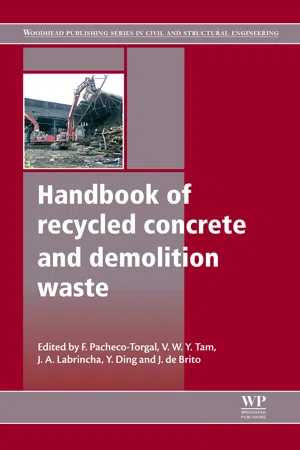
Handbook of Recycled Concrete and Demolition Waste
- 672 pages
- English
- ePUB (mobile friendly)
- Available on iOS & Android
eBook - ePub
Handbook of Recycled Concrete and Demolition Waste
About this book
The civil engineering sector accounts for a significant percentage of global material and energy consumption and is a major contributor of waste material. The ability to recycle and reuse concrete and demolition waste is critical to reducing environmental impacts in meeting national, regional and global environmental targets. Handbook of recycled concrete and demolition waste summarises key recent research in achieving these goals.Part one considers techniques for managing construction and demolition waste, including waste management plans, ways of estimating levels of waste, the types and optimal location of waste recycling plants and the economics of managing construction and demolition waste. Part two reviews key steps in handling construction and demolition waste. It begins with a comparison between conventional demolition and construction techniques before going on to discuss the preparation, refinement and quality control of concrete aggregates produced from waste. It concludes by assessing the mechanical properties, strength and durability of concrete made using recycled aggregates. Part three includes examples of the use of recycled aggregates in applications such as roads, pavements, high-performance concrete and alkali-activated or geopolymer cements. Finally, the book discusses environmental and safety issues such as the removal of gypsum, asbestos and alkali-silica reaction (ASR) concrete, as well as life-cycle analysis of concrete with recycled aggregates.Handbook of recycled concrete and demolition waste is a standard reference for all those involved in the civil engineering sector, as well as academic researchers in the field.
- Summarises key recent research in recycling and reusing concrete and demolition waste to reduce environmental impacts and meet national, regional and global environmental targets
- Considers techniques for managing construction and demolition waste, including waste management plans, ways of estimating levels of waste, the types and optimal location of waste recycling plants
- Reviews key steps in handling construction and demolition waste
Information
Subtopic
Gestione ambientale1
Introduction to the recycling of construction and demolition waste (CDW)
F. Pacheco-Torgal, University of Minho, Portugal
Abstract:
The chapter starts with an overview on the recycling of construction and demolition wastes (CDW), followed by a brief analysis on the EU 70% recycling target for 2020. The chapter also includes a book outline.
Key words
construction and demolition wastes (CDW)
recycling
resource efficiency
waste management
life-cycle assessment (LCA)
1.1 Introduction
The high volume of construction and demolition waste (CDW) generated today constitutes a serious problem. CDW in the United States is estimated at around 140 million metric tons (Yuan et al., 2012). Eurostat estimates the total for Europe to be 970 million tons/year, representing an average value of almost 2.0 ton/per capita (Sonigo et al., 2010). It should be noted that the figures for CDW generation per capita in Europe have a wide geographical variation (e.g. 0.04 tons for Latvia and 5.9 tons for France). These figures must be viewed as lower estimates, as this type of waste is often dumped illegally. The data are also hard to interpret because of the different waste definitions and reporting mechanisms in different countries (Sonigo et al., 2010).
Recycling of CDW is of paramount importance because it reduces environmental pressure. It prevents an increase in the area needed for waste disposal and also avoids the exploitation of non-renewable raw materials. Environmental impacts caused by the extraction of non-renewable raw materials include extensive deforestation, top-soil loss, air pollution and pollution of water reserves. It should be noted that 40% of all materials are used by the construction industry (Kulatunga et al. 2006). Wang et al. (2010) records that construction in China consumes approximately 40% of total natural resources and around 40% of energy. During the last century, the use of global materials increased eight-fold. As a result, almost 60 billion tons (Gt) are currently used per year (Krausmann et al., 2009). It has been forecast that demand for materials will reach at least double the current levels by 2050 (Allwood et al., 2011).
In the context of housing life-cycle assessment (LCA), the environmental gains associated with the recycling of CDW constitute a very small fraction (just 3% in United Kingdom) of the total global warming potential (GWP). Ninety percent of the GWP relates to the use stage (Cuéllar-Franca and Azapagic, 2012). This situation is not confined to the UK residential sector and applies generally in Europe and in other parts of the world where high energy-efficient buildings are the exception (Pacheco-Torgal et al., 2013). However, the recast of the Energy Performance of Buildings Directive (EPBD), which was adopted by the European Parliament and the Council of the European Union on 19 May 2010, sets 2020 as the deadline for all new buildings to be ‘nearly zero energy’. This will dramatically increase the percentage (Pacheco-Torgal et al., 2013a).
The benefits of effective CDW recycling are economic as well as environmental. For example, the Environment Agency of the US (EPA, 2002) states that the incineration of 10 000 tonnes of waste can mean the creation of 1 job, landfill can create 6 jobs, but recycling the same amount of waste can create 36 jobs. The recent report Strategic Analysis of the European Recycled Materials and Chemicals Market in Construction Industry records that the market for recycled construction materials generated revenues of €744.1 million in 2010 and is estimated to reach €1.3 billion by 2016 (Frost and Sullivan, 2011). This is a low estimate as it does not take into account a near 100% CDW recycling scenario, which will be the future of construction (Phillips et al., 2011).
During the last 15 years, investigations in the field of CDW have focused on three major topics: generation, reduction and recycling. This is guided by the ‘3Rs’ principle (Lu and Yuan, 2011). However, as it is a more complex issue, zero-waste will demand a much wider approach requiring ‘strong industry leadership, new policies and effective education curricula, as well as raising awareness and refocusing research agendas to bring about attitudinal change and the reduction of wasteful consumption’ (Lehmann, 2011).
1.2 EU 70% recycling target for 2020
According to the revised Waste Framework Directive 2008/98/EC (WFD), the minimum recycling percentage of ‘non-hazardous’ CDW by 2020 (‘excluding naturally occurring material defined in category 170504 (soil and stones not containing dangerous substances) in the European Waste Catalogue’) should be at least 70% by weight (Saez et al., 2011; del Rio Merino et al., 2011). This target and also the communication A Resource Efficient Europe (COM, 2011) indicates the determination of the EU to emphasise the importance of recycling. As the current average recycling rate of CDW for EU-27 is only 47% (Sonigo et al., 2010), increasing it by 70% in just a decade seems an ambitious goal.
CDW are often used as aggregates in roadfill, constituting a down-cycling option. Worldwide aggregate consumption is around 20 000 million tons/year and an annual growth rate of 4.7% is expected (Bleischwitz and Bahn-Walkowiak, 2011). The environmental impact of primary aggregates includes the consumption of non-renewable raw materials, energy consumption and more importantly, the reduction of biodiversity at extraction sites. The cost of aggregates is dependent on transport distances and the price per ton doubles for every 30 km (Van den Heede and De Belie, 2012). Extraction operations therefore have to be near construction sites, which increase the number of quarries and the biodiversity impact. More than one-third of aggregate consumption is related to the production of concrete, which is the most widely used construction material, currently standing at about 10 km3/year (Gartner and Macphee, 2011). By comparison, the amount of fired clay, timber and steel used in construction represents, respectively, around 2, 1.3 and 0.1 km3 (Flatt et al., 2012).
Although the use of CDW as recycled aggregates in concrete has been studied for almost 50 years, there are still too many concrete structures made with virgin aggregates (Pacheco-Torgal and Jalali, 2011; Pacheco-Torgal et al., 2013b). This is due to their low cost, lack of incentives, low landfill costs and in some cases, a lack of up-to-date technical regulation (Marie and Quiasrawi, 2012). Recycled aggregates also contain impurities which can be deleterious in Portland cement concrete. It is therefore difficult for the concrete industry to use these materials unless uncontaminated recycled aggregates are used. This issue highlights the importance of developing new binders, which are more suitable for CDW recycling. The WFD 70% target increases the need for effective recycling methods and it is the purpose of this book to make a contribution in this area. It also addresses new techniques for the remediation and/or immobilisation of hazardous wastes such as asbestos and for CDW prevention/reduction, which remains the best option (EC, 2006).
1.3 Outline of the book
Part I is concerned with the management of CDW (chapters 2 to 6).
Chapter 2 considers waste management plans, reviews existing methods in several countries and presents the results of a wide survey assessing the effectiveness of the requirements in implementing waste management plans for the Hong Kong construction industry. Attitudes, benefits and difficulties related to the implementation of waste management plans are discussed.
Chapter 3 covers methods of estimating CDW and includes studies and tables to estimate the amount of CDW. Seventeen examples and case studies on the factors affecting such estimates, the improvement achieved in management scenarios and the benefits of its implementation are presented.
In Chapter 4, waste management plants and technology for recycling CDW are addressed. The types and choices of waste management plants are discussed. Particular attention is given to the health and safety of workers.
Chapter 5 covers the use of multi-criteria decision-making methods for optimal CDW recycling facilities.
Chapter 6 reviews the relevant economic issues in the management of CDW facilities.
Part II is concerned with the processing and properties of recycled aggregates from CDW (chapters 7 to 13).
Chapter 7 compares conventional de...
Table of contents
- Cover image
- Title page
- Table of Contents
- Copyright
- Contributor contact details
- Woodhead Publishing Series in Civil and Structural Engineering
- Chapter 1: Introduction to the recycling of construction and demolition waste (CDW)
- Part I: Managing construction and demolition waste
- Part II: Processing and properties of recycled aggregates from construction and demolition waste
- Part III: Applications of recycled aggregates from construction and demolition waste
- Part IV: Environmental issues affecting recycled aggregates from construction and demolition waste
- Index
Trusted by 375,005 students
Access to over 1.5 million titles for a fair monthly price.
Study more efficiently using our study tools.
Frequently asked questions
Yes, you can cancel anytime from the Subscription tab in your account settings on the Perlego website. Your subscription will stay active until the end of your current billing period. Learn how to cancel your subscription
No, books cannot be downloaded as external files, such as PDFs, for use outside of Perlego. However, you can download books within the Perlego app for offline reading on mobile or tablet. Learn how to download books offline
Perlego offers two plans: Essential and Complete
- Essential is ideal for learners and professionals who enjoy exploring a wide range of subjects. Access the Essential Library with 800,000+ trusted titles and best-sellers across business, personal growth, and the humanities. Includes unlimited reading time and Standard Read Aloud voice.
- Complete: Perfect for advanced learners and researchers needing full, unrestricted access. Unlock 1.5M+ books across hundreds of subjects, including academic and specialized titles. The Complete Plan also includes advanced features like Premium Read Aloud and Research Assistant.
We are an online textbook subscription service, where you can get access to an entire online library for less than the price of a single book per month. With over 1.5 million books across 990+ topics, we’ve got you covered! Learn about our mission
Look out for the read-aloud symbol on your next book to see if you can listen to it. The read-aloud tool reads text aloud for you, highlighting the text as it is being read. You can pause it, speed it up and slow it down. Learn more about Read Aloud
Yes! You can use the Perlego app on both iOS and Android devices to read anytime, anywhere — even offline. Perfect for commutes or when you’re on the go.
Please note we cannot support devices running on iOS 13 and Android 7 or earlier. Learn more about using the app
Please note we cannot support devices running on iOS 13 and Android 7 or earlier. Learn more about using the app
Yes, you can access Handbook of Recycled Concrete and Demolition Waste by F. Pacheco-Torgal,Yining Ding,Fernando Pacheco-Torgal in PDF and/or ePUB format, as well as other popular books in Tecnologia e ingegneria & Gestione ambientale. We have over 1.5 million books available in our catalogue for you to explore.