- 504 pages
- English
- ePUB (mobile friendly)
- Available on iOS & Android
eBook - ePub
About this book
Marine Concrete Structures: Design, Durability and Performance comprehensively examines structures located in, under, or in close proximity to the sea. A major emphasis of the book is on the long-term performance of marine concrete structures that not only represent major infrastructure investment and provision, but are also required to operate with minimal maintenance.
Chapters review the design, specification, construction, and operation of marine concrete structures, and examine their performance and durability in the marine environment. A number of case studies of significant marine concrete structures from around the world are included which help to reinforce the principles outlined in earlier chapters and provide useful background to these types of structures. The result is a thorough and up-to-date reference source that engineers, researchers, and postgraduate students in this field will find invaluable.
- Covers, in detail, the design, specification, construction, and operation of marine concrete structures
- Examines the properties and performance of concrete in the marine environment
- Provides case studies on significant marine concrete structures and durability-based design from around the world
Information
1
Introduction
Importance of marine concrete structures and durability design
M.G. Alexander, and G. Nganga University of Cape Town, South Africa
Abstract
This introductory chapter sets the scene for the book. It mentions the importance of marine or coastal localities in terms of concentrations of world population and economic activity, and therefore the need for construction in these environments. It argues that concrete will continue to be the dominant construction material in marine environments in the foreseeable future because of its inherent robustness, strength and durability. Nevertheless, it is stressed that, with developmental pressures on marine localities in the future, greater robustness and resilience will be needed from marine concrete infrastructure, with increasing demands for greater durability. The chapter, therefore, briefly describes the fundamental requirements for marine concrete structures, particularly materials selection and design, as well as structural selection and form. It introduces the role and importance of design standards and guidelines, but it stresses the need for additional guidance when designing and constructing in the marine environment. Last, the chapter indicates that this book provides useful information on many important aspects of marine concrete structures, and it reinforces this information by way of informative case studies.
Keywords
Coastal; Concrete structures; Exposure; Loading; Marine; Maritime; Standards1.1. Introduction
This book is about the design, durability, and performance of marine concrete structures, which come in many different types and shapes. Some are mass unreinforced concrete structures; others are reinforced to withstand the forces and actions that bear upon them. Concrete in its various forms permits the construction of coastal facilities, including docks and harbours, quays, jetties, wharves, seawalls, pipelines, tunnels, and so on, which in turn facilitate on-shore and near-shore developments such as cities, industrial areas, recreational sites, and many other needed developments. The demand for human development worldwide continues to grow, and much of this development will occur in marine areas in the future because of the great advantages of coastal localities in terms of trade and transport opportunities, areas suitable for human habitation and recreation, and accessibility. Thus, it is extremely important that engineers and designers understand the requirements of marine concrete structures, and particularly how they perform over the long-term in regard to their durability. This book links the concepts of design, durability, and performance, recognising that a durable concrete structure that performs acceptably over its intended lifespan begins with appropriate design and specification, although clearly construction and execution are also critical. This latter aspect is also covered in the book.
Three commonly used terms require definition.
Marine is an adjective usually applied to things or aspects relating to the sea, for example, marine biology, marine geology, and marine structures. It almost always refers exclusively to seawater environments.
Maritime is usually an adjective that describes objects or activities relating to the sea, most often activities such as shipping and sailing.a
Coastal refers to a zone where interaction of sea and land processes occurs.
In this book, the term ‘marine’ will be used frequently since it is a broad term relating to the sea or ocean; it will mostly be used in relation to ‘marine structures’, that is, structures in or in very close proximity to the sea or in contact with the sea. However, ‘coastal’ will also be used on occasions.
1.1.1. Importance of concrete in the marine environment
Concrete is widely used in the marine environment, as evidenced by the vast stock of concrete structures near, in, or under the sea. Fig. 1.1 shows a selection of a port, a bridge, a high-rise building, and an oil platform, all in marine environments. There are good reasons for the extensive use of concrete. First, concrete is highly versatile, and it can be cast and moulded into useful shapes or made in factory environments for inclusion in subsequent construction. Second, concrete is a cost-effective material with inherent mechanical and durability properties that make it attractive for use, especially in severe environments such as the marine environment. Concrete is also increasingly understood as a relatively ‘low-carbon footprint’ material, contrary to uninformed perceptions, and research effort is increasingly being put toward further reducing its carbon footprint. The reality is that concrete will continue to be the construction material of choice for use in marine environments, as well as in a range of other demanding environments, into the foreseeable future. At this stage, there is simply no other viable alternative (Scrivener, 2014).
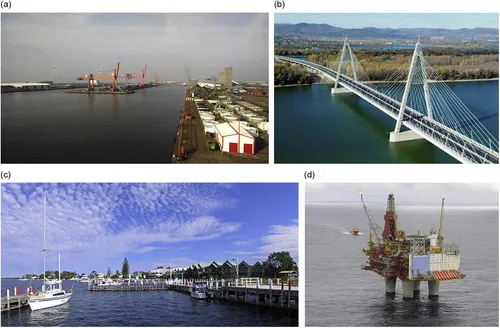
Figure 1.1 (a) Avonmouth docks, Port of Bristol, England. (https://commons.wikimedia.org/wiki/File:Avonmouth_Docks.webp.) (b) Megyeri Bridge, Hungary. (https://commons.wikimedia.org/wiki/Cable-stayed_bridges#/media/File:Civertanmegyeri4.webp.) (c) Metung-Wharf-Pano, Victoria, Australia. (https://commons.wikimedia.org/wiki/File:Metung-Wharf-Pano,-Vic.webp.) (d) Troll A Platform, Norway. (Photograph taken from South East, viewed November 2015. https://en.wikipedia.org/wiki/Troll_A_platform.)
Concrete, as a material and as applied in different structural forms, is continually undergoing improvements that will render it even more cost-effective, durable, environmentally friendly, and long-lasting in the future. For example, it is now possible to make highly durable concretes that have such low chloride diffusion coefficients as to be almost impenetrable to chlorides. Interestingly, this is achieved not by greater use of the primary binder, Portland cement, but by engineered use of supplementary cementitious materials (SCMs) in appreciable proportions, which also reduces concrete's carbon footprint. The aggressive marine environment also gives rise to substantial physical and mechanical forces acting on concrete structures, such as severe abrasion, wave loading, and occasional accidental ship impact loading, and in this respect, concrete is eminently suitable, being of sufficient self-weight and robustness to withstand these effects.
The current (2015) global population is approximately 7.3 billion, of which approximately 44% is estimated to live within 150 km of the sea (UN Atlas, 2010). Thus, a vast number of people are affected directly or indirectly in their daily lives by the sea, and this includes the structures in which they live and work, or those that are provided by way of urban or industrial infrastructure. Marine infrastructure takes many various forms such as ports and harbours for trade, tourist and recreational attractions, residential and commercial buildings, and many others. Over the years, there has been growth in the number and size of ports, particularly in the developing world such as in China, India, Indonesia, and South Africa, as well as in the developed world such as Japan, Hong Kong, and Europe (Hinrichsen, 1999). This growth in ports and coastal facilities is accompanied by an increase in economic activities and job opportunities that lead to further increase in the human population along coastal regions. Therefore, major infrastructure development will occur in coastal and marine areas into the future, with concrete continuing to be the dominant construction material.
Considering future challenges for marine concrete construction, global warming and related effects of climate change are likely to be among the most serious. Already, there are rising temperatures and sea levels and increases in extreme weather events around the globe. These are particularly destructive and damaging when they impact coastal infrastructure. Coupled with the likely growth of populations in coastal localities, this poses a major challenge for designers, constructors, and operators of marine concrete infrastructure. Greater robustness and resilience will be needed from this infrastructure, and demands for increased durability are likely to multiply. Further, with increasing pressure on land-based space, underwater construction for cities and other uses is almost certain to occur. Chapter 16 ‘...
Table of contents
- Cover image
- Title page
- Table of Contents
- Related titles
- Copyright
- List of contributors
- Woodhead Publishing Series in Civil and Structural Engineering
- Preface and acknowledgements
- 1. Introduction: Importance of marine concrete structures and durability design
- Part One. Design, specification and construction of marineconcrete structures
- Part Two. The performance and properties of concretein the marine environment
- Part Three. Case studies on marine concrete and durability–based design
- Index
Trusted by 375,005 students
Access to over 1.5 million titles for a fair monthly price.
Study more efficiently using our study tools.
Frequently asked questions
Yes, you can cancel anytime from the Subscription tab in your account settings on the Perlego website. Your subscription will stay active until the end of your current billing period. Learn how to cancel your subscription
No, books cannot be downloaded as external files, such as PDFs, for use outside of Perlego. However, you can download books within the Perlego app for offline reading on mobile or tablet. Learn how to download books offline
Perlego offers two plans: Essential and Complete
- Essential is ideal for learners and professionals who enjoy exploring a wide range of subjects. Access the Essential Library with 800,000+ trusted titles and best-sellers across business, personal growth, and the humanities. Includes unlimited reading time and Standard Read Aloud voice.
- Complete: Perfect for advanced learners and researchers needing full, unrestricted access. Unlock 1.5M+ books across hundreds of subjects, including academic and specialized titles. The Complete Plan also includes advanced features like Premium Read Aloud and Research Assistant.
We are an online textbook subscription service, where you can get access to an entire online library for less than the price of a single book per month. With over 1.5 million books across 990+ topics, we’ve got you covered! Learn about our mission
Look out for the read-aloud symbol on your next book to see if you can listen to it. The read-aloud tool reads text aloud for you, highlighting the text as it is being read. You can pause it, speed it up and slow it down. Learn more about Read Aloud
Yes! You can use the Perlego app on both iOS and Android devices to read anytime, anywhere — even offline. Perfect for commutes or when you’re on the go.
Please note we cannot support devices running on iOS 13 and Android 7 or earlier. Learn more about using the app
Please note we cannot support devices running on iOS 13 and Android 7 or earlier. Learn more about using the app
Yes, you can access Marine Concrete Structures by Mark Alexander in PDF and/or ePUB format, as well as other popular books in Technology & Engineering & Civil Engineering. We have over 1.5 million books available in our catalogue for you to explore.