- 496 pages
- English
- ePUB (mobile friendly)
- Available on iOS & Android
eBook - ePub
Cannabinoids in Neurologic and Mental Disease
About this book
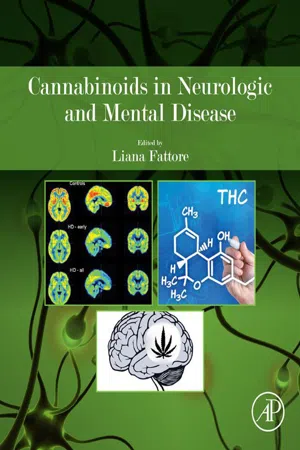
The application of cannabis sativa for the treatment of neurologic and mental disease is expanding. Cannabinoids in Neurologic and Mental Disease collects and presents for the first time recent research involving the use of pharmacological cannabinoids for the treatment of neurodegenerative and neuroinflammatory disease. The neurologic application of cannabinoid therapy builds upon psychiatric and psychological use for the treatment of a variety of core mental disorders. This comprehensive reference on the known uses of cannabinoids will be useful for clinical neurologists, neuroscience and clinical neuroscience researchers, clinical psychologists and psychiatrists and the general medical community.
- A comprehensive reference on the clinical uses of cannabinoids for treating major neurologic and mental diseases
- Detailed coverage of cannabinoid use for neuroinflammatory and neurodegenerative disease including Multiple Sclerosis, Epilepsy, Huntington's disease, Parkinson's disease, and Alzheimer's disease
- Detailed coverage of cannabinoid use for major psychiatric and psychological diseases and disorders including schizophrenia, bipolar disorders, Tourette's syndrome, and post-traumatic stress disorder (PTSD)
Information
Topic
MedicinaSubtopic
NeurologíaPart 1
Role of the endocannabinoids in neuroinflammatory and neurodegenerative disorders
Outline
Chapter 1
Cannabinoids for the treatment of neuroinflammation
Maria L. de Ceballos, Neurodegeneration Group, Department of Cellular, Molecular and Developmental Neurobiology and CIBERNED, Cajal Institute, CSIC, Madrid, Spain
Neuroinflammation is an inflammatory condition of the brain, in which glial cells, namely, astrocytes and microglia, the resident macrophages of the brain, are involved along with blood-borne cells. Although in the past glial activation in neuroinflammation has been considered detrimental to the brain in general, currently the reparative/protective aspects are being recognized. Cannabinoids, whether plant derived (phytocannabinoids), synthetic, or endogenous (endocannabinoids), affect different glial functions. Importantly, glial cells are endowed with several, if not all, of the elements of the endocannabinoid system, and therefore are sensitive to cannabinoids and at the same time are a source of endocannabinoids. There appears to be general agreement that cannabinoids reduce the synthesis, production, and/or release of cytotoxic molecules such as proinflammatory cytokines and nitric oxide. On the other hand, these agents modify microglial cell migration in such a way that the result is usually beneficial in resolving neuroinflammation or limiting ensuing neurodegeneration. The therapeutic use of cannabinoids in preclinical studies is therefore being actively pursued in models of many neurodegenerative and mental diseases with great success. Nevertheless, the investigation of the effects of other important glial functions, and their consequences, should be extended in the near future.
Keywords
astrocytes; cannabinoids; cytokines; growth factors; microglia; neuroinflammation
Neuroinflammation
Neuroinflammation has emerged as a relatively new concept and relates to the inflammatory response occurring within the brain, which has distinct features in comparison with peripheral inflammation. In the periphery, the majority of cells engaged in inflammation are cells of hematopoietic origin, macrophages and lymphocytes, that extravasate from the vascular beds invading the harmed tissue. The complexity of the inflammatory response is still being unraveled. It aims to combat pathogens, which are sensed as intruders, eliminating damaged cells and all sorts of irritants or damaging molecules. In the case of neuroinflammation, the major players are glial cells, including astrocytes and microglial cells, along with blood-derived lymphocytes, monocytes, and macrophages. One of the more evident consequences of glial activation is the synthesis and release of a great number of cytotoxic molecules (such as the complements, cytokines, chemokines, glutamate, interleukins, nitric oxide, and reactive oxygen species), which are detrimental for neurons, although sometimes the beneficial consequences of neuroinflammation have been disregarded. The final objective is to eliminate the possible pathogens or cell debris from dead neurons, and culminate in brain tissue repair. Indeed, this is the case, as several anti-inflammatory cytokines are released, while growth factors and tissue repairing molecules also restore brain homeostasis. The complex inflammatory response is context dependent, e.g., it depends on the actual trigger of the reaction, the brain region where it occurs, and the age of the subject. This process is very dynamic since it evolves by changing over time, but should be limited both in space and in time. This is the case, for example, following an infection or after an acute injury. However, in neurodegenerative diseases, inflammation is sustained, albeit of lower intensity, thus contributing to neurodegeneration. This has led to the proposal that chronic inflammation is a causative factor to the pathogenesis of neurological diseases and disorders (Minghetti, 2005).
Nowadays, it is considered that many neurological and mental diseases involve some kind of neuroinflammation, whether primary in the disease, or secondary to an overt neurodegeneration. Furthermore, even during normal aging there is glial activation and in age-associated degenerative conditions this can be exacerbated. Therefore, the use of molecules with anti-inflammatory properties in their treatment is warranted. In that respect, cannabinoids are agents with a very interesting pharmacological profile, since they have shown in a wide spectrum of paradigms that they are neuroprotective (Grundy et al., 2001; van der Stelt and Di Marzo, 2005; Gowran et al., 2011) and have demonstrated anti-inflammatory activity as well (Correa et al., 2005; Croxford and Yamamura, 2005; Klein, 2005).
As already mentioned, for years neuroinflammation has been considered detrimental to the brain. Indeed, it has been modeled by the administration of a lipopolysaccharide (endotoxin, LPS), a bacterial membrane component, or a β-amyloid peptide (Aβ), a major constituent of senile plaques in Alzheimer’s disease (AD), which increases the release of cytotoxic molecules including nitric oxide (NO), superoxide anion, arachidonic acid, and proinflammatory cytokines, such as tumor necrosis factor-α (TNF-α), interleukin-1β (IL-1β), or IL-6. Microglia, the resident macrophage of the brain, mediate multiple facets of neuroinflammation, including cytotoxicity, repair, regeneration, and immunosuppression due to their ability to acquire diverse activation states, or phenotypes. Indeed, microglial cells when activated by these former agents release such molecules, showing what we now call the M1 activation state, which has a predominantly cytotoxic profile. However, there are activated microglia that release anti-inflammatory cytokines, such as IL-4 or IL-10, expressing the enzyme arginase-1, which is involved in arginine degradation like nitric oxide synthase (NOS), and other repairing molecules, which are considered to be alternatively activated or in the M2 state. Some authors (see Chhor et al., 2013) even describe intermediate phenotypes: M2a with an alternate activation and involved in repair and regeneration, M2b with an immunoregulatory phenotype, or M2c with an acquired-deactivating phenotype.
Endocannabinoid System Elements in Glial Cells
The endocannabinoid system consists of two established (CB1 and CB2) and some candidate metabotropic receptors including the GPR55, and endocannabinoid signal molecules including arachidonoylethanolamide (anandamide, AEA) and 2-arachidonoylglycerol (2-AG), along with their synthesizing and degrading enzymes (Piomelli, 2005; Di Marzo and De Petrocellis, 2012; Pertwee, 2012). However, different cannabinoids can also interact with other receptors, for instance transient receptor potential vanilloid 1 (TRPV1). All types of cells present in the brain bear cannabinoid CB1 receptors (CB1Rs). Indeed, CB1Rs are very well represented in the brain (very high density and widespread distribution), and thus initially were named as the central cannabinoid receptor, while the CB2Rs were considered the peripheral receptor, due to their predominant presence in immune cells and organs. Neurons express CB1Rs, as is very well known, but there is increasing evidence that some neurons can express also CB2Rs, as shown by in situ hybridization, immunohistochemistry, and different functional responses with selective CB2R agonists (van Sickle et al., 2005; Atwood and Mackie, 2010; Lanciego et al., 2011; Andó et al., 2012; den Boon et al., 2012).
As mentioned above, glial cells also bear CB1Rs and CB2Rs as well. First, the existence of CB1Rs in cultured astrocytes was reported (for reviews see Stella, 2004, 2010), and was followed by immunocytochemical evidence in brain sections (Rodriguez et al., 2001; Navarrete and Araque, 2008; Duarte et al., 2012). In regard to CB2Rs, the first report of their astrocytic existence was pharmacologic, as a selective CB2R antagonist blocked AEA effect (Molina-Holgado et al., 2002), whose expression was confirmed later in human astrocytes (Sheng et al., 2005) and in gliosome preparations from adult rats (Bari et al., 2011). Importantly, astrocytes in culture also show endocannabinoid synthesizing and degrading enzymes, and may release endocannabinoids upon stimulation of different neurotransmitter receptors (Walter et al., 2002; Stella 2004, 2010). In fact, astrocytes in culture from different species (mouse, rat, and human) synthesize AEA and other related acylethanolamides, as measured by chemical ionization gas chromatography/mass spectrometry, which are released by a calcium-dependent process (Walter et al., 2002). If results obtained in neonatal astrocytes in culture cast some doubts, they have been confirmed in gliosomes from adult animals (Bari et al., 2011), which bear all the endocannabinoid system armamentarium. Taking into account all these findings, one may conclude that astrocytes are both sources and targets of cannabinoids, which may alter different astrocytic functions. Moreover, endocannabinoids released from astrocytes may modulate other cell types (see below).
Similarly, microglial cells also have all of these endocannabinoid system elements (Stella, 2009). Indeed, the presence of both cannabinoid receptors has been shown in primary microglial cells or different cell lines in culture (Cabra...
Table of contents
- Cover image
- Title page
- Table of Contents
- Copyright
- Dedication
- Preface
- List of Contributors
- The ever-expanding world of the endocannabinoids: A concise introduction
- Part 1: Role of the endocannabinoids in neuroinflammatory and neurodegenerative disorders
- Part 2: Role of the endocannabinoids in psychological and psychiatric disorders
- Part 3: Role of the endocannabinoids in impulsive and compulsive disorders
- Index
Trusted by 375,005 students
Access to over 1.5 million titles for a fair monthly price.
Study more efficiently using our study tools.
Frequently asked questions
Yes, you can cancel anytime from the Subscription tab in your account settings on the Perlego website. Your subscription will stay active until the end of your current billing period. Learn how to cancel your subscription
No, books cannot be downloaded as external files, such as PDFs, for use outside of Perlego. However, you can download books within the Perlego app for offline reading on mobile or tablet. Learn how to download books offline
Perlego offers two plans: Essential and Complete
- Essential is ideal for learners and professionals who enjoy exploring a wide range of subjects. Access the Essential Library with 800,000+ trusted titles and best-sellers across business, personal growth, and the humanities. Includes unlimited reading time and Standard Read Aloud voice.
- Complete: Perfect for advanced learners and researchers needing full, unrestricted access. Unlock 1.5M+ books across hundreds of subjects, including academic and specialized titles. The Complete Plan also includes advanced features like Premium Read Aloud and Research Assistant.
We are an online textbook subscription service, where you can get access to an entire online library for less than the price of a single book per month. With over 1.5 million books across 990+ topics, we’ve got you covered! Learn about our mission
Look out for the read-aloud symbol on your next book to see if you can listen to it. The read-aloud tool reads text aloud for you, highlighting the text as it is being read. You can pause it, speed it up and slow it down. Learn more about Read Aloud
Yes! You can use the Perlego app on both iOS and Android devices to read anytime, anywhere — even offline. Perfect for commutes or when you’re on the go.
Please note we cannot support devices running on iOS 13 and Android 7 or earlier. Learn more about using the app
Please note we cannot support devices running on iOS 13 and Android 7 or earlier. Learn more about using the app
Yes, you can access Cannabinoids in Neurologic and Mental Disease by Liana Fattore in PDF and/or ePUB format, as well as other popular books in Medicina & Neurología. We have over 1.5 million books available in our catalogue for you to explore.