
- 688 pages
- English
- ePUB (mobile friendly)
- Available on iOS & Android
eBook - ePub
About this book
Solid-state lasers which offer multiple desirable qualities, including enhanced reliability, robustness, efficiency and wavelength diversity, are absolutely indispensable for many applications. The Handbook of solid-state lasers reviews the key materials, processes and applications of solid-state lasers across a wide range of fields.Part one begins by reviewing solid-state laser materials. Fluoride laser crystals, oxide laser ceramics, crystals and fluoride laser ceramics doped by rare earth and transition metal ions are discussed alongside neodymium, erbium and ytterbium laser glasses, and nonlinear crystals for solid-state lasers. Part two then goes on to explore solid-state laser systems and their applications, beginning with a discussion of the principles, powering and operation regimes for solid-state lasers. The use of neodymium-doped materials is considered, followed by system sizing issues with diode-pumped quasi-three level materials, erbium glass lasers, and microchip, fiber, Raman and cryogenic lasers. Laser mid-infrared systems, laser induced breakdown spectroscope and the clinical applications of surgical solid-state lasers are also explored. The use of solid-state lasers in defense programs is then reviewed, before the book concludes by presenting some environmental applications of solid-state lasers.With its distinguished editors and international team of expert contributors, the Handbook of solid-state lasers is an authoritative guide for all those involved in the design and application of this technology, including laser and materials scientists and engineers, medical and military professionals, environmental researchers, and academics working in this field.
- Reviews the materials used in solid-state lasers
- Explores the principles of solid-state laser systems and their applications
- Considers defence and environmental applications
Information
Part I
Solid-state laser materials
1
Oxide laser crystals doped with rare earth and transition metal ions
K. Petermann, University of Hamburg, Germany
Abstract:
At the beginning of this chapter the most prominent transition metal-and rare earth-doped oxide lasers and their emission wavelengths are introduced. After a short section about the fabrication of the laser crystals, some aspects concerning the geometry of the active medium for high-power lasers are presented. Finally, the spectroscopy as well as the laser results of rare earth-doped sesquioxides are reported in more detail. The chapter ends with some expected trends for the future.
Key words
high-power solid-state lasers
transition metal-and rare earth-doped oxides
growth of laser crystals
spectroscopy of rare earth-doped sesquioxides
sesquioxide lasers
1.1 Introduction
Since the renaissance of solid-state lasers in the mid-1980s numerous types of continuous and pulsed lasers on the basis of transition metal (TM) and rare earth (RE) ions have been developed. Many new laser wavelengths have been realised, but a few wavelength gaps still exist, for example in the yellow and blue/near UV spectral range. Especially, UV lasers are challenging, because high-energy photons very often create colour centres in the active medium, resulting in high laser losses. Furthermore, compact and efficient pump sources are not yet available, except (In,Ga)N-diode lasers. So, further research is necessary to close these wavelength gaps.
Also, many new host materials like oxides, fluorides, and glasses have been investigated in the past. However, the most successful family of host lattices for high-power lasers are still the garnets. With nd-and Yb-doped YAG (Y3A15O12) multi-kilowatt lasers are available nowadays. But also the vanadates (YVO4 and GdVO4) are very important laser materials due to their high absorption and emission cross-sections. A new class of hosts are the sesquioxides (Sc2O3, Y2O3, and Lu2O3), which exhibit high thermal conductivity and can be doped with high concentrations of RE ions. Thus, these laser materials are predestined for high-power solid-state lasers, although the growth of single crystalline material is quite complicated.
This chapter on TM-and RE-doped oxides is structured as follows. In the next two sections the most important laser-active TM and RE ions are introduced as well as the commonly used host crystals and their growth techniques. In Section 1.4 a short introduction to thin-disk lasers is given, and in Section 1.5 the spectroscopic properties of RE-doped sesquioxides are presented as well as the results of the cw-laser experiments. With a brief section about pulsed laser systems and a short outlook into future developments, this chapter will close.
1.2 Laser-active ions
The basic properties of a solid-state laser are dominated by the interaction of the laser-active ion and the host lattice. This interaction is quite strong in the case of transition metal ions (TM ions) due to the non-shielded 3d-electrons, which couple easily with the phonons of the surrounding oxygen ligands resulting in broad 3d–3d absorption and emission bands. In contrast, the 4f-electrons of the rare earth ions (RE ions) are shielded by the electrons in the 5s-and 5p-orbitals and thus the 4f–4f transitions are narrow and only weakly influenced by the crystal field provided by the ligands. Consequently, the transition energies or laser wavelengths are rather independent of the host lattice. In Fig. 1.1 the basic difference between the energy level scheme of RE ions with weak electron–phonon coupling and the vibronic energy levels of the TM ions with strong electron–phonon coupling is demonstrated.
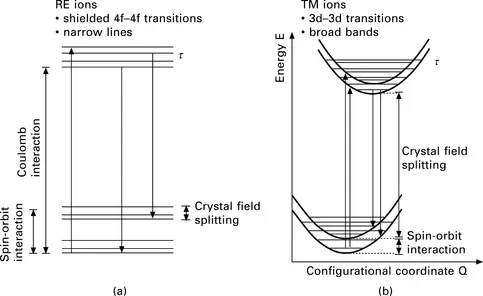
1.1 (a) Weak electron–phonon coupling of RE ions; (b) relatively strong electron–phonon coupling of TM ions described by theconfigurational coordinate model.
1.2.1 Transition metal ions
Beside Ti3+ the most important TM laser ion is chromium with its different valencies, i.e. Cr2+, Cr3+, and Cr4+. Cr3+:Al2O3 was the very first solid-state laser, developed by T. H. Maiman in 1960 (Maiman 1960), and Cr3+ doped into garnets like Gd3Sc2Ga3O12 (GSGG) was the first tunable TM ion laser in the deep red spectral range (Struve et al., 1983; Huber and Petermann 1985). The tuning range of all Cr3+ lasers is limited to about 100 nm, but the great advantage is that they can be pumped by diode lasers.
Due to the broader tuning range extending from about 680 nm to 1100 nm the Ti:Al2O3 laser has replaced the Cr3+ lasers and can be regarded as the most important tunable laser nowadays (Moulton 1985). Ti:sapphire lasers are typically pumped by frequency doubled Nd3+ lasers at 532 nm, but pumping by (Ga, In)N diode lasers will be possible in future, when diodes with sufficient cw-power are available. Presently the output power of green diode lasers is limited to about 50 mW (Avramescu et al. 2010). Tests with GaN diodes at 452 nm wavelength have already been performed, but the efficiency and stability were very low due to the creation of unknown parasitic losses (Roth et al. 2009).
For the near-to mid-infrared wavelength range between 1.9 μm and 3.4 μm Cr2+ is a suitable laser ion, if it is doped into various zinc-chalcogenides like ZnS or ZnSe (DeLoach et al. 1996). Presently, Cr2+:ZnSe is the most efficient TM laser system with more than 1 W output power and a slope efficiency of 73%, which is very close to the quantum limit of 77%. These excellent data are due to the tetrahedral coordination of the Cr2+ ion resulting in a huge emission cross-section of more than 10–18 cm2. Because of the wide tuning range of 1100 nm, Cr2+:ZnSe may be regarded as the ‘Ti:sapphire laser of the infrared’ (Sorokina 2004). However, a Cr2+:ZnO laser has not yet been developed because of the quite large ionic radius of the Cr2+ ion, which apparently prevents the diffusion of the ion into the host lattice. Here, other preparation techniques like layer growth by pulsed laser deposition (PLD) may be successful in future.
One interesting aspect of the Cr2+-doped chalcogenides is the fact that they could be pumped electrically, since they are semiconductors (Fedorov et al. 2007). Recently, the first electrically pumped Cr2+:ZnS waveguide laser was demonstrated (Vlasenko et al. 2009) and it can be expected that such laser structures will be realised in future al...
Table of contents
- Cover image
- Title page
- Table of Contents
- Copyright
- Contributor contact details
- Woodhead Publishing Series in Electronic and Optical Materials
- Foreword
- Preface
- Part I: Solid-state laser materials
- Part II: Solid-state laser systems and their applications
- Index
Trusted by 375,005 students
Access to over 1.5 million titles for a fair monthly price.
Study more efficiently using our study tools.
Frequently asked questions
Yes, you can cancel anytime from the Subscription tab in your account settings on the Perlego website. Your subscription will stay active until the end of your current billing period. Learn how to cancel your subscription
No, books cannot be downloaded as external files, such as PDFs, for use outside of Perlego. However, you can download books within the Perlego app for offline reading on mobile or tablet. Learn how to download books offline
Perlego offers two plans: Essential and Complete
- Essential is ideal for learners and professionals who enjoy exploring a wide range of subjects. Access the Essential Library with 800,000+ trusted titles and best-sellers across business, personal growth, and the humanities. Includes unlimited reading time and Standard Read Aloud voice.
- Complete: Perfect for advanced learners and researchers needing full, unrestricted access. Unlock 1.5M+ books across hundreds of subjects, including academic and specialized titles. The Complete Plan also includes advanced features like Premium Read Aloud and Research Assistant.
We are an online textbook subscription service, where you can get access to an entire online library for less than the price of a single book per month. With over 1.5 million books across 990+ topics, we’ve got you covered! Learn about our mission
Look out for the read-aloud symbol on your next book to see if you can listen to it. The read-aloud tool reads text aloud for you, highlighting the text as it is being read. You can pause it, speed it up and slow it down. Learn more about Read Aloud
Yes! You can use the Perlego app on both iOS and Android devices to read anytime, anywhere — even offline. Perfect for commutes or when you’re on the go.
Please note we cannot support devices running on iOS 13 and Android 7 or earlier. Learn more about using the app
Please note we cannot support devices running on iOS 13 and Android 7 or earlier. Learn more about using the app
Yes, you can access Handbook of Solid-State Lasers by B Denker,E Shklovsky in PDF and/or ePUB format, as well as other popular books in Technology & Engineering & Physical & Theoretical Chemistry. We have over 1.5 million books available in our catalogue for you to explore.