- 538 pages
- English
- ePUB (mobile friendly)
- Available on iOS & Android
eBook - ePub
About this book
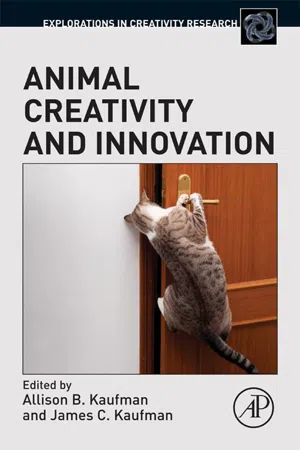
Animal Creativity and Innovation explores theories and research on animal innovation and creativity, comparing and contrasting it with theory and research on human creativity and innovation. In doing so, it encompasses findings from psychology, biology, neuroscience, engineering, business, ecology, and education. The book includes examples of animal innovation in parrots, dogs, marine mammals, insects, and primates, exploring parallels from creative play in children. The book defines creativity, differentiating it from play, and looks at evolutionary models and neurological constructs. The book further explores applied aspects of animal innovation and creativity including tool use and group dynamics, as well as barriers to creativity. The final chapters look into how creative behavior may be taught or trained. Each chapter is followed by a commentary for integration of thoughts and ideas between animal and human research, behavioral and cognitive research, and theory and observation in real life.
- Compares theory and research on animal and human creativity
- Defines and differentiates creativity from play
- Reviews applied creativity in tool use and social dynamics
- Includes examples of animal creativity in multiple species
Information
Topic
PsicologiaSubtopic
Psicologia sperimentalePart I
Evidences of Creativity
Outline
Chapter 1
Creativity and Innovation in the Grey Parrot (Psittacus erithacus)
Irene M. Pepperberg, Department of Psychology, Harvard University, Cambridge, MA, USA
Grey parrots are known to have communication skills roughly comparable to a 1.5–2 year old human child and the intellectual capacities of a 5–6 year old child, but little has been reported regarding other aspects of their cognitive and communicative abilities: in particular, creativity and innovation. This chapter thus centers on Grey parrot vocal and cognitive creativity and innovation: how these birds learn, adapt, and transfer their knowledge of speech and concepts across various cognitive domains.
Keywords
Avian cognition; avian vocal creativity; avian vocal innovation; segmentation; avian cognitive creativity; avian insight; avian cognitive innovation; Grey parrot cognition; Grey parrot vocal learning
Commentary on Chapter 1: What Can Creativity Researchers Learn from Grey Parrots?
Ronald A. Beghetto, Department of Educational Psychology, University of Connecticut, Mansfield, Storrs, CT, USA
Introduction
Creativity and innovation imply the capacity to form something that, in general, has never, in any way, previously existed. Such a definition is, however, at the extreme end of the continuum of the meaning of these terms, which can also be applied to describe the amalgamation of existing forms into something novel, to novel ways of using existent forms, or even of inferring novel solutions to problems based on circumstantial information. The terms can, of course, refer to behavior patterns in art, music, science, policy—any topic imaginable. The focus of this book, however, is on nonhuman creativity and innovation; thus this chapter describes these abilities in Grey parrots (Psittacus erithacus). The topics under consideration will involve both vocal and cognitive processes: novel combinations of human labels to describe novel items, issues of sound play, and aspects of insightful and inferential learning and behavior.
Creativity and Innovation in the Vocal Mode
Considerable data exist to demonstrate that Grey parrots use elements of English speech referentially (Pepperberg, 1999). The question has been raised, however, as to whether these birds can, like young children (e.g., de Boysson-Bardies, 1999; Greenfield, 1991; Marschark, Everhart, Martin, & West, 1987; Peperkamp, 2003; Tomasello, 2003; note Gillen, 2007), intentionally demonstrate creative or innovate use of such speech. Such examples may involve using or recombining existing utterances in novel ways to describe novel objects, engaging in sound play to create novel utterances that could relate to items in the environment, transferring of concepts across domains, and segmentation—the ability to divide and recombine parts of existing labels to create novel utterances for novel situations. Such examples may involve novel ways of replicating models, but primarily entail demonstrating some level of newness. Although the data are not extensive, several examples exist to demonstrate that at least one Grey parrot was capable of several of these forms of creativity and innovation.
Sound Play: Combinations, Recombinations, Simple Extensions in the Presence of Trainers
The bird in question, Alex, had been trained via a modeling procedure (M/R training, Pepperberg, 1981; Todt, 1975) to identify several objects, colors, shapes, and common foods. The amount of practice and creativity involved in acquisition of his initial labels is unknown, as his solitary sound play was not taped until a decade later (Pepperberg, Brese, & Harris, 1991). Early on, however, he produced novel utterances—utterances he had not heard from humans—in his trainers’ presence.
Some of these were quite simple combinations of existing labels, and were triggered by the presence of only slightly novel objects (Pepperberg, 1981). Thus, after being trained to use the labels “key,” “wood,” and “hide” to identify, respectively, a silvery key, uncolored tongue depressors and pieces of rawhide, and to combine these with the label “green” to refer to their colored counterparts, he was shown a green clothes pin. His label for clothes pins was “peg wood,” and he immediately stated “green wood, peg wood.” Similarly, after being trained on the label “rose hide” for red hide, he transferred to “rose paper” and then other red items without training. Green corks were also identified immediately, without training, as were blue hide and blue clothes pins after “blue” was acquired. The same was true after other color labels were learned. After training to label triangular and square pieces of maple as “3-corner wood” and “4-corner wood,” respectively, he promptly labeled their paper and rawhide counterparts, although he needed to chew the items first, to identify their material. He later similarly transferred other shape labels. After learning the label “rock” by repeatedly querying his trainers about a lava-stone beak conditioner, he began to call the dried corn kernels in his food “rock corn,” presumably to differentiate it from the fresh, soft variety he was also fed. He used “rock nut” to refer to a Brazil nut that he could not crack on his own, but his lack of sustained interest in the item led to the disappearance of the utterance. He labeled an unshelled almond “cork,” possibly because the shell looked like one, but accepted our term “cork nut” to distinguish between the two objects (Pepperberg, 1990). Other examples of labels that were initially applied to objects of little interest and did not remain in his repertoire are discussed in Pepperberg (1990).
In a similar vein, other parrots in my laboratory creatively and spontaneously extended the use of labels trained with respect to specific exemplars to additional items. Thus my birds, somewhat like children (e.g., Brown, 1973), tested meanings of newly acquired labels; possibly they saw humans as a means of providing additional referential information (Pepperberg, 2002). For example, a younger subject, Arthur, in ways similar to Alex, uttered one of his newly acquired labels, used previously in a very specific context, in a novel situation—here, “wool,” trained as a label for a woolen pompon, subsequently uttered while pulling at a trainer’s sweater. He seemed to be testing the situation, and our responses—“Yes, WOOL!” given with high positive affect—stimulated him further, revealing the potential power of an utterance and encouraging his early categorization attempts. Notably, such behavior was not trained in any direct manner.
Creativity with other labels seemed to involve more complicated processes. At one point, we tried to train Alex to identify an apple; at the time, he knew “banana,” “grape,” and “cherry” for the other fruits he was fed. After undergoing considerable training via our modeling procedure, Alex ignored the targeted label and said “Banerry…I want banerry.” He not only repeatedly used this term, but also slowed production and sharpened his elocution (“ban-err-eee”), much as trainers do when introducing a new label (Pepperberg, 1990). No one had ever used the term in his presence, but it did make some semantic sense, apples tasting a bit like a banana and looking like a very large cherry.
Alex also often produced new vocalizations in what appeared to be vocal play by recombining other existing label parts in their corresponding orders (Pepperberg, 1990). His spontaneous novel phonemic combinations would occur outside of testing or training, appearing in contexts and forms reminiscent of children’s play (NB: other juvenile Greys behave similarly; reviewed in Pepperberg, 2004a; see also Pepperberg & Shive, 2001). These utterances were rarely if ever used by trainers, but sometimes resembled both existing labels and separate human vocalizations. Notably, these recombinations suggest that Alex, somewhat like children (see Weir, 1962; note discussion in Treiman, 1985), abstracted rules for utterances’ beginnings and endings. In over 22,000 vocalizations, he never made backward combinations (e.g., never said “percup” instead of “cupper/copper”; Pepperberg et al., 1991). When we referentially mapped these spontaneous utterances—providing relevant objects to which they could refer—Alex rapidly integrated these labels into his repertoire. He acquired “grey,” for example, after seeing himself in a mirror and querying “What color?”; he then produced sound variants (e.g., “grape,” “grate,” “grain,” “chain,” “cane”) that we mapped to appropriate referents (respectively, fruit, a nutmeg grater, seeds, a paper-clip ring, sugar cane; see Pepperberg, 1990, 1999). With the exception of “grape,” which trainers had consistently labeled, these labels had never been produced in his presence. He promptly began to use them consistently to refer to the items. In contrast, he abandoned sounds whose combinations we could not map (e.g., “shane,” “cheenut”), or for which mapped referents were not of interest (e.g., the dried banana chips we used for “banacker”; Pepperberg, 1990). Thus, Alex’s spontaneous utterances that may initially have lacked communicative, symbolic value could, as they do for children, acquire this value if caretakers interpreted them as such (Pepperberg, 1990): that is, although his initial combinations could have simply been “babble-luck” (Thorndike, 1943), he behaved as if our interactions “conventionalized” both the sound patterns and sound-meaning connections in the direction of standard communication. Likely, after the first such instance, the excitement of the trainers and the introduction of a novel item may have impelled Alex to attempt more innovative vocal play.
Alex created very few action-related phrases, but the few he did form bear mentioning. To fashion most action-related variants, Alex excerpted part of a standard phrase, which he then used as a request; just as in referential mapping for labels, trainers responded as though he had made an intentional demand (Pepperberg, 1990). Thus, during a long training session, Alex uttered “go chair”—a portion of the (by then) commonplace phrase “wanna go chair” (see the section “Novel Combinations in the Service of Vocal Learning”). The trainer sat, temporarily discontinuing the session. Alex subsequently used this utterance to call a halt to whatever was happening. He also excerpted “go away,” which he used to break contact with trainers. This phrase was closely related to two situations in which it was first routinely used in his presence. The first situation occurred when he refused to comply with our requests for object labeling: he routinely said “no,” turned or walked away, and began to preen. We responded with a brief time-out, accompanied by the phrase “I’m gonna go away!” He subsequently asked (“go away”) that the trainer depart. The second situation involved scheduled departures of trainers (e.g., at lunch or the end of the day). At those times, we added “I’m gonna go eat lunch/dinner,” and placed Alex inside his cage. Interestingly, during long or difficult sessions, Alex began to request students to “go away,” or occasionally stated “I’m gonna go away,” after which he climbed off his training chair. Generally, attempts to continue training after such a declaration were fruitless.
Novel Combinations in the Service of Vocal Learning
My students and I had, by eavesdropping, found that Alex sometimes engaged in monologue speech in the absence of his trainers (Pepperberg & Matias, unpublished observations), seemingly playing with the sounds in his repertoire while he was in the process of acquiring new labels, as though he was practicing in private before attempting the labels in public. Note that Alex always experienced negative consequences for erring in his trainers’ presence: trainers scolded him and removed training objects from sight. Such negative events did not occur during his private monolo...
Table of contents
- Cover image
- Title page
- Table of Contents
- Copyright
- Dedication
- List of Contributors
- Foreword
- Acknowledgments
- Part I: Evidences of Creativity
- Part II: Requirements for Creativity
- Part III: The Struggle for Creativity
- Part IV: Pushing the Boundaries of Creativity
- Index
Trusted by 375,005 students
Access to over 1.5 million titles for a fair monthly price.
Study more efficiently using our study tools.
Frequently asked questions
Yes, you can cancel anytime from the Subscription tab in your account settings on the Perlego website. Your subscription will stay active until the end of your current billing period. Learn how to cancel your subscription
No, books cannot be downloaded as external files, such as PDFs, for use outside of Perlego. However, you can download books within the Perlego app for offline reading on mobile or tablet. Learn how to download books offline
We are an online textbook subscription service, where you can get access to an entire online library for less than the price of a single book per month. With over 1.5 million books across 990+ topics, we’ve got you covered! Learn about our mission
Look out for the read-aloud symbol on your next book to see if you can listen to it. The read-aloud tool reads text aloud for you, highlighting the text as it is being read. You can pause it, speed it up and slow it down. Learn more about Read Aloud
Yes! You can use the Perlego app on both iOS and Android devices to read anytime, anywhere — even offline. Perfect for commutes or when you’re on the go.
Please note we cannot support devices running on iOS 13 and Android 7 or earlier. Learn more about using the app
Please note we cannot support devices running on iOS 13 and Android 7 or earlier. Learn more about using the app
Yes, you can access Animal Creativity and Innovation by in PDF and/or ePUB format, as well as other popular books in Psicologia & Psicologia sperimentale. We have over 1.5 million books available in our catalogue for you to explore.