eBook - ePub
Volcanic Ash
Hazard Observation
- 300 pages
- English
- ePUB (mobile friendly)
- Available on iOS & Android
eBook - ePub
About this book
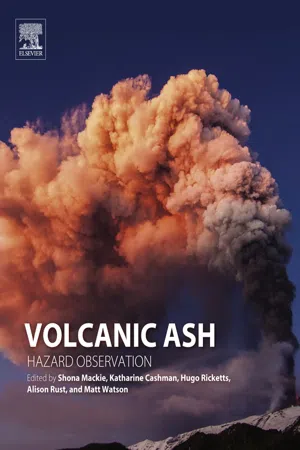
Volcanic Ash: Hazard Observation presents an introduction followed by four sections, each on a separate topic and each containing chapters from an internationally renowned pool of authors. The introduction provides a volcanological context for ash generation that sets the stage for the development and interpretation of techniques presented in subsequent sections.
The book begins with an examination of the methods to characterize ash deposits on the ground, as ash deposits on the ground have generally experienced some atmospheric transport. This section will also cover basic information on ash morphology, density, and refractive index, all parameters required to understand and analyze assumptions made for both in situ measurements and remote sensing ash inversion techniques. Sections two, three, and four focus on methods for observing volcanic ash in the atmosphere using ground-based, airborne, and spaceborne instruments respectively.
Throughout the book, the editors showcase not only the interdisciplinary nature of the volcanic ash problem, but also the challenges and rewards of interdisciplinary endeavors. Additionally, by bringing together a broad perspective on volcanic ash studies, the book not only ties together ground-, air-, academic, and applied approaches to the volcanic ash problem, but also engages with other scientific communities interested in particulate transport.
- Includes recent case studies highlighting the impact of volcanic ash, making methods used for observation more accessible to the reader
- Contains advances in volcanic ash observation that can be used in other remote sensing applications
- Presents a cross-disciplinary approach that includes not only methods of tracking and measuring ash in the atmosphere, but also of the fundamental science that supports methodological application and interpretation
- Edited by an internationally recognized team with a range of expertise within the field of volcanic ash
Trusted by 375,005 students
Access to over 1 million titles for a fair monthly price.
Study more efficiently using our study tools.
Information
Topic
Physical SciencesSubtopic
Meteorology & ClimatologyPart 1
Introduction
Introduction
S. Mackie1
K. Cashman1
H. Ricketts2
A. Rust1
I.M. Watson1
1School of Earth Sciences, University of Bristol, Bristol, United Kingdom 2National Centre for Atmospheric Science, University of Manchester, Manchester, United Kingdom
Photograph of the eruption of Sarychev Peak in 2009, taken from the International Space Station. Image courtesy of NASA.
1. Volcanic Ash: Hazard Observation
Airborne volcanic ash presents a well-publicized risk to aviation, health, and agriculture; for this reason, an important goal of volcano science relates to volcanic ash, including both its transport through the air during volcanic crises and its ultimate distribution over the ground and sea. The state of the science has advanced rapidly in the years since 2010, in large part because of interest generated by the high economic cost of the Eyjafjallajökull eruption in Iceland in that year and the disruption it caused to aviation and aviation-dependent industries. Specifically, the eruption prompted a rapid change in the management of risk to aviation from volcanic ash clouds, precipitated by the use of safety thresholds for flight. Since that eruption, there has been a drive to improve volcanic ash detection and forecasting techniques (Watson, 2015) that allow Volcanic Ash Advisory Centers (VAACs) to issue the most relevant advice to aviation authorities. These management needs have highlighted the extent to which complementary expertise from different fields needs to be combined, both to reduce duplication of effort and to advance ash studies in all fields.
Here, we aim to advance volcanic ash studies by providing an overview of current understanding and methods used for observing and monitoring ash, both while it is in the air and once it is on the ground. We start with a review of volcanic ash itself: where it has come from, and what governs its physical and chemical properties during transport through the atmosphere and deposition on the ground (Part 2). We then review state-of-the-art techniques for data collection, interpretation, and modeling from the perspectives of ash deposition on the ground (Part 3) and in situ ash sampling in the air (Part 4), followed by remote sensing from ground-based (Part 5) and satellite-based (Part 6) platforms. We conclude by summarizing the strengths and limitations of all approaches, and by highlighting the most pressing knowledge gaps in volcanic ash studies. Surprisingly, there are only a handful of eruptions for which ash deposition is sufficiently well characterized to test ways of correlating ash deposits on the ground with estimates of ash in the air. For this reason, these eruptions—of Mount St. Helens, USA, in 1980; of Mount Spurr, USA, in 1992; and of Eyjafjallajökull, Iceland, in 2010—form a common basis for study and for tuning models and algorithms. The strength of this approach is that multiple approaches are brought to bear on the same eruptions; the danger, however, is that tuning to a few events could reduce flexibility in our response to the next ash crisis.
Studies of ash on the ground are not new, and they provide the fundamental observations that underpin our understanding of explosive volcanic eruptions (Part 2). Since the 1970s, the spatial variations of ash (and tephra) thickness, mass, grain size, and components have been documented for numerous eruptions, both observed and ancient. These data can be used to constrain the eruption magnitude (erupted mass), intensity (mass eruption rate), and eruption “style,” as well as to address underlying controls on eruptive behavior. Understanding controls on eruption style is important not only for anticipating volcanic hazards, but also for choosing input parameters (ESPs, or eruption source parameters) for both ash dispersion models and remote sensing ash retrieval algorithms. Most critically, eruptions vary substantially in the size distributions of the particles that they inject into volcanic plumes, as well as in the shapes and densities of those particles. Additionally, ground based studies of ash deposits, which record conditions of ash sedimentation from volcanic plumes, show systematic changes in ash properties with transport distance.
After, and sometimes during, an eruption, it is possible to collect and study ash that has been transported through the air before deposition on the ground and in the oceans. Data from these deposits can provide valuable insights into the likely properties of the parts of the plume that remained aloft, particularly when examined within a temporal and spatial framework that identifies ash properties characteristic of long atmospheric residence times. There are great advantages to investigating ash properties by examining real samples rather than inferring properties from indirectly measured quantities (as remote sensing methods must do), and it is generally more straightforward to collect samples of deposited ash than samples of airborne ash. Part 3 of this book focuses on methods for observing ash deposits and the techniques by which eruption parameters and ash sedimentation properties can be inferred from these observations.
Perhaps the most fundamental property of a volcanic eruption is its magnitude, a characteristic that is surprisingly difficult to measure for explosive eruptions, particularly for past eruptions (Chapter 1). Accurate mass measurements are also problematic for modern eruptions, however, particularly where ash deposits are thin, when wind directions and velocities are highly variable, or when much of the ash load is deposited in the ocean. Critically, Chapter 1 also reviews the limits of ground-based deposit characterization, particularly the preservation of deposit thickness (mass) over time and the likely errors in mass estimates of distal (far-traveled) ash abundance derived from field measurements. Also important for relating ash on the ground to ash in the air are spatial and temporal variations in tephra deposits, as these variations are intimately linked to changing conditions in the transporting volcanic cloud. In general, deposit mass decreases systematically away from the vent, with larger, faster particles settling before smaller, slower particles. Importantly, new developments in 3-D imaging and high-speed photography are providing critical data that can be used to relate particle shape to measured fall velocities; these data can then be used to develop and test models of particle sedimentation behavior (Chapter 2). Not all ash particles settle singly, however; instead, small ash particles are likely to sediment as aggregates of widely varying form, size, and density (Chapter 3). Chapter 3 also introduces possible interactions between volcanic clouds and meteorology, particularly conditions of hydrometeor formation in wet volcanic plumes. From the perspective of ash hazards, the most disruptive volcanic eruptions are those that produce plumes that are laden with very small ash particles (“fine ash”). Particularly important from this perspective are eruptions where primary ash generating mechanisms are enhanced by secondary processes, such as those that act in pyroclastic density currents (PDCs; Chapter 4). Volcanic clouds (and resulting deposits) produced by these eruptions integrate small ash particles from two different sources: primary ash formed at the volcanic vent and secondary ash formed by processes acting within pyroclastic density currents. Interestingly, these deposits are often characterized by regions of secondary thickness maxima, commonly at hundreds of kilometers from the volcanic vent.
The only means of directly measuring some properties of airborne ash is in situ sampling, which can be carried out by manned aircraft, balloons, or powered unmanned aerial vehicles. The instrumentation that can be used to make these measurements and the challenges associated with their deployment are presented in Part 4. Recent eruptions in Iceland, have prompted new attempts to measure ash within volcanic plumes using optical particle counters with manned aircraft, although this approach is clearly limited to parts of the plume that have ash concentrations that are sufficiently dilute to not badly damage plane engines (Chapter 5). The use of manned aircraft is typically only sanctioned in extremis, due to the inherent risks of flying through ash. An alternative approach is to use meteorological balloons for both measurements of electrostatic properties (Chapter 6) and where they have also been deployed with optical particle counters for measurement of both liquid phase aerosol and particulates within volcanic plumes (Chapter 7).
In situ sampling can provide very accurate data on volcanic ash properties, but this is not always possible, due to cost or practical considerations. Remote sensing, as the name suggests, allows the volcanic ash to be measured from a distant location, either while it is close to the volcano or many kilometers away. Ground-based instrumentation can provide detailed remote sensing observations of ash as it passes over strategic locations. [Repetition and wrong use of ‘Ground-based instrumentation’] Remote sensing instruments can also be fitted to an aircraft and therefore measurements can be made over more targeted locations. Part 5 discusses the different instruments and techniques used for inferring ash properties from the ground and the air. Most commonly used are radar and lidar systems. Importantly, while both techniques analyze the scattering of electromagnetic waves by volcanic ash particles, they can provide different, and complementary, information. Radar is most sensitive to large particles and can penetrate an optically thick plume close to the source (Chapter 8). Lidar systems, in contrast, rely on light and are therefore most useful for optically thin plumes, such as those typically observed far from the source (Chapter 9). UV and IR techniques are also employed for ground-based volcano monitoring, although until 2008, UV systems were tuned exclusively to measure gas species in volcanic plumes, particularly SO2, and IR systems were used primarily for satellite-based ash monitoring. Chapter 10 reviews the challenges of using these techniques from the ground, and for the purpose of detecting and quantifying ash loads and properties.
The final section in this book (Part 6) presents an overview of the instruments and methods used to observe and monitor airborne ash from space. No other observation method provides the spatial coverage offered by satellite observations, which have the additional advantage that the instruments are already “in place,” meaning that observations are available for the full duration of an eruption and lifetime of the ash in the atmosphere, including the onset. In this section, the different instrumentation and associated sensitivities are discussed, infrared observations from both broad and hyperspectral sensors are presented, and different methods for interpreting the data are explained and discussed in terms of the uncertainties associated with each data stream and with the different methods of interpretation. (Chapter 11). Although not available at nighttime, UV observations are also valuable for ash monitoring, since they are subject to different uncertainties and can therefore sometimes provide useful data where infrared measurements are too uncertain to be useful (Chapter 12). Lastly, this section of the book examines the use of satellite-derived information about the likely properties of an ash plume to aid ash forecasting, either by validating the dispersion models used for predicting ash transport and evolution or by constraining those models to ensure that they are based on a reasonable picture of reality (Chapter 13). Different approaches to these problems are presented and discussed with reference to the uncertainties associated with both dispersion models and observation data. These uncertainties are key to determining the appropriate use of satellite-deriv...
Table of contents
- Cover image
- Title page
- Table of Contents
- Copyright
- List of Contributors
- Part 1. Introduction
- Part 2. Volcanic Ash: Generation and Spatial Variations
- Part 3. Observations of Ash on the Ground
- Part 4. Observations of Ash in the Air
- Part 5. Aircraft and Ground-Based Remote Sensing of Ash
- Part 6. Observing Airborne Ash From Space
- Part 7. Conclusions and Future Directions
- References
- Index
Frequently asked questions
Yes, you can cancel anytime from the Subscription tab in your account settings on the Perlego website. Your subscription will stay active until the end of your current billing period. Learn how to cancel your subscription
No, books cannot be downloaded as external files, such as PDFs, for use outside of Perlego. However, you can download books within the Perlego app for offline reading on mobile or tablet. Learn how to download books offline
Perlego offers two plans: Essential and Complete
- Essential is ideal for learners and professionals who enjoy exploring a wide range of subjects. Access the Essential Library with 800,000+ trusted titles and best-sellers across business, personal growth, and the humanities. Includes unlimited reading time and Standard Read Aloud voice.
- Complete: Perfect for advanced learners and researchers needing full, unrestricted access. Unlock 1.4M+ books across hundreds of subjects, including academic and specialized titles. The Complete Plan also includes advanced features like Premium Read Aloud and Research Assistant.
We are an online textbook subscription service, where you can get access to an entire online library for less than the price of a single book per month. With over 1 million books across 990+ topics, we’ve got you covered! Learn about our mission
Look out for the read-aloud symbol on your next book to see if you can listen to it. The read-aloud tool reads text aloud for you, highlighting the text as it is being read. You can pause it, speed it up and slow it down. Learn more about Read Aloud
Yes! You can use the Perlego app on both iOS and Android devices to read anytime, anywhere — even offline. Perfect for commutes or when you’re on the go.
Please note we cannot support devices running on iOS 13 and Android 7 or earlier. Learn more about using the app
Please note we cannot support devices running on iOS 13 and Android 7 or earlier. Learn more about using the app
Yes, you can access Volcanic Ash by Shona Mackie,Katharine Cashman,Hugo Ricketts,Alison Rust,Matt Watson in PDF and/or ePUB format, as well as other popular books in Physical Sciences & Meteorology & Climatology. We have over one million books available in our catalogue for you to explore.