eBook - ePub
Bioengineering for Surgery
The Critical Engineer Surgeon Interface
- 238 pages
- English
- ePUB (mobile friendly)
- Available on iOS & Android
eBook - ePub
About this book
Bioengineering is the application of engineering principles to address challenges in the fields of biology and medicine encompassing the principles of engineering design to the full spectrum of living systems. In surgery, recent advances in minimal invasive surgery and robotics are the culmination of the work that both engineers and surgeons have achieved in the medical field through an exciting and challenging interface. This interface rests on the medical curiosity and engineering solutions that lead eventually to collaboration and development of new ideas and technologies. Most recently, innovation by surgeons has become a fundamental contribution to medical research in the surgical field, and it is through effective communication between surgeons and biomedical engineers and promoting collaborative initiatives that translational research is possible. Bioengineering for Surgery explores this interface between surgeons and engineers and how it leads to innovation processes, providing clinical results, fundraising and prestige for the academic institution. This book is designed to teach students how engineers can fit in with their intended environment and what type of materials and design considerations must be taken into account in regards to medical ideas.
- Introduces engineers to basic medical knowledge
- Provides surgeons and medical professionals with basic engineering principles that are necessary to meet the surgeons' needs
Information
Chapter 1
Interface between Engineering and Medicine
Thomas Looi Centre for Image Guided Innovation and Therapeutic Intervention, Hospital for Sick Children, Toronto, ON, Canada
Abstract
Biomedical is a unique field of engineering that combines traditional engineering knowledge with biological/medical applications. With medicine becoming more complex and specialized, engineering helps to create new diagnostic and interventional devices. However, there is a challenge in developing novel applications because the fields of medicine and engineering are quite different, and have their own jargon and culture. To address this gap, this chapter applies the concept of “systems engineering” as a technique to facilitate the synthesis of engineering and medical knowledge. In this chapter, to support the use of systems engineering, concepts such as requirement definitions, functional block diagrams, mechanical systems design, electrical systems design, and control/software systems design are introduced.
Keywords
Control systems and software systems; Electrical systems; Functional block diagrams; Mechanical systems; Requirements; Systems engineering1.1. Introduction to Systems Engineering
1.1.1. Medicine and Engineering: Bridging the Divide
Biomedical engineering is the application of engineering principles to the field of biology and medicine. When compared with other traditional fields of engineering, such as mechanical and electrical engineering, biomedical engineering is relatively young and sometimes considered a subspecialization of the broader specialties. However, biomedical engineering is unique because it attempts to develop technology for the medical area that has often been seen as distinct and unrelated to engineering. Historically, medicine and engineering were considered to be at the opposite ends of the education spectrum because one deals with the human body and life sciences, whereas the other is involved in the study of math and physical sciences. The education system has also reinforced this ideology because university applicants to either program do not necessarily overlap in their course work and preparation.
However, as medical knowledge becomes increasingly more broad and complex, engineering can play a role in assisting and augmenting the capabilities of a physician to be more precise and accurate. In addition, advances in mechanical, chemical, electrical, and information technology have created new devices and sensors that provide new insight into biological systems previously not available. Medical imaging is a perfect example of how physics and electrical engineering have revolutionized the field of radiology. Ultrasound, computed tomography, and magnetic resonance imaging (MRI) enable physicians to look inside the body without needing to make an incision. Imaging-processing software is able to highlight and select vital anatomical structures and provides a three-dimensional model of the pathology. These tools have enabled physicians to provide early diagnosis and/or guidance when attempting to treat a specific diseased area.
These technological advances and innovations have reached across clinical spectra from inside the operating room, where one can find image-guided systems, surgical navigational systems, and surgical robotics, to the patient side, with advanced ventilators and infusion pumps. This includes not only clinical care, but also medical education, training, and teaching. Staff members are able to use simulators to augment and enhance their educational experience to create better future physicians without the ethical concerns of training on a patient. With this rapid infusion of technology into the clinical space, biomedical engineering serves to fill this gap between two previously separate and unique professions.
As devices become more complex and medicine is more personalized and unique, this creates a challenging environment to develop new solutions in medicine. For example, early ventilators were simple pumps that circulated air while removing carbon dioxide. However, modern ventilators contain many additional functions and parameters where a physician can monitor numerous parameters that can include peak lung pressure, flow resistance, in-tidal volume, and respiratory rate. This allows the physician to precisely tailor the ventilation parameters to meet a patient's condition. In some cases, the number of parameters is overwhelming and more complex than required. Devices can be “overengineered” because there are more controls and inputs available than needed to accomplish the treatment. To create effective clinical solutions, there must be a common ground and terminology to bridge the differences in the two professions' language and culture. In engineering, modeling, data gathering/analysis, and quantification form some of the base tenets of the profession. In medicine, understanding complex biological interactions of the human body is a core element. As such, the first challenge is develop a common ground: an interface in which clinicians can provide problems and feedback to engineers developing the solution.
1.1.2. Systems Engineering: A Common Platform
Even though biomedical engineering and medicine come from different environments and cultures, they share a common goal: developing better clinical solutions. For the successful development of a clinical tool, a common platform that provides an interface and terminology baseline to facilitate accurate and timely feedback between the physician and engineer is required. For simple projects, the stakeholders could be the clinicians and engineers. For more complex projects or treatments, the stakeholders could be expanded across the health care continuum to include other medical specialties, including nursing, pharmacy, and even the patient. For example, the development of an MRI-guided device could involve a team consisting of staff members from surgery, radiology, anesthesia, and nursing because the equipment uses knowledge from different areas to accomplish its goal. To help with this coordination, the focus of this section is the concept of systems engineering.
By definition, systems engineering is defined as “interdisciplinary field of engineering that focuses on how to design and manage complex engineering systems over their life cycles.” Complex systems can range from the development of vehicles (cars, ships, and airplanes) to manufacturing and power plants. These systems are often composed of smaller specialized elements. For example, an airplane consists of wings, fuselage, avionics, and engines in which each of the elements are combined to create the functionality of the plane. Hence, the role of systems engineering is to focus on the project as a system rather than as individual elements. As such, the concept of systems engineering is not necessarily new because it is a common methodology that solves complex engineering problems, but its application in medicine is novel. For the purpose of medical technology, systems engineering is an ideal approach because clinicians have a medical function that may not be solved by one technology but rather a set of technologies that performs the desired function. Because the systems engineer is involved in ensuring overall functionality, it is often seen as a centerpiece of engineering that he or she will interact with the engineering specialties to determine system feasibility (Figure 1.1). The engineer must maintain sufficient competency in various areas to have an understanding of how each of the components will affect the resulting performance. Commonly, the systems engineer is referred to as the “jack of all trades” because of the multidisciplinary role.
The definition of system is quite varied, but a common element is that it focuses on the whole entity, for example: “A system is a construct or collection of different elements that together produce results not obtainable by the elements alone. The elements, or parts, can include people, hardware, software, facilities, policies, and documents; that is, all things required to produce systems-level results. The results include system-level qualities, properties, characteristics, functions, behavior and performance. The value added by the system as a whole, beyond that contributed independently by the parts, is primarily created by the relationship among the parts; that is, how they are interconnected.” Using this definition, one can identify a variety of systems within the clinical setting. For example, an MRI device is a complex system composed of electromagnets, liquid helium cooling, control electronics, and computer console. On a smaller scale, an endoscope is an imaging system consisting of a lighting unit, camera control unit, and scope. Individually, each of the parts performs a specific function that contributes to fulfilling a feature required for the larger entity to accomplish its tasks. Using an endoscope as an example, the lighting unit provides ambient light through a fiber optic cable to the scope tip for illuminating the target area, the camera control unit interacts with the imaging sensor, and the scope provides the delivery mechanism to the target. When developing clinical solutions, it is important to look at the problem as a system to see what and how it interacts with its environment. Once the general level system is defined, it can be further defined into smaller subsystems for in-depth analysis and design. For biomedical engineering, the concept of systems engineering is a natural step to understanding complex clinical systems as a means to see where and how they interact with biological systems since the biological environment not be straightforward.
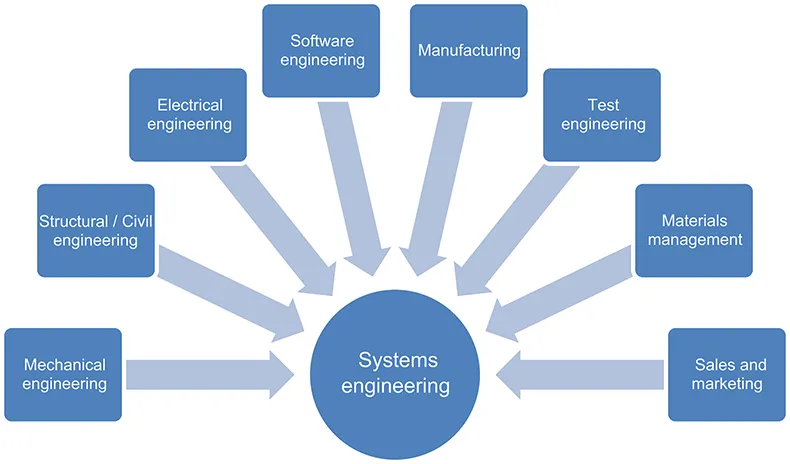
Figure 1.1 Role of a systems engineer.
The process of systems engineering is commonly referred to as a “V-model or circular process with gate checks” in which the engineer starts with a conceptual discussion with the end-user and results in a finished product (Figure 1.2). As the project progresses, each step represents an increasing level of detail and implementation. Once implementation is complete, the project moves back toward from the high-level concept and operations where the goal is to test, verify, and validate the actual hardware/software. After verification and validation, the system is delivered to the customer and the role of the systems engineer shifts to an “operations and maintenance” mode in which the engineer will support end-user operations. Throughout this “V-model,” there is an iterative process in each step between the end-user and engineer to ensure the correct requirements and definitions are met. Initial concepts and operational procedures may have been generated with a limited knowledge of the technological limitations leading to a set of requirements that are not achievable. Naturally, the less iteration, the faster and less costly a project becomes as changes later in the implementation would require changes traveling upwards toward the concept. These upward changes to the requirements may sound minor, but can cause a performance shift in other subsystems. For example, if one is designing a light source for an endoscope and realizes that a brighter bulb is needed, this could impact the overall power required and heat dissipated by the endoscope, which could result in changes to the electrical and cooling systems. Thus, it is important to recognize that a system needs to be clearly defined upfront with as much detail as possible to avoid costly changes and performance impacts to budget, schedule, and feasibility.
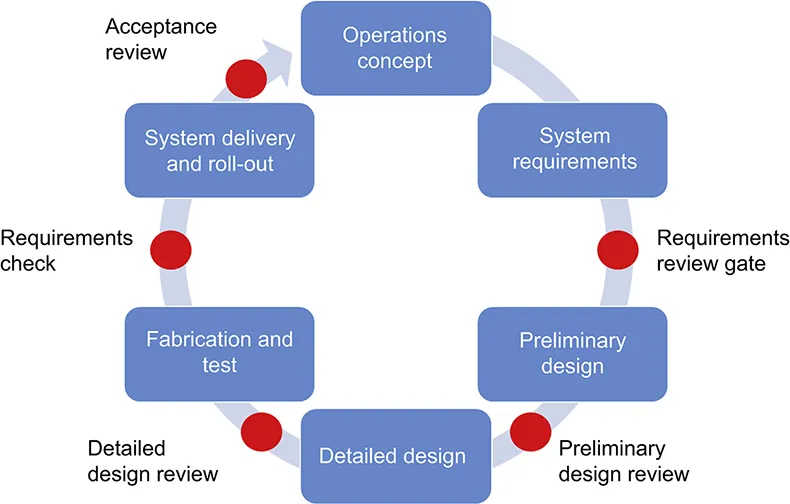
Figure 1.2 Systems engineering process.
To properly describe a system, the initial step is to develop a set of requirements: a goal, term, or performance objective that a solution must meet to be successful. These requirements will dictate what and how a system should perform. The list may include both quantitative and qualitative measurements, but one needs to be careful when using qualitative requirements because this could vary from one user to another. Figure 1.3 is an example of the performance requirements for KidsArm, an autonomous image-guided anastomosis robot. Initially, this may seem like a very simple task, but if the requirements are not quantifiable, the process can prove to be quite challenging because an engineer will not be able to design a mechanism or actuator without a target value. For example, in the design of a data acquisition system to record samples, there could be a requirement that the sampling frequency must be 60 samples per second to properly record the physical phenomenon. Yet, when this is applied to medicine, biological interactions may not be quantified as clearly. This is not the fault of medical research, but rather because of the complexity and heterogeneity of the underlying biology in which behavior is not typically straightforward. For example, if one is to design a tool to retract tissue and take a ...
Table of contents
- Cover image
- Title page
- Table of Contents
- Copyright
- About the Editors
- About the Authors
- Preface
- Acknowledgments
- Chapter 1. Interface between Engineering and Medicine
- Chapter 2. Clinical Translation and Commercialization
- Chapter 3. Image Fusion and Visualization
- Chapter 4. Image-Guided Procedures: Tools, Techniques, and Clinical Applications
- Chapter 5. Surgical Robotic Tools
- Chapter 6. Simulation in Minimal Access Surgery
- Chapter 7. A Simulation Hospital as a Model of Immersive-Based Learning: The Concept and Challenges
- Chapter 8. Virtual Simulation: Abdomen
- Chapter 9. Application of 3D Printing in Medical Simulation and Education
- Chapter 10. Simulation Surgical Models: Surgeon Perspectives
- Chapter 11. Bioengineering and Regenerative Medicine in Surgery
- Concluding Remarks
- Index
Trusted by 375,005 students
Access to over 1.5 million titles for a fair monthly price.
Study more efficiently using our study tools.
Frequently asked questions
Yes, you can cancel anytime from the Subscription tab in your account settings on the Perlego website. Your subscription will stay active until the end of your current billing period. Learn how to cancel your subscription
No, books cannot be downloaded as external files, such as PDFs, for use outside of Perlego. However, you can download books within the Perlego app for offline reading on mobile or tablet. Learn how to download books offline
Perlego offers two plans: Essential and Complete
- Essential is ideal for learners and professionals who enjoy exploring a wide range of subjects. Access the Essential Library with 800,000+ trusted titles and best-sellers across business, personal growth, and the humanities. Includes unlimited reading time and Standard Read Aloud voice.
- Complete: Perfect for advanced learners and researchers needing full, unrestricted access. Unlock 1.5M+ books across hundreds of subjects, including academic and specialized titles. The Complete Plan also includes advanced features like Premium Read Aloud and Research Assistant.
We are an online textbook subscription service, where you can get access to an entire online library for less than the price of a single book per month. With over 1.5 million books across 990+ topics, we’ve got you covered! Learn about our mission
Look out for the read-aloud symbol on your next book to see if you can listen to it. The read-aloud tool reads text aloud for you, highlighting the text as it is being read. You can pause it, speed it up and slow it down. Learn more about Read Aloud
Yes! You can use the Perlego app on both iOS and Android devices to read anytime, anywhere — even offline. Perfect for commutes or when you’re on the go.
Please note we cannot support devices running on iOS 13 and Android 7 or earlier. Learn more about using the app
Please note we cannot support devices running on iOS 13 and Android 7 or earlier. Learn more about using the app
Yes, you can access Bioengineering for Surgery by Walid Farhat,James Drake in PDF and/or ePUB format, as well as other popular books in Biological Sciences & Biotechnology. We have over 1.5 million books available in our catalogue for you to explore.