- 220 pages
- English
- ePUB (mobile friendly)
- Available on iOS & Android
eBook - ePub
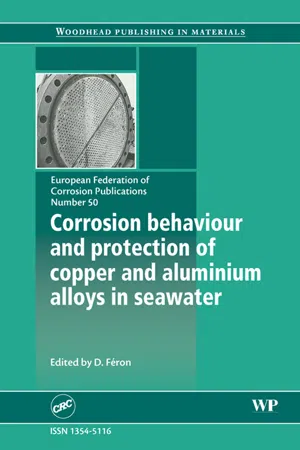
Corrosion Behaviour and Protection of Copper and Aluminium Alloys in Seawater
About this book
Copper and aluminium alloys are widely used in marine engineering in areas such as pipelines, storage tanks, ships' hulls and cladding for offshore structures. This important book reviews key factors affecting the corrosion and service life of these materials in the marine environment. The book is divided into five parts, with part one reviewing key aspects of the corrosion behaviour of both these alloys. Part two discusses the use of copper and copper-nickel alloys in seawater, whilst Parts 3 and 4 cover aluminium bronzes and alloys. The final section of the book covers the use of aluminium-based materials as anodes for the cathodic protection of marine structures.Corrosion behaviour and protection of copper and aluminium alloys in seawater is an important reference for marine engineers concerned with the corrosion and service life of these materials.
- Reviews key factors affecting the corrosion and service life of copper and aluminium alloys
- Discusses the use of the alloys in seawater
Information
Part I
Overview of copper and aluminium alloys
1
Corrosion behaviour of non-ferrous alloys in seawater in the Polish marine industry
JERZY BIRN and IGOR SKALSKI, Ship Design and Research Centre, Poland
Publisher Summary
This chapter mentions that copper, aluminum, and titanium alloys are the most important of the alloys belonging to the group of non-ferrous metals generally used in marine engineering. The chapter focuses on the corrosion behavior of copper and aluminum alloys. Copper alloys are mainly used for pipelines, heat exchangers, screw propellers, valves, gate valves, clad plates for steel hulls of small ships, clad plates for drilling rigs’ splash zones, etc. Aluminum alloys are used for hulls of fast ships and superstructures of other ships to improve their stability, for construction of Liquefied Natural Gas (LNG) cargo tanks and also for construction of yachts, sport boats, police boats, etc. The chapter considers aluminum and tin brasses, cupro–nickels 90/10 and 70/30, aluminum–nickel, tin, and silicon bronzes, as well as the Al–Mg and Al–Mg–Zn aluminum alloys. It discusses several kinds of corrosion and the main causes of their occurrence and presents the problems of modeling corrosion processes on aluminum and copper alloys and to the long-term prediction of life for these alloys.
1.1 Introduction
Copper, aluminium and titanium alloys are the most important of the alloys belonging to the group of non-ferrous metals generally used in marine engineering. Titanium alloys are usually sufficiently resistant to corrosion in sea water, so in this chapter only the corrosion behaviour of copper and aluminium alloys is discussed. Copper alloys are mainly used for pipelines, heat exchangers, screw propellers, valves, gate valves, clad plates for steel hulls of small ships, clad plates for drilling rigs’ splash zones, etc. Aluminium alloys are used for hulls of fast ships and superstructures of other ships to improve their stability, for construction of liquefied natural gas (LNG) cargo tanks, and also for construction of yachts, sport boats, police boats, etc. The following copper alloys are discussed in this chapter: aluminium and tin brasses, cupro-nickels 90/10 and 70/30, aluminium-nickel, tin and silicon bronzes as well as Al–Mg and Al–Mg–Zn aluminium alloys.
Copper alloys belong to the group of alloys having sufficient resistance to corrosion in seawater. However, they corrode under specific conditions, for instance in fast flowing seawater or when exposed to some pollutants existing in water, and also when requirements of an adequate chemical composition of the alloy are not fulfilled. Generally, copper alloys are not protected with paint coatings. Anticorrosion protection of pipes involves dosing Fe2+ ions into the seawater cooling system. An important feature of copper alloys is their antifouling activity. However, in mixed metal systems antifouling protection of these alloys may be necessary. This protection is provided by copper ions or biocides (including chlorine) dosing.
The types of corrosion that copper alloys are usually susceptible to are:
• selective corrosion (dezincification, denickelification and dealuminiumfication);
• stress corrosion and corrosion fractures;
• impingement attack;
• corrosion erosion and cavitation erosion;
• galvanic corrosion occurring when in contact with a more noble alloy;
• pitting corrosion.
Aluminium alloys, although self-passivating, do not have high resistance to chlorides contained in seawater. Some aluminium alloys, after an unfavourable heat treatment, e.g. welding, lose their corrosion resistance totally. So the use of aluminium alloys in seawater requires protection by means of paint coatings and cathodic protection.
Aluminium alloys are subject to the following kinds of corrosion:
• pitting corrosion;
• exfoliation corrosion;
• galvanic corrosion occurring when in contact with more noble alloys.
Later in this chapter, several kinds of corrosion and the main causes of their occurrence will be discussed. In conclusion, the research tasks which, in the authors’ opinion, should improve the corrosion resistance of the alloys discussed and decrease the number of corrosion failures, will be presented. The topic is so extensive that in this chapter it will be possible to present only an outline rather than a detailed or profound demonstration. Particular attention is paid to the problems of modelling corrosion processes on aluminium and copper alloys and to the long-term prediction of life for these alloys. A significant part of the material is based on a literature survey “Corrosion of Copper and Aluminium Alloys in Sea Water” [1].
1.2 Corrosion behaviour of copper alloys in seawater
1.2.1 Brasses
Brasses (together with bronzes) are the oldest alloys used in marine t...
Table of contents
- Cover image
- Title page
- Table of Contents
- Copyright
- Contributor contact details
- European Federation of Corrosion (EFC) publications: Series introduction
- Volumes in the EFC series
- Preface
- Part I: Overview of copper and aluminium alloys
- Part II: Copper alloys
- Part III: Aluminium bronzes
- PART IV: Aluminium alloys
- PART V: Aluminium-based anode material
- Index
Trusted by 375,005 students
Access to over 1.5 million titles for a fair monthly price.
Study more efficiently using our study tools.
Frequently asked questions
Yes, you can cancel anytime from the Subscription tab in your account settings on the Perlego website. Your subscription will stay active until the end of your current billing period. Learn how to cancel your subscription
No, books cannot be downloaded as external files, such as PDFs, for use outside of Perlego. However, you can download books within the Perlego app for offline reading on mobile or tablet. Learn how to download books offline
Perlego offers two plans: Essential and Complete
- Essential is ideal for learners and professionals who enjoy exploring a wide range of subjects. Access the Essential Library with 800,000+ trusted titles and best-sellers across business, personal growth, and the humanities. Includes unlimited reading time and Standard Read Aloud voice.
- Complete: Perfect for advanced learners and researchers needing full, unrestricted access. Unlock 1.5M+ books across hundreds of subjects, including academic and specialized titles. The Complete Plan also includes advanced features like Premium Read Aloud and Research Assistant.
We are an online textbook subscription service, where you can get access to an entire online library for less than the price of a single book per month. With over 1.5 million books across 990+ topics, we’ve got you covered! Learn about our mission
Look out for the read-aloud symbol on your next book to see if you can listen to it. The read-aloud tool reads text aloud for you, highlighting the text as it is being read. You can pause it, speed it up and slow it down. Learn more about Read Aloud
Yes! You can use the Perlego app on both iOS and Android devices to read anytime, anywhere — even offline. Perfect for commutes or when you’re on the go.
Please note we cannot support devices running on iOS 13 and Android 7 or earlier. Learn more about using the app
Please note we cannot support devices running on iOS 13 and Android 7 or earlier. Learn more about using the app
Yes, you can access Corrosion Behaviour and Protection of Copper and Aluminium Alloys in Seawater by D Féron in PDF and/or ePUB format, as well as other popular books in Technology & Engineering & Mining Engineering. We have over 1.5 million books available in our catalogue for you to explore.