
eBook - ePub
Education and Training for the Oil and Gas Industry: The Evolution of Four Energy Nations
Mexico, Nigeria, Brazil, and Iraq
- 136 pages
- English
- ePUB (mobile friendly)
- Available on iOS & Android
eBook - ePub
Education and Training for the Oil and Gas Industry: The Evolution of Four Energy Nations
Mexico, Nigeria, Brazil, and Iraq
About this book
The third book in the Getenergy Guides series, The Evolution of Four Energy Nations considers how four very different countries have evolved as oil and gas-producing nations and how the interventions of government, industry and the education and training sector have addressed workforce and skills development challenges in each of these countries.
This volume will explore – in each case – the historical growth of the industry, the dynamics of the industry today and the projected direction of travel for the industry in the future. Within this context, the volume will examine the nature of the skills and workforce demands that each country has experienced and will analyze the influence of policy initiatives (including those related to the establishment and running of national oil companies), the impact of industry activities, and the role of education and training providers.
Each of these four extended case studies will reveal what we can learn from past and recent experiences. The case studies will also explore the extent to which the effectiveness of approaches to skills and workforce development within the oil and gas industry are contextual and what commonalities there are in terms of success factors. The Guide will conclude with a set of observations regarding best (and worst) practices that can inform future interventions in hydrocarbon-producing nations across the world.
- Multi-authored by Getenergy's principal collaborators who collectively have more than 100 years of experience in the oil and gas industry
- Includes full-color images to underscore key concepts
- Focuses on knowledge transfer from experienced oil/gas professionals to national staff
- Utilizes specific case studies from Mexico, Nigeria, Brazil, and Iraq to illustrate various approaches to evolution as an oil and gas-producting nation
Information
Subtopic
Chemie- & BiochemietechnikCase Study 1
Mexico
The Mixed Blessing of Oil Nationalism
Abstract
This case study takes an in-depth look at Mexico's evolution as an energy economy and explores the drive towards oil nationalism and the role of the national oil company Pemex in achieving this goal. It evaluates how oil and gas revenues have been channelled into national development through education and training, particularly technical and vocational training for the extraction and production of hydrocarbons and considers the extent to which a largely nationalised industry has managed to effectively meet labour and workforce requirements for the industry and beyond. The chapter also analyses how the current energy reforms will change labour market needs and potentially impact on future workforce development dynamics.
Keywords
Education; Gas; Hydrocarbons; Labour; Latin America; Local capacity; Local content; Market; Mexico; National developmentoil; Oil nationalism; Pemex; Skills; Technical; Training; Vocational; WorkforceThe authors would like to thanks David Shields, Director General, Energia a Debate for his help with this case study. We would also like to express our gratitude to Colin Stabler, Consulting Geologist and to Carlos Reyes Abreu, Director General de Energía, Secretaria de Energía, Recursos Naturales y Protección Ambiental, Gobierno del Estado de Tabasco for their time and wisdom.
Introduction
On March 18, 1938, Mexico’s president, Lázaro Cárdenas, announced the expropriation decree, effectively nationalising all the assets of international oil companies operating in the country. This marked the beginning of 70 years of state control over the oil and gas sector in Mexico. In 2012, Mexico began a process of constitutional change that would allow the re-entry of international competition into the Mexican hydrocarbon sector, enabling international oil companies to bid for exploration and production contracts. The reforms themselves, very much the personal project of President Enrique Peña Nieto, will redraw the map of the Mexican energy sector and are driven by the belief that the future of this sector is of profound significance to the health of the economy and the wellbeing of Mexico’s 120 million citizens. The world is now watching to see whether these reforms can boost the country’s oil output and bring new opportunities for employment and economic development.
The story of Mexico’s oil and gas industry is one rooted in a deep sense of ownership amongst the people, a belief that natural resources are national assets that should be owned and controlled by the people for the people. The concept of local content was, for many years, superseded by the realities of an industry entirely dominated by the state-owned national oil company, Petróleos Mexicanos (or Pemex as it is commonly known), a company established in 1938 and that grew to become one of the largest oil producers in the world. To this day, the vast majority Pemex’s employees are Mexican meaning that, since the 1930s, the ability of the Mexican state to educate, train and develop its citizens for the industry underpinned (or perhaps undermined) the strength of the industry as a whole.
In exploring the case of Mexico’s evolution as an energy nation, we will examine and evaluate the advantages and dangers inherent in state domination of the sector. We will also explore the reality that lies beyond the visible nationalism that defined the industry for so many years, a reality that reveals an industry much more dependent on foreign expertise that one might think. And we will reflect on the genesis of the new reforms in Mexico (which relate very strongly to workforce challenges) and what these reforms are likely to mean for the industry in Mexico and for the development of a new cadre of skilled people across the country.
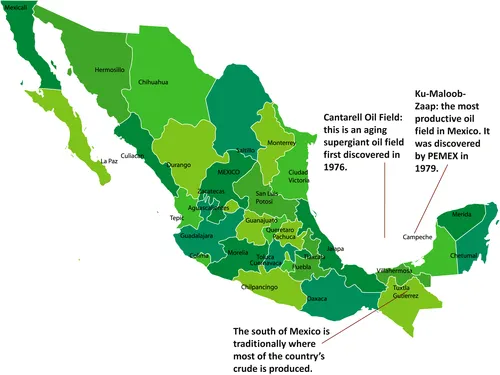
© Shutterstock
Country Facts
• Mexico’s population estimate for 2013 was 118,395,054, which is a 1.77% increase from 2010.
• Gross domestic product for 2014 was estimated to be US$2.143 trillion total. Mexico has the 4th largest nominal GDP and the 10th largest in terms of purchasing power parity.1
• Mexico has a young population, with 58.5% of the total population aged between 15 and 54 (18.1% aged 15–24 and 40.4% aged 25–54).2 The age profile of Mexico’s population has helped contribute to its economic success.
• The oil and gas industry generates 10% of Mexico’s export revenues; total export revenues in 2012 were estimated to be in the region of US$370.9 billion. However, more recent analysis of the state of Mexico’s oil industry reveals a sharp decline in the overall amount that the hydrocarbon sector contributes to export revenues – crude exports fell from a peak of over US$49 billion in 2011 to around $36.9 billion in 2014.3 This is primarily down to a reduction in the amount of oil exported to the USA as a result of increased domestic production there.
• Pemex’s oil revenue is the single biggest contributor to the Mexican treasury, supplying roughly one-third of the national budget.
• Mexico is the sixth largest producer of oil globally. However, recent years have seen a steady drop in production levels with estimates showing oil output to be 2.5 million b/d4 in 2014. This has had a significant effect on Mexico’s export revenues and is a factor underpinning the reforms to the sector that are being introduced.
• The decline in Mexico’s oil output is related to two key factors. Firstly Mexico’s developed fields are maturing. 25% of the country’s oil production originates from fields that are 65% depleted. Further to this another 45% of production comes from fields that only contain 25% of their original reserves. Together this means that about 70% of Mexico’s oil output relies on mature fields unable to maintain peak rates of production.5 Secondly Pemex, the national oil company, is limited in its ability to develop untapped fields/reserves due to financial restrictions and a lack of technology and know-how.
• The Cantarell Complex – located 80 km offshore in the Bay of Campeche and made up of four fields – is the largest oil field in Mexico. However, the field is now an ageing supergiant and no longer produces oil at historic rates. Production peaked, with the assistance of nitrogen injection enhanced oil recovery (EOR) techniques, in 2003 resulting in 2.1 million b/d. However, since 2012, this has sharply decreased and production rates are now below 0.3 million b/d.6 Estimates show that only a fifth of Cantarell’s original 35 billion barrels of reserves remains. The KMZ field, which has, since 2009, overtaken the adjacent Cantarell field in terms of production levels, produced 0.87 million b/d in 2013 and accounts for one-third of Mexico’s oil production. The same EOR techniques have been employed to increase flow and production rates. KMZ is now showing the first signs of maturing, with annual production marginally falling.
• Mexico has a mixed economy with industry accounting for 36.6%, services 59.8% and agriculture 3.6%.7 The country exports cars, electronics and electrical goods, silver, fruit and vegetables, coffee and cotton (as well as oil). These sectors employ a labour force of 78.2 million, of which 33.4% work in industry, 10.7% in agriculture and 55.9% in the services sector.
• Despite Mexico’s large and diverse economy – and the wealth that continues to flow from the production and export of natural resources – the country faces serious socioeconomic challenges. 52.3% of the population live below the poverty line8 and official unemployment stands at 4.5% (2014).9 These figures raise some serious concerns for a country with aspirations to becoming one of the world’s leading economies.
• Corruption is seen as a major issue affecting enterprises and government (including Pemex) with the impact being seen in an inability to further grow and diversify the economy and an increase in the cost of consumer goods and services.10
• Pemex, the national oil company, has lost millions of dollars in revenue due to corruption at the state and corporate levels. Mexico ranks 39th on the World Bank Group’s Doing Business index, 4 places up from 2014s rank.11
• Mexico’s workforce is rated by the OECD and the World Trade Organisation as the hardest working in the world when judged by the amount of hours worked annually,12 yet pay rates remain low and national debt is relatively high, accounting for 37.7% of GDP in 2013.13 However, the country has made significant strides towards educating and improving the skills, expertise and human capacity of its population.
• Workforce diversification is improving, with the national oil company making important moves to attract more female employees. In 2010, 139,143 employees were male (75.6%) and 44,947 were female (24.4%).14 Pemex has also demonstrated a commitment to investing in the education and development of its employees with the company spending US$672.6 million in training in 2010. A total of 13,206 courses equalling 736,493 hours of training were undertaken. There were 175,876 employees who participated in courses.15
• The U.S. Energy Information Agency forecasts that Mexico’s oil production will decline by 600,000 barrels a day by 2020, at which point the country would become a net oil importer.
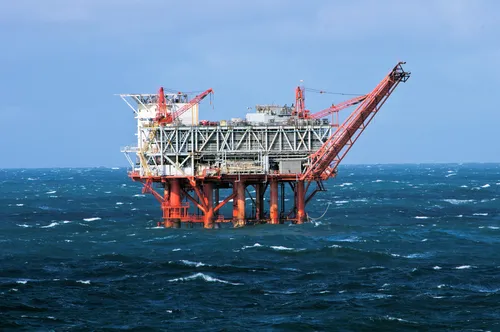
Gulf of Mexico oil rig in stormy seas.
A History of Mexico’s Oil and Gas Sector
The identification of Panuco-Ebano and Faja de Oro fields in 1910 marked the dawn of Mexico’s oil industry. Exploration activities were...
Table of contents
- Cover image
- Title page
- Table of Contents
- Copyright
- Dedication
- About the Authors
- Preface
- Acknowledgements
- The Case Studies
- About Getenergy Intelligence
- Case Study 1. Mexico: The Mixed Blessing of Oil Nationalism
- Case Study 2. Nigeria: The Story of an Ailing African Oil Giant
- Case Study 3. Brazil: Global Success through Local Capacity Building
- Case Study 4. Iraq: The Struggle to Capitalise on Abundant Oil Wealth
- Glossary of Acronyms
- Index
Trusted by 375,005 students
Access to over 1.5 million titles for a fair monthly price.
Study more efficiently using our study tools.
Frequently asked questions
Yes, you can cancel anytime from the Subscription tab in your account settings on the Perlego website. Your subscription will stay active until the end of your current billing period. Learn how to cancel your subscription
No, books cannot be downloaded as external files, such as PDFs, for use outside of Perlego. However, you can download books within the Perlego app for offline reading on mobile or tablet. Learn how to download books offline
Perlego offers two plans: Essential and Complete
- Essential is ideal for learners and professionals who enjoy exploring a wide range of subjects. Access the Essential Library with 800,000+ trusted titles and best-sellers across business, personal growth, and the humanities. Includes unlimited reading time and Standard Read Aloud voice.
- Complete: Perfect for advanced learners and researchers needing full, unrestricted access. Unlock 1.5M+ books across hundreds of subjects, including academic and specialized titles. The Complete Plan also includes advanced features like Premium Read Aloud and Research Assistant.
We are an online textbook subscription service, where you can get access to an entire online library for less than the price of a single book per month. With over 1.5 million books across 990+ topics, we’ve got you covered! Learn about our mission
Look out for the read-aloud symbol on your next book to see if you can listen to it. The read-aloud tool reads text aloud for you, highlighting the text as it is being read. You can pause it, speed it up and slow it down. Learn more about Read Aloud
Yes! You can use the Perlego app on both iOS and Android devices to read anytime, anywhere — even offline. Perfect for commutes or when you’re on the go.
Please note we cannot support devices running on iOS 13 and Android 7 or earlier. Learn more about using the app
Please note we cannot support devices running on iOS 13 and Android 7 or earlier. Learn more about using the app
Yes, you can access Education and Training for the Oil and Gas Industry: The Evolution of Four Energy Nations by Phil Andrews,Jim Playfoot,Simon Augustus in PDF and/or ePUB format, as well as other popular books in Technik & Maschinenbau & Chemie- & Biochemietechnik. We have over 1.5 million books available in our catalogue for you to explore.