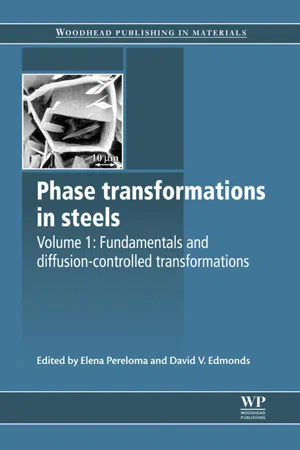
eBook - ePub
Phase Transformations in Steels
Fundamentals and Diffusion-Controlled Transformations
- 656 pages
- English
- ePUB (mobile friendly)
- Available on iOS & Android
eBook - ePub
Phase Transformations in Steels
Fundamentals and Diffusion-Controlled Transformations
About this book
The processing-microstructure-property relationships in steels continue to present challenges to researchers because of the complexity of phase transformation reactions and the wide spectrum of microstructures and properties achievable. This major two-volume work summarises the current state of research on phase transformations in steels and its implications for the emergence of new steels with enhanced engineering properties.Volume 1 reviews fundamentals and diffusion-controlled phase transformations. After a historical overview, chapters in part one discuss fundamental principles of thermodynamics, diffusion and kinetics as well as phase boundary interfaces. Chapters in part two go on to consider ferrite formation, proeutectoid ferrite and cementite transformations, pearlite formation and massive austenite-ferrite phase transformations. Part three discusses the mechanisms of bainite transformations, including carbide-containing and carbide-free bainite. The final part of the book considers additional driving forces for transformation including nucleation and growth during austenite-to-ferrite phase transformations, dynamic strain-induced ferrite transformations (DIST) as well as the effects of magnetic fields and heating rates.With its distinguished editors and distinguished international team of contributors, the two volumes of Phase transformations in steels is a standard reference for all those researching the properties of steel and developing new steels in such areas as automotive engineering, oil and gas and energy production.
- Discusses the fundamental principles of thermodynamics, diffusion and kinetics
- Considers various transformations, including ferrite formation, proeutectoid ferrite and cementite transformations
- Considers additional driving forces for transformation including nucleation and growth during austenite-to-ferrite phase transformations
Information
Part I
Fundamentals of phase transformations
1
The historical development of phase transformations understanding in ferrous alloys
R.E. Hackenberg, Los Alamos National Laboratory, USA
Abstract:
This chapter reviews the historical evolution of phase transformations understanding as it was developed in steels and other ferrous alloys. The focus is on the discoveries, dead ends, confusions, controversies, and achievements in the 1880–1925 period when the age-old ‘hardening problem’ in steel was pursued using metallography, thermal analysis, and the Gibbs phase rule. The shift in paradigm regarding metal structure and phase transformations was completed in the following period, 1925–1970, when breakthroughs afforded by X-ray diffraction and other techniques shed new light on all transformations. The evolving interactions of physical metallurgy with chemistry, physics, and other fields will be highlighted.
Key words
history
kinetics
metallography
microstructure
X-ray diffraction
1.1 Introduction
1.1.1 The importance and variety of ferrous phase transformations
The technological importance of steels and other ferrous alloys is beyond doubt. Iron is abundant, constituting 4.2% of the earth’s crust. Over millennia iron ore has been reduced to metal and altered by heat treatment and metalworking. The core structural applications of steel stem from a combination of high strength, good ductility, and low cost. The diverse uses of ferrous alloys in applications requiring tailored electrochemical, magnetic, thermal expansion, and other functional properties testify to their tremendous versatility.
Phase transformations are the most potent means of tailoring the microstructure and properties of ferrous alloys. The rich variety of phase transformations stems from several fortuitous characteristics specific to iron (Leslie and Hornbogen, 1996):
• allotropic phase changes between face-centered-cubic (FCC) γ-austenite and body-centered cubic (BCC) α- and δ-ferrites,
• ferromagnetic ordering, whose thermodynamics give rise to this anomalous allotropy of iron,
• high solubility of carbon and other elements in γ,
• carbon’s anisotropic distortion of supersaturated α, giving the extremely hard body-centered tetragonal (BCT) α′-martensite,
• vastly different diffusion rates of interstitial and substitutional solutes, and
• reasonable mobility of substitutional solutes at subcritical temperatures where α is stable.
1.1.2 Scope of this review
The historical development of phase transformations understanding will be reviewed through the lens of ferrous alloys. The origin and evolution of the major concepts that shaped this sub-field of physical metallurgy will be brought into focus. In many ways, iron and steel affords a privileged vantage point from which to survey the history of phase transformations:
• Ferrous alloys have been the dominant metallic materials available for practical applications for a very long time – over many centuries – during which time different conceptions of metal structure and the scientific method more generally have evolved. Many of the same questions, experiments and theories first posed to understand ferrous alloys were applied to newer alloys such as aluminum, nickel, titanium, and uranium.
• The allotropy of iron afforded a variety of very distinct first-order phase changes, ones capable of altering 100% of the starting microstructure, which as a consequence were more readily measured by length and property changes as compared with other alloys that transformed in more subtle ways via evolution of much smaller volume fractions of clusters and precipitates that were more difficult to measure.
• The ferromagnetism of iron provided an additional, perhaps crucial, window into measuring the phase transformations behavior.
This scientific history is intertwined with technological change. The development of inexpensive, high-tonnage methods of ironmaking and steelmaking in the mid-19th century vastly expanded the applications of steel. This in part explains why phase transformation studies began when they did, around 1880, as a scientific response to the needs of steel production and use in railroads, building construction, naval armor and automotive applications (Misa, 1995). Section 1.2 covers the ‘pre-history’ of phase transformation studies prior to 1880.
Two major periods of development followed. The first period, 1880–1925, will be surveyed in Section 1.3. Researchers worked to answer the major question of the day: how does steel harden, and why? This was a period of evolving and conflicting ideas, originating from disparate perspectives: classical chemistry and physics, extractive and process metallurgy, geology, engineering, mechanics, and metallurgical craft traditions. The question had not been answered by 1925, though significant progress had been made.
Studies of steel by X-ray diffraction opened the second period, 1925–1970 (Section 1.4). X-ray and electron microscopy freed phase transformations understanding from the limitations of its progenitor disciplines (especially chemistry) and opened it up to the influence of more suitable concepts originating in solid state physics. Advances in understanding diffusion, defects, and crystallography were pivotal in completing this paradigm shift. The normative concepts and methods of phase transformations developed in this period set the research agenda and approach for the...
Table of contents
- Cover image
- Title page
- Table of Contents
- Copyright
- Contributor contact details
- Foreword
- Introduction
- Part I: Fundamentals of phase transformations
- Part II: Diffusion-controlled transformations
- Part III: Bainite and diffusional-displacive transformations
- Part IV: Additional driving forces for transformations
- Index
Trusted by 375,005 students
Access to over 1.5 million titles for a fair monthly price.
Study more efficiently using our study tools.
Frequently asked questions
Yes, you can cancel anytime from the Subscription tab in your account settings on the Perlego website. Your subscription will stay active until the end of your current billing period. Learn how to cancel your subscription
No, books cannot be downloaded as external files, such as PDFs, for use outside of Perlego. However, you can download books within the Perlego app for offline reading on mobile or tablet. Learn how to download books offline
Perlego offers two plans: Essential and Complete
- Essential is ideal for learners and professionals who enjoy exploring a wide range of subjects. Access the Essential Library with 800,000+ trusted titles and best-sellers across business, personal growth, and the humanities. Includes unlimited reading time and Standard Read Aloud voice.
- Complete: Perfect for advanced learners and researchers needing full, unrestricted access. Unlock 1.5M+ books across hundreds of subjects, including academic and specialized titles. The Complete Plan also includes advanced features like Premium Read Aloud and Research Assistant.
We are an online textbook subscription service, where you can get access to an entire online library for less than the price of a single book per month. With over 1.5 million books across 990+ topics, we’ve got you covered! Learn about our mission
Look out for the read-aloud symbol on your next book to see if you can listen to it. The read-aloud tool reads text aloud for you, highlighting the text as it is being read. You can pause it, speed it up and slow it down. Learn more about Read Aloud
Yes! You can use the Perlego app on both iOS and Android devices to read anytime, anywhere — even offline. Perfect for commutes or when you’re on the go.
Please note we cannot support devices running on iOS 13 and Android 7 or earlier. Learn more about using the app
Please note we cannot support devices running on iOS 13 and Android 7 or earlier. Learn more about using the app
Yes, you can access Phase Transformations in Steels by Elena Pereloma,David V Edmonds in PDF and/or ePUB format, as well as other popular books in Technology & Engineering & Mining Engineering. We have over 1.5 million books available in our catalogue for you to explore.