- 608 pages
- English
- ePUB (mobile friendly)
- Available on iOS & Android
eBook - ePub
Failure Analysis and Fractography of Polymer Composites
About this book
The growing use of polymer composites is leading to increasing demand for fractographic expertise. Fractography is the study of fracture surface morphologies and it gives an insight into damage and failure mechanisms, underpinning the development of physically-based failure criteria. In composites research it provides a crucial link between predictive models and experimental observations. Finally, it is vital for post-mortem analysis of failed or crashed polymer composite components, the findings of which can be used to optimise future designs.Failure analysis and fractography of polymer composites covers the following topics: methodology and tools for failure analysis; fibre-dominated failures; delamination-dominated failures; fatigue failures; the influence of fibre architecture on failure; types of defect and damage; case studies of failures due to overload and design deficiencies; case studies of failures due to material and manufacturing defects; and case studies of failures due to in-service factors.With its distinguished author, Failure analysis and fractography of polymer composites is a standard reference text for researchers working on damage and failure mechanisms in composites, engineers characterising manufacturing and in-service defects in composite structures, and investigators undertaking post-mortem failure analysis of components. The book is aimed at both academic and industrial users, specifically final year and postgraduate engineering and materials students researching composites and industry designers and engineers in aerospace, civil, marine, power and transport applications.
- Examines the study of fracture surface morphologies in uderstanding composite structural behaviour
- Discusses composites research and post-modern analysis of failed or crashed polymer composite components
- Provides an overview of damage mechanisms, types of defect and failure criteria
Information
1
Introduction to failure analysis and fractography of polymer composites
Abstract
Before introducing composites fractography, a very brief overview of polymer composites, the various types of reinforcement and matrix, and the architecture of composites is presented. This provides an insight as to how the discipline of fractography fits into the general field of polymer composites. Failure of composites is then presented, and the general topic of fractography is introduced. Polymer composite fractography is discussed in terms of how this contrasts with fractographic analysis of isotropic materials. Finally, the aims and objectives of the book are presented.
Key words
fractography
polymer composites
failure analysis
1.1 Background
I have been working on polymer composites for over twenty years, having been at the Royal Aircraft Establishment (RAE, which became DERA and ultimately QinetiQ) for most of that time, and then more recently at Imperial College London. From the start of my career I have been using fractography, initially under the tutorage of David Purslow who was one of the key researchers in the development of this field. Twenty years ago, fractography was perceived as a ‘black art’; the analyst would be presented with a pile of broken bits and would, by some mysterious means, deduce the source and sequence of failure! To some extent this perception still persists today, and many materials engineers do not even consider examining the broken components to glean information about the fracture processes. Over the last twenty years, fractography has underpinned my research and has proved to be an invaluable tool for understanding composites. Therefore, the principal reason for collating and writing this book has been to make polymer composite fractography more amenable to researchers and engineers.
1.2 Introduction to polymer composites
Before introducing composites fractography, a very brief overview of polymer composites may be of value to the reader. Although many readers may already be acquainted with this, it does provide an insight as to how the discipline of fractography fits into the general field of polymer composites. More in-depth descriptions of polymer composites are given by Astrom, Matthews and Rawlings, and Hull and Clyne1–3 and further details regarding fractography have been presented in other studies.4–9
1.2.1 Definition of a composite and composite architecture
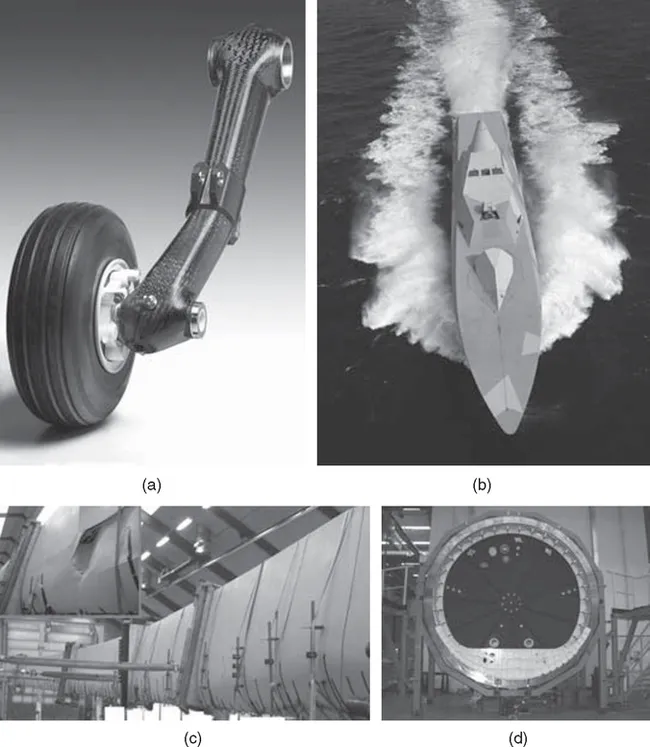
Polymer composites are becoming increasingly prevalent in structural engineering. These materials were once only considered for high-performance applications, such as space, aerospace and motor sport.2,10 However, over the last few decades, they have become important materials for all sectors of engineering, as shown by the examples in Fig. 1.1. There are a number of definitions as to what actually constitutes a composite but perhaps the most overarching is ‘the combination of two or more distinctly different materials to make an improved or superior material’.2,3,11
In general, the composites comprise of a reinforcing phase, which has high mechanical properties such as stiffness, and a matrix phase, which transfers load between reinforcement particles, provides toughening when individual reinforcement particles break and protects the reinforcement from wear and the environment. Successful reinforcements have low density combined with high strength and stiffness whilst successful matrices are tough, durable and cheap. The relative influence of the reinforcement is partly controlled by the reinforcement volume fraction (vf). In general, to achieve optimum performance, composite designers strive for vf of 60%,2 but generally the vf is <55%.1 A further factor, which can be considered as the third constituent in a composite, is the interface between the reinforcement and the matrix phases. The performance of the interface is critical to the overall composite performance. Too weak an interface gives low composite strength and stiffness; too strong and the composite will be brittle.3,7,12,13
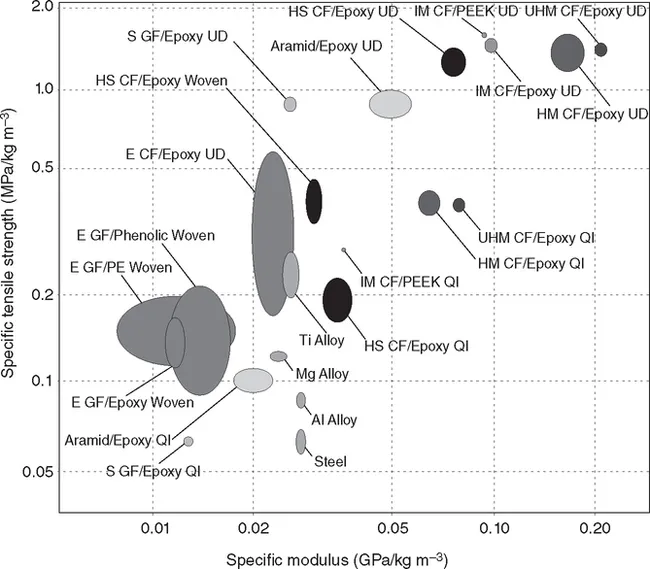
Often the purpose in developing a composite is to improve mechanical properties such as toughness and strength, but sometimes it is to reduce costs (e.g. aggregate in cement).2 Various composites have been used for centuries (straw-reinforced bricks, paper, concrete),2’3 but recent developments in reinforcing fibres has led to greater possibilities in materials’ design.10 These are now challenging conventional materials in many applications. The advantages composites offer over conventional materials include high stiffness and strength at low weight (Fig. 1.2), properties which can be tailored by choice of matrix and reinforcement, good corrosion resistance and fatigue properties and, finally, improved toughness via exploiting multiple crack paths. However, the disadvantages include higher cost than most conventional materials and low strength and toughness in certain orientations.2,3
The main parameter which dictates the composite anisotropy, mechanical and physical characteristics is the architecture: the configuration of the reinforcement phase within the matrix phase.3 The architecture is intrinsically linked to the processing route by which the composite can be manufactured.1 Consequently, this dictates which types of defect will occur, and the potential severity they will incur upon performance.7 Finally, the architecture will dictate how efficiently the reinforcement phase is being utilised within the composite.3 The most basic architecture is particulate or short- fibre composites,1 the performance of which depends upon the spread of fibre lengths, orientations and distribution. To fully utilise the properties of this reinforcement along its length, the fibres must have an aspect ratio in excess of thirty,3 greater than which the fibre reinforced composite is deemed to be continuous. However,...
Table of contents
- Cover image
- Title page
- Table of Contents
- Related titles
- Copyright
- Dedication
- Author contact details
- Chapter 1: Introduction to failure analysis and fractography of polymer composites
- Chapter 2: Methodology and tools for failure analysis of polymer composites
- Chapter 3: Fibre-dominated failures of polymer composites
- Chapter 4: Delamination-dominated failures in polymer composites
- Chapter 5: Fatigue failures of polymer composites
- Chapter 6: The influence of fibre architecture in the failure of polymer composites
- Chapter 7: Defects and damage and their role in the failure of polymer composites
- Chapter 8: Case studies: failures due to overload and design deficiencies
- Chapter 9: Case studies: failures due to material and manufacturing defects
- Chapter 10: Case studies: failures of polymer composites due to in-service factors
- Index
Trusted by 375,005 students
Access to over 1.5 million titles for a fair monthly price.
Study more efficiently using our study tools.
Frequently asked questions
Yes, you can cancel anytime from the Subscription tab in your account settings on the Perlego website. Your subscription will stay active until the end of your current billing period. Learn how to cancel your subscription
No, books cannot be downloaded as external files, such as PDFs, for use outside of Perlego. However, you can download books within the Perlego app for offline reading on mobile or tablet. Learn how to download books offline
Perlego offers two plans: Essential and Complete
- Essential is ideal for learners and professionals who enjoy exploring a wide range of subjects. Access the Essential Library with 800,000+ trusted titles and best-sellers across business, personal growth, and the humanities. Includes unlimited reading time and Standard Read Aloud voice.
- Complete: Perfect for advanced learners and researchers needing full, unrestricted access. Unlock 1.5M+ books across hundreds of subjects, including academic and specialized titles. The Complete Plan also includes advanced features like Premium Read Aloud and Research Assistant.
We are an online textbook subscription service, where you can get access to an entire online library for less than the price of a single book per month. With over 1.5 million books across 990+ topics, we’ve got you covered! Learn about our mission
Look out for the read-aloud symbol on your next book to see if you can listen to it. The read-aloud tool reads text aloud for you, highlighting the text as it is being read. You can pause it, speed it up and slow it down. Learn more about Read Aloud
Yes! You can use the Perlego app on both iOS and Android devices to read anytime, anywhere — even offline. Perfect for commutes or when you’re on the go.
Please note we cannot support devices running on iOS 13 and Android 7 or earlier. Learn more about using the app
Please note we cannot support devices running on iOS 13 and Android 7 or earlier. Learn more about using the app
Yes, you can access Failure Analysis and Fractography of Polymer Composites by Emile Greenhalgh in PDF and/or ePUB format, as well as other popular books in Technology & Engineering & Materials Science. We have over 1.5 million books available in our catalogue for you to explore.