The use of reactive polymers enables manufacturers to make chemical changes at a late stage in the production process—these in turn cause changes in performance and properties. Material selection and control of the reaction are essential to acheive optimal performance. The second edition of Reactive Polymers Fundamentals and Applications introduces engineers and scientists to the range of reactive polymers available, explains the reactions that take place, and details applications and performance benefits.
Basic principles and industrial processes are described for each class of reactive resin (thermoset), as well as additives, the curing process, and applications and uses. The initial chapters are devoted to individual resin types (e.g. epoxides, cyanacrylates, etc.); followed by more general chapters on topics such as reactive extrusion and dental applications. Material new to this edition includes the most recent developments, applications and commercial products for each chemical class of thermosets, as well as sections on fabrication methods, reactive biopolymers, recycling of reactive polymers, and case studies. Injection molding of reactive polymers, radiation curing, thermosetting elastomers, and reactive extrusion equipment are all covered as well.
- Most comprehensive source of information about reactive polymers
- Covers basics as well as most recent developments, including reactive biopolymers, recycling of reactive polymers, nanocomposites, and fluorosilicones
- Indispensable guide for engineers and advanced students alike—providing extensive literature and patent review
Unsaturated polyester resins consist of two polymers, i.e., a short-chain polyester containing polymerizable double bonds and a vinyl monomer. The curing reaction consists of a copolymerization of the vinyl monomer with the double bonds of the polyester. In the course of curing, a three-dimensional networkis formed. Unsaturated polyester resins belong to the group of so-called thermosets. There are several monographs and reviews on unsaturated polyesters and unsaturated polyester resins [1–7].
We will differentiate between unsaturated polyesters and unsaturated polyester resins. Unsaturated polyesters are the polyesters as they emerge from the condensation vessel. They are rarely sold as such, because they are brittleat room temperature and difficult to handle. Instead, whenever a polyester is freshly synthesized in a plant, it is mixed with the vinyl monomer in the molten state. Thus materials that are viscous at room temperature, with a styrene content of ca. 60%, are sold. Such a mixture of an unsaturated polyester with the vinyl polymer is referred to here as an unsaturated polyester resin.
1.1 History
It was realized long ago that some natural oils as well as alkyle resins can be dried by certain additives and used as coatings. This drying results from a polymerization of the unsaturated moieties in the ester molecules. Next it was discovered that the addition of styrene would accelerate the drying. The invention of unsaturated polyester resins is ascribed to Carleton Ellis (1876–1941). The first patents with regard to polyester resins emerged in the 1930s [8–10]. Commercial production started in 1941 already reinforced with glass fibers for radar domes, also referred to as radomes.
1.2 Monomers
According to the composition of an unsaturated polyester resin, the monomers can be grouped in two main classes, i.e., components for the polyester and components for the vinyl monomer.
1.2.1 Monomers for an Unsaturated Polyester
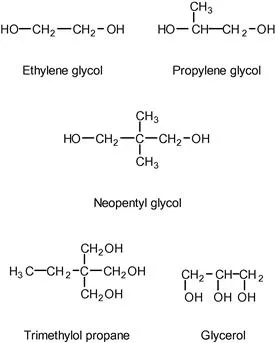
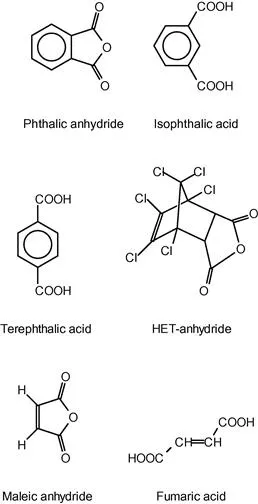
Monomers used for unsaturated polyesters are shown in Table 1.1 and in Figures 1.1 and 1.2. Unsaturated diols are only rarely used.
Table 1.1
Monomers for Unsaturated Polyesters
Saturated Alcohols
Remarks
1,2-Propylene glycol
Most common glycol
Ethylene glycol
Less compatible with styrene than propylene glycol
Diethylene glycol
Good drying properties
Neopentyl glycol
Good hydrolysis resistance
Glycerol
Trifunctional alcohol, for branched polyesters. Danger of crosslinking during condensation
Flame retardant
Tetrabromobisphenol A (TBBPA)
Trimethylol propane
Trifunctional alcohol, cheaper than glycerol
Trimethylol propane mono allyl ether
Weather resistant for coatings [12,13]
Undecanol
Used as chain stopper
Saturated Acids and Anhydrides
Remarks
Phthalic anhydride
Most common anhydride
Isophthalic acid
Good hydrolysis resistance
Terephthalic acid
Superior hydrolysis resistance
HET acid
Flame retardant systems. In fact, even when addressed as HET acid, the HET anhydride is used
Tetrabromophthalic anhydride
Flame retardant systems
Adipic acid
Soft resins
Sebacic acid
Soft resins
o-Carboxy phthalanilic acid
[14]
Unsaturated Acids and Anhydrides
Remarks
Maleic anhydride
Most common
Fumaric acid
Copolymerizes better with styrene than maleic anhydride
Itaconic acid
Figure 1.1 Diols and triols used for unsaturated polyester resins.
Figure 1.2 Acids and anhydrides used for unsaturated polyester resins.
1.2.1.1 Alcohol Components
The most common alcohol components are 1,2-propylene glycol and ethylene glycol (EG). Ether containing alcohols exhibit better air-drying properties and are used in topcoats. Polyesters based on unsaturated diols can be prepared by the transesterification of diethyl adipate with unsaturated diols, e.g., cis-2-butene-1,4-diol and 2-butyne-1,4-diol. The transesterification method is a suitable procedure for the preparation of unsaturated polyesters in comparison to the direct polycondensation [11]. cis-2-Butene-1,4-diol, the most available aliphatic unsaturated diol, has been used to produce some valuable polymers such as graftable unsaturated segmented poly(urethane)s and crosslinkable polyesters for medical purposes.
Chemically modified soybean oil is an inexpensive alternative candidate for unsaturated polyester (UP) compositions. In addition, when reinforced with natural fibers, these composites could yield comparable and adequate properties to common products. Acrylated epoxidized soybean oil or maleated acrylated epoxidized soybean oil can be used for the synthesis of a prepolymer that contains vinyl groups. These groups are then copolymerized with styrene, as otherwise usual [15].
1.2.1.2 Acid and Anhydride Components
A general-purpose industrial unsaturated polyester is made from 1,2-propylene glycol, phthalic anhydride, and maleic anhydride. The most commonly used vinyl monomer is styrene. Maleic anhydride without phthalic anhydride would yield a polyester with a high density of double bonds along the polyester chain. This would result in a high crosslinking density of the cured product, thus in a brittle product. Therefore, the unsaturated acid component is always diluted with an acid with non-polymerizable double bonds. Note that aromatic double bonds also will not polymerize with vinyl components. The double bond in HET acid will not polymerize. Fumaric acid copolymerizes well with styrene, but fumaric acid is more costly than maleic anhydride. Therefore, maleic anhydride is the preferred unsaturated acid component. Another aspect is that during the condensation of fumaric acid, 2 mol of water must be removed from the reaction mixtures, whereas in the case of maleic anhydride only 1 mol of water must be removed. Anhydrides are preferred over the corresponding acids because of the higher reactivity.
Isophthalic acid and terephthalic acid cannot form an anhydride. These compounds do not condense as fast as phthalic anhydride. On the other hand, the polyesters from isophthalic acid and terephthalic acid are more stable than those made from phthalic anhydride. That is why these polyesters with neopentyl glycol are used in aggressive environments and as gel coats and top coats. A gel coat is the first layer of a multilayer material; the top coat is the layer on the opposite side. For instance, if a polyester boat is built, the gel coat is first painted into the model. Then a series of glass-fiber-reinforced laminates are applied, and finally the top coat is painted.
Isomerization
During the synthesis of the polyester, maleic anhydride partly isomerizes to fumaric acid. The isomerization follows second-order kineticsbecause of the catalysisby maleic acid. The activation energy of the isomerization is ca.
[16].
2-Methyl-1,3-propanediol offers significant process advantages to resin producers because it is an easily handled liquid, it has a high boiling point, and it has two primary hydroxyl groups for rapid condensations. Polyester resins produced from 2-methyl-1,3-propanediol using conventional condensation polymerization, however, have relatively low fumarate contents (60–70%), and simply increasing the reaction temperature to promote isomerization causes color problems.
The two-step process helps increase the degree of isomerization for such systems. First, the aromatic dicarboxylic acid is allowed to react with 2-methyl-1,3-propanediol at a temperature of up to 225 °C to produce an ester diol intermediate. In the second step, the intermediate reacts with maleic anhydride and with 1,2-propylene glycol. The resulting unsaturated polyester resin has a fumarate content greater than about 85% [17]. The high fumarate conten...
Table of contents
Cover image
Title page
Table of Contents
Plastics Design Library (PDL)
Copyright
PDL Series Editor’s Preface
Preface
Chapter 1. Unsaturated Polyester Resins
Chapter 2. Poly(urethane)s
Chapter 3. Epoxy Resins
Chapter 4. Phenol/Formaldehyde Resins
Chapter 5. Urea/Formaldehyde Resins
Chapter 6. Melamine Resins
Chapter 7. Furan Resins
Chapter 8. Silicones
Chapter 9. Acrylic Resins
Chapter 10. Cyanate Ester Resins
Chapter 11. Bismaleimide Resins
Chapter 12. Terpene Resins
Chapter 13. Cyanoacrylates
Chapter 14. Benzocyclobutene Resins
Chapter 15. Reactive Extrusion
Chapter 16. Compatibilization
Chapter 17. Rheology Control
Chapter 18. Grafting
Chapter 19. Acrylic Dental Fillers
Chapter 20. Toners
Index
Trusted by 375,005 students
Access to over 1.5 million titles for a fair monthly price.
Study more efficiently using our study tools.
Frequently asked questions
Yes, you can cancel anytime from the Subscription tab in your account settings on the Perlego website. Your subscription will stay active until the end of your current billing period. Learn how to cancel your subscription
No, books cannot be downloaded as external files, such as PDFs, for use outside of Perlego. However, you can download books within the Perlego app for offline reading on mobile or tablet. Learn how to download books offline
We are an online textbook subscription service, where you can get access to an entire online library for less than the price of a single book per month. With over 1.5 million books across 990+ topics, we’ve got you covered! Learn about our mission
Look out for the read-aloud symbol on your next book to see if you can listen to it. The read-aloud tool reads text aloud for you, highlighting the text as it is being read. You can pause it, speed it up and slow it down. Learn more about Read Aloud
Yes! You can use the Perlego app on both iOS and Android devices to read anytime, anywhere — even offline. Perfect for commutes or when you’re on the go. Please note we cannot support devices running on iOS 13 and Android 7 or earlier. Learn more about using the app
Yes, you can access Reactive Polymers Fundamentals and Applications by Johannes Karl Fink in PDF and/or ePUB format, as well as other popular books in Technology & Engineering & Chemical & Biochemical Engineering. We have over 1.5 million books available in our catalogue for you to explore.