eBook - ePub
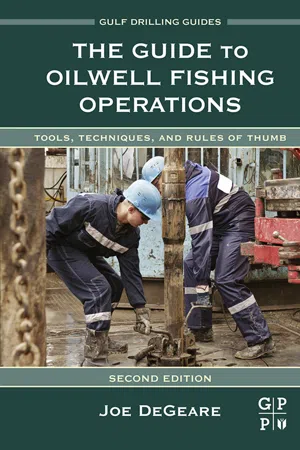
The Guide to Oilwell Fishing Operations
Tools, Techniques, and Rules of Thumb
- 234 pages
- English
- ePUB (mobile friendly)
- Available on iOS & Android
eBook - ePub
About this book
Unpredictable, unwanted, and costly, oil and gas well fishing is not a typical practice for drilling, workover and completion projects, but roughly one in every five wells experience this intervention. To stay on top, The Guide to Oilwell Fishing Operations, Second Edition will keep fishing tool product managers, drilling managers and all other well intervention specialists keyed in to all the latest tools, techniques and rules of thumb critical to conventional and complex wellbore projects, such as extended reach horizontal wells, thru-tubing, and coiled tubing operations.
Strengthened with updated material and a new chapter on wellbore cleaning, The Guide to Oilwell Fishing Operations, Second Edition ensures that the life of the well will be saved no matter the unforeseen circumstances. Crucial aspects include:
- Enhancements with updated equipment, technology, and a new chapter on wellbore cleaning methods
- Additional input from worldwide service companies, providing a more comprehensive balance
- Remains the only all-inclusive guide exclusively devoted to fishing tools, techniques, and rules of thumb
- Remodeled with latest jars on the market, catch tools, and retrieving stuck packers with cutting technology
- Improved with information on methods such as sidetracking and plug-and-abandon operations
- Modernized with approaches and tactics on more advanced well projects such as high-angle deviated and horizontal wells and expandable casing technology to repair casing failure and leaks
Information
Topic
Physical SciencesSubtopic
EnergyChapter 1
Conventional Fishing
Abstract
In oil-field operations, fishing is the technique of removing lost or stuck objects from the wellbore. The term fishing is taken from the early days of cable-tool drilling. At that time, when a wireline would break, a crew member put a hook on a line and attempted to catch the wireline to retrieve, or “fish for,” the tool. Necessity and ingenuity led these oil-field fishers to develop new “bait.” The trial-and-error methods of industry’s early days built the foundation for many of the catch tools used currently. Fishing jobs fall into three categories: open hole, when there is no casing in the area of the fish; cased hole, when the fish is inside casing; or thru-tubing, when it is necessary to fish through the restriction of a smaller pipe size (tubing).
Keywords
Bottom-hole assemblies
Coiled tubing
Conventional fishing
Risk management strategy
Thru-tubing fishing/milling
Wireline fishing
In oil-field operations, fishing is the technique of removing lost or stuck objects from the wellbore. The term fishing is taken from the early days of cable-tool drilling. At that time, when a wireline would break, a crew member put a hook on a line and attempted to catch the wireline to retrieve, or “fish for,” the tool. Necessity and ingenuity led these oil-field fishers to develop new “bait.” The trial-and-error methods of industry’s early days built the foundation for many of the catch tools used currently. Fishing jobs fall into three categories: open hole, when there is no casing in the area of the fish; cased hole, when the fish is inside casing; or thru-tubing, when it is necessary to fish through the restriction of a smaller pipe size (tubing).
Fishing-tool companies have kept pace with the oil industry’s rapid development and the deployment of new technology. Today, many are capable of fishing successfully in well depths exceeding 20,000 ft., in high-angle and horizontal wellbores, and in deep water.
A fish can be any number of things, including stuck pipe, broken pipe, drill collars, bits, bit cones, dropped hand tools, sanded-up or mud-stuck pipe, stuck packers, or other junk in the hole. Washovers, overshot runs, spear runs, wireline fishing, stripping jobs, and jar runs are among the many fishing techniques developed to deal with the different varieties of fish.
Because there are so many kinds of fish and fishing jobs, many different tools and methods can be used. Some of them are very simple; others are extremely complex. No two fishing jobs are alike, yet many are similar. A seasoned fishing-tool supervisor will draw from the experience gained from many jobs, as well as the expertise of fellow fishing tool operators.
Fishing jobs are very much a part of the planning process in drilling and workover operations. With the increasing cost of rig time and deeper, more complicated wells, operators will often budget for fishing operations. When a fishing operation is planned for a workover, the operator will work closely with a fishing-tool company to design a procedure and develop a cost estimate. Taking into account the probability of success, the cost of a fishing job has to be less than the cost of redrilling or sidetracking the well for it to make economic sense.
Fishing can be thought of as a risk management strategy. When used successfully, it can save a well. Because fishing is more of an applied skill supported by experience than an exact science, there will be more than one possible solution for a given problem. A clear understanding of the problem, the equipment used to solve the problem, and the best-fitting solution will lead to a successful operation.
This experience usually points to a specific approach when all factors are considered. Although no fishing job technique can be guaranteed, the combination of experienced personnel and continuing advances in fishing-tool technology usually offers an option with a good probability of success.
To maximize this probability, properly planning a fishing job is most important. Preplanning meetings should be held that include everyone involved in the job, such as fishing-tool operators or supervisors, mud-company personnel, rig personnel, electric-wireline company representatives (where applicable), and any others who might become involved. It is much cheaper to determine that a certain procedure will not work before doing it.
Thru-tubing fishing
The increased use of coiled tubing in the last 30 years has led to many technological advancements in thru-tubing workover applications. These include cleanouts, acid stimulation, milling, underreaming, cutting, and coiled-tubing conveyed thru-tubing fishing systems. The ability to perform these operations without having to pull the production string has provided the operator with a cost-effective alternative to conventional rig workovers. Coiled tubing conveyance also allows remedial operations to be completed without having to kill the well, which eliminates possible formation damage from heavyweight kill fluids in the well. Operations using coiled tubing are usually completed in a much shorter time than conventional rig workovers, which means that the shut-in time of the well is reduced, resulting in less loss of production.
With the ever-increasing horizontal drilling throughout the oil industry, coiled tubing operations have become more acceptable for milling of composite bridge plugs after a fracking operation, as well as removal of ball drop seats from a sleeve system. Extended reach wells can require the need for assistance in getting coiled tubing to the desired depth, which can be done with the use of an agitator tool, as well as friction reducers and bead systems. You should always recommend that the coiled tubing service company run a coiled tubing modeling software program. This will give you a better grasp of where the coiled tubing will friction out and you will not be able to go any further.
Early thru-tubing fishing systems were composed of tools designed for wireline conveyance and did not take advantage of the attributes of the coiled tubing. These tools did not allow circulation through them, and early tools that had been modified to allow circulation restricted flow paths. Also, these tools did not have the tensile strength required to handle the impact loads of the jarring systems being developed for coiled tubing use. In addition, some tools developed for other coiled tubing services, such as inflatable-packer operations, proved inadequate for fishing applications. Some tools had to be designed specifically for thru-tubing fishing operations. A dramatic evolution in thru-tubing fishing-tool technology and design has occurred in the last decade, and individual tool components can now be assembled to suit much more demanding and varied applications.
Thru-tubing fishing systems that run on coiled tubing are used to retrieve many different types of fish. These include coiled tubing conveyed bottom-hole assemblies (BHAs) that have been disconnected, stuck flow-control devices in landing nipples that cannot be retrieved with wireline, inflatable bridge plugs, wireline lost in the hole, and coiled tubing itself. If wireline fishing is unsuccessful, coiled tubing conveyed fishing gives the operator another alternative before a conventional rig workover is required.
Chapters 22 to 30 will outline the specific tools and techniques used in coiled-tubing conveyed thru-tubing fishing applications and services. Tool-string hookup design will also be discussed as applied to common thru-tubing fishing applications being carried out today.
This book will not make you a fishing expert, but it will give you a basic understanding of fishing, fishing tools, and fishing problems that you may encounter. With this knowledge, you should be better prepared to make logical decisions when fishing becomes necessary.
Chapter 2
Using Communication to Avoid Hazards
Abstract
Like many other oil-field operations, fishing jobs bring together rig, operating-company, and service-company personnel who may not work closely together every day. When such a group is formed to solve the complex problems that fishing jobs can present, the importance of clear and precise communication cannot be overemphasized. Never assume that people understand the explanation or description of a problem. Because fishing jobs can be hazardous, it is critical to make sure that all descriptions of the problem and plans for its solution are thoroughly understood by all the parties involved.
Keywords
Communication
Contingency plan
Fishing equipment
Fishing jobs
Hazards
Like many other oil-field operations, fishing jobs bring together rig, operating-company, and service-company personnel who may not work closely together every day. When such a group is formed to solve the complex problems that fishing jobs can present, the importance of clear and precise communication cannot be overemphasized. Never assume that people understand the explanation or description of a problem. Because fishing jobs can be hazardous, it is critical to make sure that all descriptions of the problem and plans for its solution are thoroughly understood by all the parties involved.
To avoid hazards, the following steps should be followed prior to and during a fishing job. Remember that these actions can only be performed successfully by employing clear and accurate communication among all parties:
• Collect complete and accurate information.
• Notify all parties involved, such as the fishing-tool company, mud company, and wireline company. It is imperative that all parties cooperate and communicate at all times. This is the most important factor in a successful fishing operation, and it is only through effective communication that the individuals involved will be able to select the proper tools and methods to do the job in the safest, most cost-effective manner.
• Every effort should be made to recover something or to otherwise improve the situation on each trip into the hole. Misruns waste money, and additional mishaps are possible with every additional trip into the hole.
• Drawings (including dimensions) should always be made of everything run into the wellbore. This responsibility should not be left to service-company personnel alone. Operating-company personnel should also make independent measurements and sketches. Keeping track of the accurate dimensions of all equipment is critical for economical fishing.
• If a large or unusual tool or downhole assembly is being run, a contingency plan should be created to fish it. Always ask these questions: Can this be fished? Can it be washed over? Do I have the tools available to fish it? What is the risk of the fishing tools becoming stuck or lost based on the conditions of the hole?
• Confirm that all tools will work properly downhole prior to running them, either by surface testing or by having the service company supply copies of test and inspection reports.
• When running any fishing tool into a well, use a moderate speed. Most fishing tools are designed to go over and around the fish. For a tool to do this, it has to be larger than the fish diameter. In most cases, this makes the tool close to the size of the hole. If the tool is run at a fast speed while going into the hole, it will act as a piston and cause excess pressure below it, which can cause lost circulation. If a space in the we...
Table of contents
- Cover image
- Title page
- Table of Contents
- Copyright
- Dedication
- Disclaimer
- Preface
- Chapter 1: Conventional Fishing
- Chapter 2: Using Communication to Avoid Hazards
- Chapter 3: The Economics of Fishing
- Chapter 4: The Cardinal Rules of Fishing
- Chapter 5: Pipe Sticking
- Chapter 6: Types of Free Point Tools
- Chapter 7: Parting the Pipe String
- Chapter 8: Catch Tools
- Chapter 9: Impact Tools
- Chapter 10: Washover Operations
- Chapter 11: Loose-Junk Fishing
- Chapter 12: Milling Operations
- Chapter 13: Wireline Fishing
- Chapter 14: Retrieving Stuck Packers
- Chapter 15: Fishing in Cavities
- Chapter 16: Sidetracking Methods
- Chapter 17: Section Milling
- Chapter 18: Repair of Casing Failures and Leaks
- Chapter 19: Fishing in High-Angle Deviated and Horizontal Wells
- Chapter 20: Plug-and-Abandon Operations
- Chapter 21: Miscellaneous Tools
- Chapter 22: Thru-Tubing Standard Tools
- Chapter 23: Thru-Tubing Fishing
- Chapter 24: Thru-Tubing Fishing Jars and Accelerators
- Chapter 25: Thru-Tubing Debris Catchers
- Chapter 26: Thru-Tubing Workover Motors
- Chapter 27: Thru-Tubing Milling
- Chapter 28: Thru-Tubing Underreaming
- Chapter 29: Coiled-Tubing-Conveyed Tubing and Drill-Pipe Cutting
- Chapter 30: Thru-Tubing Impact Drilling
- Chapter 31: Precautionary Measures and Inspection Procedures
- Chapter 32: Service Providers
- Chapter 33: Down-hole Video Cameras
- Glossary
- Bibliography
- Index
Trusted by 375,005 students
Access to over 1.5 million titles for a fair monthly price.
Study more efficiently using our study tools.
Frequently asked questions
Yes, you can cancel anytime from the Subscription tab in your account settings on the Perlego website. Your subscription will stay active until the end of your current billing period. Learn how to cancel your subscription
No, books cannot be downloaded as external files, such as PDFs, for use outside of Perlego. However, you can download books within the Perlego app for offline reading on mobile or tablet. Learn how to download books offline
Perlego offers two plans: Essential and Complete
- Essential is ideal for learners and professionals who enjoy exploring a wide range of subjects. Access the Essential Library with 800,000+ trusted titles and best-sellers across business, personal growth, and the humanities. Includes unlimited reading time and Standard Read Aloud voice.
- Complete: Perfect for advanced learners and researchers needing full, unrestricted access. Unlock 1.5M+ books across hundreds of subjects, including academic and specialized titles. The Complete Plan also includes advanced features like Premium Read Aloud and Research Assistant.
We are an online textbook subscription service, where you can get access to an entire online library for less than the price of a single book per month. With over 1.5 million books across 990+ topics, we’ve got you covered! Learn about our mission
Look out for the read-aloud symbol on your next book to see if you can listen to it. The read-aloud tool reads text aloud for you, highlighting the text as it is being read. You can pause it, speed it up and slow it down. Learn more about Read Aloud
Yes! You can use the Perlego app on both iOS and Android devices to read anytime, anywhere — even offline. Perfect for commutes or when you’re on the go.
Please note we cannot support devices running on iOS 13 and Android 7 or earlier. Learn more about using the app
Please note we cannot support devices running on iOS 13 and Android 7 or earlier. Learn more about using the app
Yes, you can access The Guide to Oilwell Fishing Operations by Joe P. DeGeare in PDF and/or ePUB format, as well as other popular books in Physical Sciences & Energy. We have over 1.5 million books available in our catalogue for you to explore.