- 248 pages
- English
- ePUB (mobile friendly)
- Available on iOS & Android
eBook - ePub
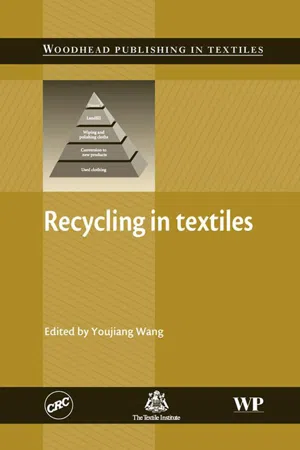
Recycling in Textiles
About this book
An increasing amount of waste is generated each year from textiles and their production. For economic and environmental reasons it is necessary that as much of this waste as possible is recycled instead of being disposed of in landfill sites. In reality the rate of textile recycling is still relatively low. On average, approximately ten million tonnes of textile waste is currently dumped in Europe and America each year. Considering the diversity of fibrous waste and structures, many technologies must work in concert in an integrated industry in order to increase the rate of recycling. Recycling in textiles shows how this can be achieved.The first part of the book introduces the subject by looking at the general issues involved and the technologies concerned. Part Two explores the chemical aspects of textile recycling. Part Three focuses on recycled textile products, including nonwovens and alternative fibres. Finally, the last part of the book discusses possible applications of recycled textiles, including using recycled products in the operating theatre, for soil stabilisation and in concrete reinforcement.Recycling in textiles presents several promising technologies and ideas for recycling systems. This is the first book of its kind to bring together textile recycling issues, technology, products, processes and applications. It will prove an invaluable guide to all those in the industry who are now looking for ways to recycle their textile waste.
- Provides extensive coverage of this hot topic
- An invaluable guide for all in the textile industry
- Learn how to increase the rate of recycling
Information
1
Introduction
Y. Wang Georgia Institute of Technology, USA
There are many compelling reasons for the recycling of waste from textile products and processes. They include conservation of resources, reduction of the need for landfills and paying the associated tipping fees, and provision of low-cost raw materials for products. Yet, in reality, the rate of recycling in textiles is not very high. Besides the often attributed reason of insufficient public willingness to participate in recycling, economics is often the reason behind the adoption of other modes of waste disposal. Although legislation could easily tip the balance in favor of recycling, such a forced move could have just the opposite effect in terms of environmental protection. Recycling, a seemingly obvious choice, is more complicated than it appears.
World fiber production has been steadily increasing in the past few decades. In 2004 it exceeded 64 million tons.1 The increase in fiber demand and consumption is a result of global population growth and overall improvement in living standards. In general, applications of fibers belong to the following three broad categories: apparel, home furnishing, and industrial. Most of the fiber products are for short term (e.g. disposables) to medium term (e.g. apparel, carpet, automotive interior) use, lasting up to a few years in their service life. In the United States of America alone, about 10 million tons of textile waste was generated in 2003,2 accounting for 4.5 wt% of the total municipal solid waste at 236 million tons per year. According to the same data source, 55% of the municipal solid waste is landfilled, 14% is incinerated in waste-to-energy facilities, and 31% is recovered.
Most of the fibrous waste is composed of natural and synthetic polymeric materials such as cotton, polyester, nylon, and polypropylene. The primary source of raw material for synthetic polymers is petroleum. Even for renewable natural polymers such as cotton, the production requires energy and chemicals that are based on non-renewable resources. Although the global petroleum reserve may last at least another several hundred years at the rate of current consumption, petroleum and other natural resources are non-renewable in practical terms. It is our responsibility to conserve these resources for the benefit of future generations.
Recovery from the waste stream includes re-use of a product in its original form, a common practice for clothes, and recycling to convert the waste into a product. Typically, recycling technologies are divided into primary, secondary, tertiary, and quaternary approaches. Primary approaches involve recycling a product into its original form; secondary recycling involves melt processing a plastic product into a new product that has a lower level of physical, mechanical and/or chemical properties. Tertiary recycling involves processes such as pyrolysis and hydrolysis, which convert the plastic wastes into basic chemicals or fuels. Quaternary recycling refers to burning the fibrous solid waste and utilizing the heat generated. All of these four approaches exist for fiber recycling.
The predominant method of solid waste disposal in the USA is by landfilling. There are several disadvantages associated with this practice concerning fibrous waste. First, a tipping fee is required. Second, due to environmental concerns there is increasing demand to ban polymers from landfills. Third, landfilling polymers is a waste of energy and materials. Considering such, recycling becomes an obvious choice when dealing with fibrous waste. However, recycling itself faces many challenges.
Other than direct re-use, some processing such as mechanical, chemical or biological is involved to recycle waste into products, requiring the consumption of certain amount of energy, additional raw materials, and causing the emission of waste into the air, water and soil. Once a recycled product is made, it must be marketed. Is there a reasonable demand? Is it cost-competitive? The next challenge concerns the availability of waste to be processed. Is there a consistent supply at reasonable price, especially when production is at full capacity?
It is therefore conceivable that a recycling operation could consume more petroleum than it saves, cause more harm to the environment due to emissions, produce a product that is too expensive for a quickly saturated market, and have insufficient supply to run the production plant efficiently. Such a scenario is obviously to be avoided.
While one hopes to find an ideal recycling scheme on the other end of the spectrum, a practical process will likely be somewhere in the middle in terms of environmental benefits and cost. Therefore, to evaluate the feasibility of a recycling process, these questions must be asked:
• Do the energy savings and pollutions from the recycling process outweigh the alternatives such as virgin materials, other recycling approaches, Waste-to-Energy?
• Do the products have viable markets and are they cost-competitive?
It is not an easy task to answer the above questions because of the many uncertainties involved. There are some environmental accounting tools that could be employed in the evaluation process, such as life-cycle analysis, cost/benefit analysis, and contingent valuation method.3
Currently, the overall rate of recovery for fibrous waste is quite low; it is about 15% in the USA.2 Many enterprises have been quite successful in fiber recycling, while others, including some with US$100 million-plus facilities, are no longer in operation due to lack of profitability.
Clearly, recycling is not always the preferred approach, considering environmental impact and product competitiveness, but ‘preference’ is always relative and changing. For example, a rise in oil price may favor the recovery of plastics, the market demand for products may change, and legislation could put a limit on other options such as landfilling. Even without these external factors that could be unpredictable, recycling may still outshine the alternatives and increase in acceptance. The key here is the availability of better technologies that are cleaner, more energy efficient, and less expensive. Developing better technologies requires talent, resources, and time. It requires a close public–private–academia co-operation.
Considering the diversity of fibrous waste and structures, many technologies must work in concert in an integrated industry in order to have any noticeable impact on fibrous waste recovery. Several promising technologies and ideas for the recycling systems are presented in this book.
Part I
General textile recycling issues and technology
2
Textile recycling: a system perspective
J.M. Hawley University of Missouri, USA
2.1 Introduction
The juxtaposition of a throw-away society with the realization that natural resources are threatened is a vivid illustration of the perplexing problem of contemporary lifestyle. As we consider the case of textile and apparel recycling it becomes apparent that the process impacts many entities and contributes significantly, in a broader sense, to the social responsibility of contemporary culture. By recycling, companies can realize larger profits because they avoid charges associated with dumping in landfills, while at the same time contributing to goodwill associated with environmentalism, employment for marginally employable laborers, donations to charities and disaster relief, and the movement of used clothing to areas of the world where clothing is needed.
Because textiles are nearly 100% recyclable, nothing in the textile and apparel industry should be wasted. Harley Davidson jackets go to Japan, neckties to Vietnam, raincoats to London, cotton shirts to Uganda, sleepwear to Belize, shoes to Haiti, Levi’s are coveted all over the world, and worn-out promotional T-shirts are made into shoddy or wiping rags. In 2003, it was projected there would be a 3–5% increase in world fiber consumption, which equals 2 million tons per year (http://bharattextile.com; Estur and Becerra, 2003). This presents a double-edged sword in that while it stimulates the economy (projected to add 10–20 new factories to meet the world market demand), it also gives rise to the increased problem of apparel and textile disposal.
This chapter begins with an overview of systems theory then a model that depicts the textiles recycling processes, particularly as it pertains to apparel. After that, a micro-macro model using social systems theory is presented. Finally, a synthesis of how systems theory provides a useful tool to project future trends for the textile and apparel recycling process is presented. It is important to note that this work is based primarily on the processes as they are in the United States. The research is based on over five years of qualitative data collection on, primarily, apparel and other fashion products consumed throughout the USA and the world.
2.2 Systems theory
Systems theory provides a useful theoretical framework for understanding the textile recycling process. Because of a holistic view (Olsen and Haslett, 2002), systemic thinking helps to explain the connectedness, interdependencies, feedback processes, and integration of the textile recycling system. General Systems Theory (GST) was first presented in the 1950s by Bertalanffy. His intent was to provide a superstructure that could be applied to various scientific fields. Bertalanffy’s work stimulated many theorists to apply systems theories to their own field in one form or another. As a result, GST has been applied to economics, biology, organizations, and engineering, to name a few. It has been only recently that systems theory has been applied to complex social (human) systems. Mayrhofer (2004) pointed out that humans were an ‘essential element in the system’s environment’ (p. 1). GST, as it applies to social systems, provides a way of better understanding human and social units that are not only distinct, but also interrelated.
Social systems theory offers a unified framework for the analysis of social reality at a higher level. The theory allows for the unde...
Table of contents
- Cover image
- Title page
- Table of Contents
- Copyright page
- Contributor contact details
- 1: Introduction
- Part I: General textile recycling issues and technology
- Part II: Chemical aspects in textile recycling
- Part III: Recycled textile products
- Part IV: Applications of recycled textiles
- Index
Trusted by 375,005 students
Access to over 1.5 million titles for a fair monthly price.
Study more efficiently using our study tools.
Frequently asked questions
Yes, you can cancel anytime from the Subscription tab in your account settings on the Perlego website. Your subscription will stay active until the end of your current billing period. Learn how to cancel your subscription
No, books cannot be downloaded as external files, such as PDFs, for use outside of Perlego. However, you can download books within the Perlego app for offline reading on mobile or tablet. Learn how to download books offline
Perlego offers two plans: Essential and Complete
- Essential is ideal for learners and professionals who enjoy exploring a wide range of subjects. Access the Essential Library with 800,000+ trusted titles and best-sellers across business, personal growth, and the humanities. Includes unlimited reading time and Standard Read Aloud voice.
- Complete: Perfect for advanced learners and researchers needing full, unrestricted access. Unlock 1.5M+ books across hundreds of subjects, including academic and specialized titles. The Complete Plan also includes advanced features like Premium Read Aloud and Research Assistant.
We are an online textbook subscription service, where you can get access to an entire online library for less than the price of a single book per month. With over 1.5 million books across 990+ topics, we’ve got you covered! Learn about our mission
Look out for the read-aloud symbol on your next book to see if you can listen to it. The read-aloud tool reads text aloud for you, highlighting the text as it is being read. You can pause it, speed it up and slow it down. Learn more about Read Aloud
Yes! You can use the Perlego app on both iOS and Android devices to read anytime, anywhere — even offline. Perfect for commutes or when you’re on the go.
Please note we cannot support devices running on iOS 13 and Android 7 or earlier. Learn more about using the app
Please note we cannot support devices running on iOS 13 and Android 7 or earlier. Learn more about using the app
Yes, you can access Recycling in Textiles by Youjiang Wang in PDF and/or ePUB format, as well as other popular books in Technology & Engineering & Industrial Engineering. We have over 1.5 million books available in our catalogue for you to explore.