- 184 pages
- English
- ePUB (mobile friendly)
- Available on iOS & Android
eBook - ePub
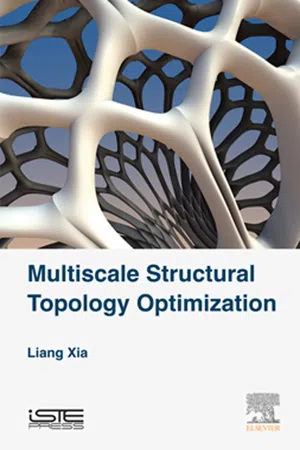
Multiscale Structural Topology Optimization
About this book
Multiscale Structural Topology Optimization discusses the development of a multiscale design framework for topology optimization of multiscale nonlinear structures. With the intention to alleviate the heavy computational burden of the design framework, the authors present a POD-based adaptive surrogate model for the RVE solutions at the microscopic scale and make a step further towards the design of multiscale elastoviscoplastic structures.
Various optimization methods for structural size, shape, and topology designs have been developed and widely employed in engineering applications. Topology optimization has been recognized as one of the most effective tools for least weight and performance design, especially in aeronautics and aerospace engineering.
This book focuses on the simultaneous design of both macroscopic structure and microscopic materials. In this model, the material microstructures are optimized in response to the macroscopic solution, which results in the nonlinearity of the equilibrium problem of the interface of the two scales. The authors include a reduce database model from a set of numerical experiments in the space of effective strain.
- Presents the first attempts towards topology optimization design of nonlinear highly heterogeneous structures
- Helps with simultaneous design of the topologies of both macroscopic structure and microscopic materials
- Helps with development of computer codes for the designs of nonlinear structures and of materials with extreme constitutive properties
- Focuses on the simultaneous design of both macroscopic structure and microscopic materials
- Includes a reduce database model from a set of numerical experiments in the space of effective strain
Information
1
Topology Optimization Framework for Multiscale Nonlinear Structures
Abstract:
This chapter introduces a topology optimization framework for multiscale nonlinear structures. As an extension of the conventional monoscale design, except that the material constitutive law is governed by one or multiple RVEs defined at the microscopic scale, the developed general multiscale design framework is made up of two key ingredients: multiscale modeling for structural performance simulation and topology optimization for structural design. This framework will serve as a basis for the developments presented in the subsequent chapters.
Keywords
BESO updating scheme; FE2 method; Finite element discretization; Model; Multiscale design; Nonlinear heterogeneous structure; Nonlinear homogeneous structure; Periodic boundary conditions; Sensitivity analysis; Topology optimization model
This chapter introduces a topology optimization framework for multiscale nonlinear structures. As an extension of the conventional monoscale design, except that the material constitutive law is governed by one or multiple RVEs defined at the microscopic scale, the developed general multiscale design framework is made up of two key ingredients: multiscale modeling for structural performance simulation and topology optimization for structural design. This framework will serve as a basis for the developments presented in the subsequent chapters.
With regard to the first ingredient, we employ the first-order computational homogenization method FE2 [FEY 00] to bridge structural and material scales. By this method, a clear separation of scales is a...
Table of contents
- Cover image
- Title page
- Table of Contents
- Copyright
- Introduction
- 1: Topology Optimization Framework for Multiscale Nonlinear Structures
- 2: POD-based Adaptive Surrogate for the Design of Multiscale Structures
- 3: Topology Optimization of Multiscale Elastoviscoplastic Structures
- 4: Simultaneous Topology Optimization of Structure and Materials
- 5: Reduced Database Model for Material Microstructure Optimizations
- Conclusion and Perspectives
- Appendix: Design of Extreme Materials in Matlab
- Bibliography
- Index
Trusted by 375,005 students
Access to over 1.5 million titles for a fair monthly price.
Study more efficiently using our study tools.
Frequently asked questions
Yes, you can cancel anytime from the Subscription tab in your account settings on the Perlego website. Your subscription will stay active until the end of your current billing period. Learn how to cancel your subscription
No, books cannot be downloaded as external files, such as PDFs, for use outside of Perlego. However, you can download books within the Perlego app for offline reading on mobile or tablet. Learn how to download books offline
Perlego offers two plans: Essential and Complete
- Essential is ideal for learners and professionals who enjoy exploring a wide range of subjects. Access the Essential Library with 800,000+ trusted titles and best-sellers across business, personal growth, and the humanities. Includes unlimited reading time and Standard Read Aloud voice.
- Complete: Perfect for advanced learners and researchers needing full, unrestricted access. Unlock 1.5M+ books across hundreds of subjects, including academic and specialized titles. The Complete Plan also includes advanced features like Premium Read Aloud and Research Assistant.
We are an online textbook subscription service, where you can get access to an entire online library for less than the price of a single book per month. With over 1.5 million books across 990+ topics, we’ve got you covered! Learn about our mission
Look out for the read-aloud symbol on your next book to see if you can listen to it. The read-aloud tool reads text aloud for you, highlighting the text as it is being read. You can pause it, speed it up and slow it down. Learn more about Read Aloud
Yes! You can use the Perlego app on both iOS and Android devices to read anytime, anywhere — even offline. Perfect for commutes or when you’re on the go.
Please note we cannot support devices running on iOS 13 and Android 7 or earlier. Learn more about using the app
Please note we cannot support devices running on iOS 13 and Android 7 or earlier. Learn more about using the app
Yes, you can access Multiscale Structural Topology Optimization by Liang Xia in PDF and/or ePUB format, as well as other popular books in Technology & Engineering & Applied Mathematics. We have over 1.5 million books available in our catalogue for you to explore.