eBook - ePub
Aquatic Functional Biodiversity
An Ecological and Evolutionary Perspective
- 312 pages
- English
- ePUB (mobile friendly)
- Available on iOS & Android
eBook - ePub
Aquatic Functional Biodiversity
An Ecological and Evolutionary Perspective
About this book
Aquatic Functional Biodiversity: An Ecological and Evolutionary Perspective provides a general conceptual framework by some of the most prominent investigators in the field for how to link eco-evolutionary approaches with functional diversity to understand and conserve the provisioning of ecosystem services in aquatic systems. Rather than producing another methodological book, the editors and authors primarily concentrate on defining common grounds, connecting conceptual frameworks and providing examples by a more detailed discussion of a few empirical studies and projects, which illustrate key ideas and an outline of potential future directions and challenges that are expected in this interdisciplinary research field.
Recent years have seen an explosion of interest in using network approaches to disentangle the relationship between biodiversity, community structure and functioning. Novel methods for model construction are being developed constantly, and modern methods allow for the inclusion of almost any type of explanatory variable that can be correlated either with biodiversity or ecosystem functioning. As a result these models have been widely used in ecology, conservation and eco-evolutionary biology. Nevertheless, there remains a considerable gap on how well these approaches are feasible to understand the mechanisms on how biodiversity constrains the provisioning of ecosystem services.
- Defines common theoretical grounds in terms of terminology and conceptual issues
- Connects theory and practice in ecology and eco-evolutionary sciences
- Provides examples for successful biodiversity conservation and ecosystem service management
Information
Topic
Scienze biologicheSubtopic
EcologiaSection I
Theoretical Background
Chapter 1
From Metabolic Constraints on Individuals to the Dynamics of Ecosystems
Samraat Pawar1, Anthony I. Dell2, and Van M. Savage3,4,5 1Department of Life Sciences, Imperial College London, Ascot, Berkshire, UK 2National Great Rivers Research and Education Center, Alton, IL, USA 3Department of Biomathematics, David Geffen School of Medicine, University of California, Los Angeles, CA, USA 4Department of Ecology and Evolutionary Biology, University of California, Los Angeles, CA, USA 5Santa Fe Institute, Santa Fe, NM, USA
Abstract
A major challenge in biology is to predict eco-evolutionary dynamics—coupled changes in the ecological dynamics of population density and the evolution of phenotypic (functional trait) variation within and between species—of entire communities and ecosystems. Although mathematical and computational tools allow eco-evolutionary dynamics to be simulated, it is difficult to isolate underlying mechanisms and therefore establish if simulated dynamics are relevant to the real world where the physical environment changes constantly over space and time. We argue that this problem can be resolved, or at least simplified, by first quantifying biomechanical and metabolic constraints on individual organisms, and then scaling these constraints up though ecological interactions to communities. This approach is logical also because environmental fluctuations affect ecosystems through their direct impacts on the fitness of individual organisms. We highlight recent theoretical and empirical advances toward the development of a mechanistic and metabolic-based understanding of trophic interactions and their eco-evolutionary consequences. In particular, we show how a metabolic theory of species interactions can naturally capture the ubiquitous effects of environmental temperature and body size constraints on community dynamics. Nevertheless, this theory is very much a work in progress, and we identify a number of important hurdles that stand in the way of a general, mechanistic understanding of the eco-evolutionary dynamics of aquatic ecosystems.
Keywords
Biomechanics; Body size; Consumer–resource dynamics; Fitness; Metabolism; Population dynamics; Spatial dimensionality; Stability; Temperature; Traits; Trophic interactionsIntroduction
Abiotic factors, such as temperature or the dimensionality of space within which organisms live, move, and search for food, directly impact ecological systems at the level of metabolic rate (rate of energy use) of individual organisms. Individual metabolic rate sets the “pace of life” for populations through generation time and maximal growth rate, rmax (Brown et al., 2004; Savage et al., 2004), which also scales up to influence coupled ecological and evolutionary dynamics. Therefore, understanding how environmental factors constrain individual metabolic rate, and how these individual-level constraints influence population dynamics of the whole interacting community, is key for understanding ecosystems (Figure 1). Indeed, there is now increasing consensus that individual physiology is fundamental for predicting how global climate change affects the eco-evolutionary dynamics of ecosystems (Manila et al., 1990; Allen et al., 2005; Lavergne et al., 2010; Yvon-Durocher et al., 2011; Dell et al., 2011; Thuiller et al., 2013). Furthermore, understanding how these dynamics differ between aquatic and terrestrial ecosystems is an interesting and important problem (Cohen and Fenchel, 1994; Shurin et al., 2006).
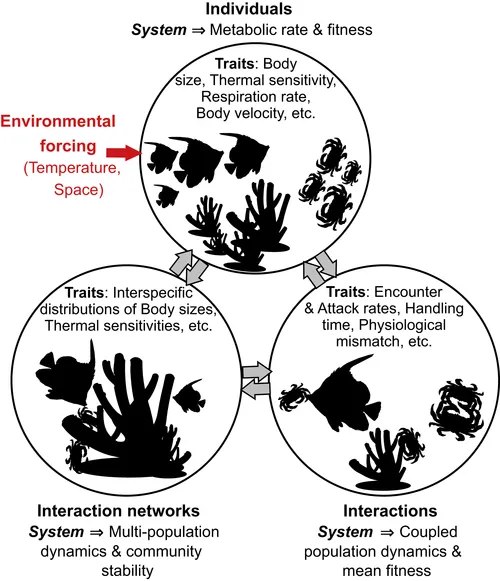
Figure 1 The study of coupled ecological and evolutionary dynamics is inherently hierarchical, each level (individuals, interactions, and interaction networks) comprising a system with distinct measurable dynamics. Note that although we deal mostly with consumer-resource (or trophic) interactions in this paper, we use the more general term “interaction” because many of the principles we discuss also apply to, or involve, other types of interactions such as intraspecific interactions. The bidirectional arrows connecting levels indicate that ecological (e.g., changes in abundance) and evolutionary (e.g., changes in trait distributions) feedback from one level can influence the system structure and dynamics in another. We include population dynamics and mean fitness as systemic properties of interactions, because no population grows or evolves in isolation from other populations in nature. Also note that community stability embodies the coupled dynamics of multiple populations, and that community-level traits, under our definition, consist of distributions of individual-level or interaction-level traits across species.
The last two decades have heralded a golden age for research on physiological ecology. This new surge of research has led to the publication of key concept...
Table of contents
- Cover image
- Title page
- Table of Contents
- Copyright
- Contributors
- Perspective: Functional Biodiversity during the Anthropocene
- Section I. Theoretical Background
- Section II. Across Aquatic Ecosystems
- Section III. In the Wild: Biodiversity and Ecosystem Service Conservation
- Epilogue: The Robustness of Aquatic Biodiversity Functioning under Environmental Change: The Ythan Estuary, Scotland
- Index
Trusted by 375,005 students
Access to over 1.5 million titles for a fair monthly price.
Study more efficiently using our study tools.
Frequently asked questions
Yes, you can cancel anytime from the Subscription tab in your account settings on the Perlego website. Your subscription will stay active until the end of your current billing period. Learn how to cancel your subscription
No, books cannot be downloaded as external files, such as PDFs, for use outside of Perlego. However, you can download books within the Perlego app for offline reading on mobile or tablet. Learn how to download books offline
Perlego offers two plans: Essential and Complete
- Essential is ideal for learners and professionals who enjoy exploring a wide range of subjects. Access the Essential Library with 800,000+ trusted titles and best-sellers across business, personal growth, and the humanities. Includes unlimited reading time and Standard Read Aloud voice.
- Complete: Perfect for advanced learners and researchers needing full, unrestricted access. Unlock 1.5M+ books across hundreds of subjects, including academic and specialized titles. The Complete Plan also includes advanced features like Premium Read Aloud and Research Assistant.
We are an online textbook subscription service, where you can get access to an entire online library for less than the price of a single book per month. With over 1.5 million books across 990+ topics, we’ve got you covered! Learn about our mission
Look out for the read-aloud symbol on your next book to see if you can listen to it. The read-aloud tool reads text aloud for you, highlighting the text as it is being read. You can pause it, speed it up and slow it down. Learn more about Read Aloud
Yes! You can use the Perlego app on both iOS and Android devices to read anytime, anywhere — even offline. Perfect for commutes or when you’re on the go.
Please note we cannot support devices running on iOS 13 and Android 7 or earlier. Learn more about using the app
Please note we cannot support devices running on iOS 13 and Android 7 or earlier. Learn more about using the app
Yes, you can access Aquatic Functional Biodiversity by Andrea Belgrano,Guy Woodward,Ute Jacob in PDF and/or ePUB format, as well as other popular books in Scienze biologiche & Ecologia. We have over 1.5 million books available in our catalogue for you to explore.