eBook - ePub
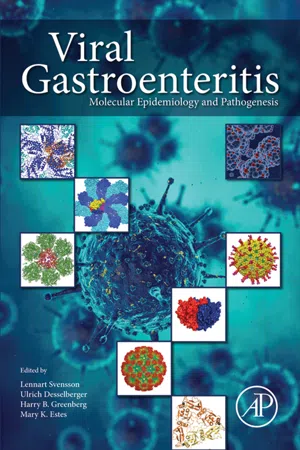
Viral Gastroenteritis
Molecular Epidemiology and Pathogenesis
- 588 pages
- English
- ePUB (mobile friendly)
- Available on iOS & Android
eBook - ePub
Viral Gastroenteritis
Molecular Epidemiology and Pathogenesis
About this book
Viral Gastroenteritis: Molecular Epidemiology and Pathogenesis provides a comprehensive review of research on viruses causing acute gastroenteritis in infants and young children, including coverage of rotaviruses, human caliciviruses, astroviruses, enteric adenoviruses, and viruses causing gastroenteritis more rarely. Includes general chapters on gastrointestinal physiology and pathophysiology, gastrointestinal immune mechanisms, immunodeficiencies and host genetics influencing susceptibility to viral gastroenteritis, and therapeutic and preventative approaches.
The book also includes special sections on virus particle structures, replication cycles, pathogenesis, immunology, epidemiology, and preventative measures. This book covers both basic science and translational applications and is an appropriate resource for virologists, molecular biologists, epidemiologists, gastroenterologists, vaccinologists, and those with an interest in public health.
- Features new approaches in diagnosis and characterization of viral gastroenteritis pathogens
- Includes coverage of therapeutic and preventative methods
- Covers recent advances in characterizing the molecular biology and immune responses of rotaviruses and noroviruses
- Covers both basic science and translational applications and is an appropriate resource for virologists, molecular biologists, epidemiologists, gastroenterologists, vaccinologists, and those with an interest in public health
Information
Chapter 1.1
Gastrointestinal Physiology and Pathophysiology
N.C. Zachos Hopkins Conte Digestive Disease Basic and Translational Research Core Center, Department of Medicine, Division of Gastroenterology and Hepatology, Johns Hopkins University School of Medicine, Baltimore, MD, United States
Abstract
Rotaviruses, noroviruses, astroviruses, and enteric adenoviruses are the four major viral causes of acute gastroenteritis, which is a major public health concern and a common cause of morbidity worldwide and mortality in low income settings. Although the intestinal epithelium serves as a protective barrier, enteric viral pathogens disrupt normal intestinal homeostasis, resulting in excessive nutrient and water loss. However, the cellular and molecular mechanisms responsible for viral diarrhea are not fully understood. While significant advances in viral diarrheal disease research have been accomplished, most of our understanding of the pathogenesis of gastroenteritis has come from studies of bacterial pathogens. The goal of this chapter is to describe the current understanding of normal intestinal physiology and compare the molecular mechanisms that are altered in diarrheal diseases induced by bacterial or viral pathogens.
Keywords
gut physiology
gut pathophysiology
fluid balance
intestinal absorption
sugar transport
anion secretion
intestinal enteroids
1. Introduction
The intestinal epithelium constantly manages the complex regulation of paracellular and transcellular transport of water, electrolytes, and small solutes to promote nutrient absorption and secretion of various compounds (electrolytes, methyl sulfides, benzopyrrole derivatives a.o.) while preventing excess fluid loss. The balance of absorptive and secretory processes is tightly regulated to manage the nearly 9 L/day of fluid in the intestinal lumen, of which nearly 98% are absorbed by the intestinal epithelium. These functions occur through the coordinated interplay of polarized columnar epithelial cells that are aligned in a continuous monolayer contoured by villi and crypts, which in addition to epithelial microvilli, enhance the plain surface area by greater than 600-fold (Montrose et al., 1999). The villous epithelium is predominantly comprised of mature enterocytes along with mucus-secreting Goblet cells, hormone producing entero-endocrine cells, and tuft cells while the crypt epithelium is mostly composed of immature enterocytes with Paneth and stem cells located at the crypt base (Barker et al., 2008; Cheng and Leblond, 1974). Pioneering work by the laboratory of Hans Clevers has identified Lgr5 as the molecular marker for the constantly dividing intestinal stem cells that differentiate into all intestinal epithelial cell types (Sato et al., 2011a). Intestinal stem cells confer segment-specific functions such that the proximal sma...
Table of contents
- Cover
- Title page
- Table of Contents
- Copyright
- Contributors
- Introduction
- Chapter 1.1: Gastrointestinal Physiology and Pathophysiology
- Chapter 1.2: Immunity in the Gut: Mechanisms and Functions
- Chapter 1.3: Immunodeficiencies: Significance for Gastrointestinal Disease
- Chapter 1.4: Therapy of Viral Gastroenteritis
- Chapter 2.1: Structure and Function of the Rotavirus Particle
- Chapter 2.2: Rotavirus Attachment, Internalization, and Vesicular Traffic
- Chapter 2.3: Rotavirus Replication and Reverse Genetics
- Chapter 2.4: Pleiotropic Properties of Rotavirus Nonstructural Protein 4 (NSP4) and Their Effects on Viral Replication and Pathogenesis
- Chapter 2.5: Rotavirus Replication: the Role of Lipid Droplets
- Chapter 2.6: Rotavirus Disease Mechanisms
- Chapter 2.7: Gnotobiotic Neonatal Pig Model of Rotavirus Infection and Disease
- Chapter 2.8: Innate Immune Responses to Rotavirus Infection
- Chapter 2.9: Human Acquired Immunity to Rotavirus Disease and Correlates of Protection
- Chapter 2.10: Molecular Epidemiology and Evolution of Rotaviruses
- Chapter 2.11: Rotavirus Vaccines and Vaccination
- Chapter 3.1: Structural Biology of Noroviruses
- Chapter 3.2: Calicivirus Replication and Reverse Genetics
- Chapter 3.3: Human Norovirus Receptors
- Chapter 3.4: Animal Models of Norovirus Infection
- Chapter 3.5: Molecular Epidemiology and Evolution of Noroviruses
- Chapter 3.6: Norovirus Vaccine Development
- Chapter 4.1: Studies of Astrovirus Structure–Function Relationships
- Chapter 4.2: Astrovirus Replication and Reverse Genetics
- Chapter 4.3: Molecular Epidemiology of Astroviruses
- Chapter 5.1: Enteric Viral Metagenomics
- Chapter 5.2: Interactions Between Enteric Viruses and the Gut Microbiota
- Index
Trusted by 375,005 students
Access to over 1.5 million titles for a fair monthly price.
Study more efficiently using our study tools.
Frequently asked questions
Yes, you can cancel anytime from the Subscription tab in your account settings on the Perlego website. Your subscription will stay active until the end of your current billing period. Learn how to cancel your subscription
No, books cannot be downloaded as external files, such as PDFs, for use outside of Perlego. However, you can download books within the Perlego app for offline reading on mobile or tablet. Learn how to download books offline
Perlego offers two plans: Essential and Complete
- Essential is ideal for learners and professionals who enjoy exploring a wide range of subjects. Access the Essential Library with 800,000+ trusted titles and best-sellers across business, personal growth, and the humanities. Includes unlimited reading time and Standard Read Aloud voice.
- Complete: Perfect for advanced learners and researchers needing full, unrestricted access. Unlock 1.5M+ books across hundreds of subjects, including academic and specialized titles. The Complete Plan also includes advanced features like Premium Read Aloud and Research Assistant.
We are an online textbook subscription service, where you can get access to an entire online library for less than the price of a single book per month. With over 1.5 million books across 990+ topics, we’ve got you covered! Learn about our mission
Look out for the read-aloud symbol on your next book to see if you can listen to it. The read-aloud tool reads text aloud for you, highlighting the text as it is being read. You can pause it, speed it up and slow it down. Learn more about Read Aloud
Yes! You can use the Perlego app on both iOS and Android devices to read anytime, anywhere — even offline. Perfect for commutes or when you’re on the go.
Please note we cannot support devices running on iOS 13 and Android 7 or earlier. Learn more about using the app
Please note we cannot support devices running on iOS 13 and Android 7 or earlier. Learn more about using the app
Yes, you can access Viral Gastroenteritis by Lennart Svensson,Ulrich Desselberger,Mary K Estes,Harry B Greenberg in PDF and/or ePUB format, as well as other popular books in Biological Sciences & Microbiology. We have over 1.5 million books available in our catalogue for you to explore.