- 316 pages
- English
- ePUB (mobile friendly)
- Available on iOS & Android
eBook - ePub
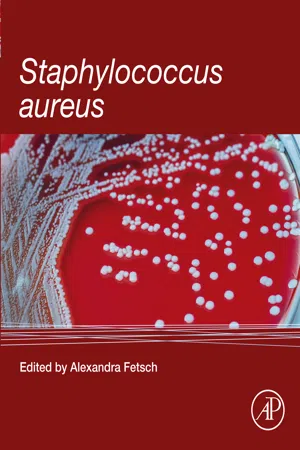
Staphylococcus aureus
About this book
Staphylococcus aureus provides information on food borne outbreaks of disease and their impact on human health. It is for anyone interested in the features of the pathogen, and its food safety aspects, as well as its prevalence and possible control and eradication options. This is a practical reference for those in the food industry, but also includes some theoretical information useful for advising.
The book introduces detailed features and molecular biology of the pathogen, as well as selective methods of detection, prevention and eradication essential for research. It covers methicillin-resistant staphylococcus aureus for food related industries, information on genetic lineages, cell wall components, cell division machinery, molecular characterization, and capillary electrophoresis for detecting and characterizing staphylococcus aureus.
- Includes information on established and novel antibiotic agents for experimental studies and methods of control and eradication
- Presents use cases of outbreak studies in molecular and cell biology
- Provides summary points of detection methods and applicability of those methods to other foodborne pathogens
- Covers the Staphylococcus aureus' mode of transmission, detection, biology and impact on foodborne illness
Information
Part I
Introduction
Chapter 1
Staphylococcus aureus—A Foodborne Pathogen
Epidemiology, Detection, Characterization, Prevention, and Control: An Overview
Delia Grace1, and Alexandra Fetsch2 1International Livestock Research Institute (ILRI), Nairobi, Kenya 2German Federal Institute for Risk Assessment (BfR), Berlin, Germany
Abstract
The genus Staphylococcus currently comprises more than 50 species. These small, hardy bacteria are normal inhabitants of the skin and mucous membrane in many animal species including humans; they are also ubiquitous in the environment. However, Staphylococcus aureus is also an important pathogen of humans and animals. It is a common cause of skin infections and foodborne disease in people, as well as sepsis in hospitals and nurseries. It is also an important cause of mastitis in dairy animals and of bone and joint lesions in poultry (bumblefoot) as well as an occasional cause of skin infections in livestock. Companion animals, such as dogs, cats, and horses, may play a role in S. aureus transmission; they are also vulnerable to S. aureus infections (Bierowiec et al., 2016). This chapter aims to provide a brief introduction of the versatile bacterial organism S. aureus, with special focus on its role as foodborne pathogen both, from the perspective of the industrialized and the developing word. Moreover, this chapter briefly outlines the content of the whole book.
Keywords
Foodborne disease; MRSA; Overview; Staphylococcus aureus
1. Introduction
The genus Staphylococcus currently comprises more than 50 species. These small, hardy bacteria are normal inhabitants of the skin and mucous membrane in many animal species including humans; they are also ubiquitous in the environment. However, Staphylococcus aureus is also an important pathogen of humans and animals. It is a common cause of skin infections and foodborne disease (FBD) in people, as well as sepsis in hospitals and nurseries. It is also an important cause of mastitis in dairy animals and of bone and joint lesions in poultry (bumblefoot) as well as an occasional cause of skin infections in livestock. Companion animals, such as dogs, cats and horses, may play a role in S. aureus transmission; they are also vulnerable to S. aureus infections (Bierowiec et al., 2016).
This chapter aims to provide a brief introduction of the versatile bacterial organism S. aureus, with special focus on its role as foodborne pathogen both, from the perspective of the industrialized and the developing word. Moreover, this chapter briefly outlines the content of the whole book.
2. Staphylococcus aureus—A Brief Overview
Staphylococci were first isolated from human pus in 1880 by the Scottish surgeon Alexander Ogston: the name derives from staphyle (bunch of grapes) and kokkos (berry) because the bacteria resembled bunches of grapes when viewed microscopically (Licitra, 2013). In 1886, two strains of Staphylococcus were isolated in pure culture by Anton J. Rosenbach, a German surgeon (Rosenbach, 1884). One of these was S. aureus, so-named because of the color of the pigmented colonies (aureus means gold-colored in Latin). In the 1920s, it was recognized that presence of coagulase (an enzyme that clots plasma) was associated with pathogenicity, and a coagulase test developed in the late 1930s was an important advance in diagnosis. During the Second World War, penicillin was introduced to clinical use: S. aureus was highly susceptible. However, by the late 1940s, penicillin use was common in hospitals and resistant strains started to outnumber susceptible strains. Increased resistance stimulated development of semisynthetic penicillins, such as methicillin, but by the 1990s hospitals were reporting high levels of methicillin-resistant S. aureus (MRSA) as well as emerging cases of community-associated MRSA, now an important problem in some parts of the world (Chambers and DeLeo, 2009; David and Daum, 2010). Vancomycin is a common treatment for MRSA but resistance to this has also developed. In the early 21st century a new strain of MRSA was identified in pigs and swine workers, and subsequently other livestock-associated MRSA (LA-MRSA) strains have been found in livestock and raw meat. These LA-MRSA are sporadic causes of human infections in several countries but there is also concern that LA-MRSA could readapt to humans resulting in widespread endemic and epidemic human disease (Cuny et al., 2015).
The largest ecological reservoir of human strains of S. aureus is the human nose; however, the skin, hair, and mucous membranes may also be colonized. These resident bacteria do not normally cause disease but nasal carriage is strongly associated with infection; although, only a tiny minority of carriers will ever fall ill from S. aureus infection (Brown et al., 2013).
Molecular analysis and pathogenesis suggest that the ancestral host of S. aureus is humans (Ng et al., 2009) and phylogenetic data estimate a root age of 25,000 to 142,000 years ago (Weinert et al., 2012). As such, S. aureus can be considered an “heirloom disease”, i.e., one that has been passed down for millennia from person-to-person (Grace and McDermott, 2011). The health of humans and animals is closely interdependent and many human diseases are shared with animals and vice versa. Molecular epidemiology suggests that S. aureus has jumped from humans to livestock several times in the past and has more rarely switched species from livestock back to people (Shepheard et al., 2013). The first jump from humans to cattle took place around 5500 years ago, coinciding with the expansion of cattle domestication throughout the Old World. The first jump to poultry is estimated at around 275 years ago (Weinert et al., 2012). It is currently thought there were at least 13 jumps from humans and animals and two jumps from animal populations back to humans (Shepheard et al., 2013).
As for many diseases, S. aureus infections tend to appear in cyclical outbreaks when new epidemic strains appear, spread widely, and then fade again (Shinefield and Ruff, 2009). The last century saw four major waves of drug resistant S. aureus in human medicine (Chambers and DeLeo, 2009). Similarly, the clone of S. aureus responsible for an ongoing pandemic of lameness in broiler poultry is likely the descendants of a single human-to-poultry host jump that occurred about 40 years ago probably promoted by industrialization of the poultry industry (Lowder et al., 2009).
This book focuses on the role of S. aureus as a foodborne pathogen, but the organism causes a wide range of important diseases in people and animals. In humans, S. aureus can infect damaged skin resulting in superficial or deep infections of skin and soft tissue. Less commonly but with more severe consequences, S. aureus causes bacteremia; this is often hospital associated, following breaching of the skin barrier with surgical devices or implants. Bacteremia can be complicated septicemia and localization in organs, joints, bones, and elsewhere. Staphylococcal pneumonia may be a primary infection or result from hematogenous spread: it is not common in community-acquired infections but it is in hospital-acquired infections. Neonates, especially those born prematurely, are also susceptible to staphylococcal disease, resulting in scalded skin syndrome and other manifestations. S. aureus is also a cause of toxic shock syndrome, first described in children and later associated with use of superabsorbent tampons in menstruating women.
S. aureus is not only a human (facultative) pathogen but a commensal bacteria and pathogen of several animal species, too. However, the strains carried by animals usually are host-specific and not normally present in humans. In countries with a developed dairy sector, S. aureus is one of the most important causes of mastitis, which in turn is the most common and costly disease on dairy farms (Kee...
Table of contents
- Cover image
- Title page
- Table of Contents
- Copyright
- List of Contributors
- Preface
- Part I. Introduction
- Part II. Characteristics and Detection of Staphylococcus aureus
- Part III. Staphylococcus aureus From Farm to Fork—Food Safety Aspects
- Part IV. Prevention and Control of Staphylococcus aureus in the Food Chain
- Index
Trusted by 375,005 students
Access to over 1.5 million titles for a fair monthly price.
Study more efficiently using our study tools.
Frequently asked questions
Yes, you can cancel anytime from the Subscription tab in your account settings on the Perlego website. Your subscription will stay active until the end of your current billing period. Learn how to cancel your subscription
No, books cannot be downloaded as external files, such as PDFs, for use outside of Perlego. However, you can download books within the Perlego app for offline reading on mobile or tablet. Learn how to download books offline
Perlego offers two plans: Essential and Complete
- Essential is ideal for learners and professionals who enjoy exploring a wide range of subjects. Access the Essential Library with 800,000+ trusted titles and best-sellers across business, personal growth, and the humanities. Includes unlimited reading time and Standard Read Aloud voice.
- Complete: Perfect for advanced learners and researchers needing full, unrestricted access. Unlock 1.5M+ books across hundreds of subjects, including academic and specialized titles. The Complete Plan also includes advanced features like Premium Read Aloud and Research Assistant.
We are an online textbook subscription service, where you can get access to an entire online library for less than the price of a single book per month. With over 1.5 million books across 990+ topics, we’ve got you covered! Learn about our mission
Look out for the read-aloud symbol on your next book to see if you can listen to it. The read-aloud tool reads text aloud for you, highlighting the text as it is being read. You can pause it, speed it up and slow it down. Learn more about Read Aloud
Yes! You can use the Perlego app on both iOS and Android devices to read anytime, anywhere — even offline. Perfect for commutes or when you’re on the go.
Please note we cannot support devices running on iOS 13 and Android 7 or earlier. Learn more about using the app
Please note we cannot support devices running on iOS 13 and Android 7 or earlier. Learn more about using the app
Yes, you can access Staphylococcus aureus by Alexandra Fetsch in PDF and/or ePUB format, as well as other popular books in Biological Sciences & Microbiology. We have over 1.5 million books available in our catalogue for you to explore.