- 292 pages
- English
- ePUB (mobile friendly)
- Available on iOS & Android
eBook - ePub
About this book
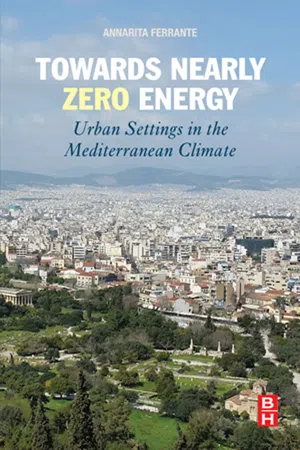
Towards Nearly Zero Energy: Urban Settings in the Mediterranean Climate discusses tactics that can be used to effectively reduce energy consumption towards zero energy. With energy usage in buildings accounting for over 40% of primary energy use and 24% of greenhouse gas emissions worldwide, this remains an unavoidable objective.
The book looks at the life of the systems of energy production from renewable sources amidst the exceptionally challenging global economic crisis that the Mediterranean areas and other societies are currently experiencing. By using an innovative and interdisciplinary approach of socio-oriented technological design, the book indicates tools and measures that can be developed at the public, legislative, and market levels to counterbalance the large pay-back times of energy efficiency measures.
In particular, the book displays guidelines and best practices to activate new forms of economic incentives in order to attract potential investors that demonstrate that a large set of possible solutions is technically feasible to achieve nearly zero energy, even in high energy consuming circumstances and urban settings.
Furthermore, by discussing and comparing the economic and energy impact of different technology options, this work offers guidelines and best practices to activate new cost-effective forms and social incentives in order to attract both potential investors and motivate the urban stakeholders toward nearly zero energy.
- Strategies and zero energy solutions for practitioners
- Policy s and economic resolutions to combat legislative barriers
- Examples and case studies of nearly zero energy urban environments
Information
Topic
BetriebswirtschaftSubtopic
EnergiebrancheChapter 1
The Framework of Urban Built Environments
Abstract
This chapter is concerned with the framework of urban built environments and related energy issues; it discusses some progress in nearly zero energy research and practice, with particular reference to the Mediterranean context and the Athens metropolitan area. This chapter gives a review of the main energy-related issues in an urban environment, with a particular reference to a background description of the Mediterranean climate and its cooling demand related to the heat island phenomenon; a brief review of the current policy background related to nearly zero energy buildings (nZEBs) with some notes on the definition of nZEBs with regard to recent European directives; and a concise review on past and recent case studies and demonstration projects in the Mediterranean region. Starting from these studies in literature and from achievements in pilot projects aimed at reducing the cooling and heating demand in these buildings, a brief discussion to consolidate current technical knowledge in nZEB and its deeper penetration in common building practices is presented. The final section of the chapter also presents the next steps that must be undertaken to widen the nZEB technical knowledge in the existing built environments of Mediterranean cities and to shift the application of today’s technical achievements from being used not only in newly conceived buildings, but also toward the rehabilitation of existing building stock.
Keywords
nearly zero energy buildings and urban settings
heat island effect
passive houses
passive cooling techniques
mediterranean climate
sustainable building design
1.1. Introduction
In some ways, nowadays the concept of green buildings belongs to the “history of architecture,” as the first prototype solar houses and the first attempts to achieve zero heating date back to the 1950s (Hernandez and Kenny, 2010). Over the past several decades, energy-oriented innovations in building technology have emerged in many areas of the building construction sector (Brown and Vergragt, 2008).The latest projects are aimed at setting to zero the energy demand and the carbon emissions of new housing developments and even of a whole city. Working toward this goal is the well-known urban village BedZED, the Beddington Zero Emission Development, winner of the prestigious Energy Awards in Linz, Housing and Building category, Austria, 2002 (Dunster et al., 2009). Another well-known example is the first zero waste/zero carbon emission city designed by Norman Foster, in Abu Dhabi, Masdar City, where the urban development is designed as a huge, positive energy building complex, resulting in a self-sustaining, car-free, urban environment. Finally, a pilot city plan to set to zero the carbon emissions of the entire city of Copenhagen (The Climate Plan, City of Copenhagen, 2009) shows how to make this city the world’s first carbon-neutral capital by 2025, by means of using biomass in power stations, erecting windmill parks, increasing reliance on geothermal power, and renovating the district heating network.
We may assume that at present, energy-saving technologies have been successfully developed, that energy-efficient building designs have been experienced and extensively publicized, and that we own a large set of best available technologies (BATs). In other words, we now possess the technical knowledge to design and construct zero-energy buildings and city as well. “Moreover, extensive monitoring of local, national, and international building stocks means we know more than ever before about the precise potential for improved energy performance” (Guy, 2006).
Today, the concept of nearly zero energy building (nZEB) has gained great international attention. It represents the principal target of the next generation of buildings; in fact, building design construction and practices need to respond quickly to the mandatory nearly zero energy requirements for new construction within a few years (EU Directive on Energy Performance of Buildings, 2011; EU Communication, 2011a, 2011b).1 The increasing interest in nZEBs, the recent European and national directives on energy performance of b (EPB), and more easily accessible BATs and renewable energy sources (RES) all seem to point to further exploitation of BATs and better penetration of RES into new building construction. However, current construction practices in the new housing sector show limited signs of change (Ferrante and Semprini, 2011). Furthermore, despite growing investments in RES technology (Bürer and Wüstenhagen, 2009), feed-in tariffs and, in general, policy incentives (Bulkeley, 2010), additional investments are needed to reduce carbon emissions and fossil fuel consumption.2 “Needless to say, this is particularly challenging in a context of global economic slowdown such as the one the world is currently experiencing” (Masini and Menichetti, 2010).
This concern is particularly true within the Mediterranean areas, where mild win...
Table of contents
- Cover
- Title page
- Table of Contents
- Copyright
- Foreword
- Chapter 1: The Framework of Urban Built Environments
- Chapter 2: Nearly Zero Energy Urban Settings (ZEUS)
- Chapter 3: Understanding Economic Constraints to Achieve Nearly ZEUS
- Appendix
- Glossary
- Subject Index
Trusted by 375,005 students
Access to over 1.5 million titles for a fair monthly price.
Study more efficiently using our study tools.
Frequently asked questions
Yes, you can cancel anytime from the Subscription tab in your account settings on the Perlego website. Your subscription will stay active until the end of your current billing period. Learn how to cancel your subscription
No, books cannot be downloaded as external files, such as PDFs, for use outside of Perlego. However, you can download books within the Perlego app for offline reading on mobile or tablet. Learn how to download books offline
Perlego offers two plans: Essential and Complete
- Essential is ideal for learners and professionals who enjoy exploring a wide range of subjects. Access the Essential Library with 800,000+ trusted titles and best-sellers across business, personal growth, and the humanities. Includes unlimited reading time and Standard Read Aloud voice.
- Complete: Perfect for advanced learners and researchers needing full, unrestricted access. Unlock 1.5M+ books across hundreds of subjects, including academic and specialized titles. The Complete Plan also includes advanced features like Premium Read Aloud and Research Assistant.
We are an online textbook subscription service, where you can get access to an entire online library for less than the price of a single book per month. With over 1.5 million books across 990+ topics, we’ve got you covered! Learn about our mission
Look out for the read-aloud symbol on your next book to see if you can listen to it. The read-aloud tool reads text aloud for you, highlighting the text as it is being read. You can pause it, speed it up and slow it down. Learn more about Read Aloud
Yes! You can use the Perlego app on both iOS and Android devices to read anytime, anywhere — even offline. Perfect for commutes or when you’re on the go.
Please note we cannot support devices running on iOS 13 and Android 7 or earlier. Learn more about using the app
Please note we cannot support devices running on iOS 13 and Android 7 or earlier. Learn more about using the app
Yes, you can access Towards Nearly Zero Energy by Annarita Ferrante in PDF and/or ePUB format, as well as other popular books in Betriebswirtschaft & Energiebranche. We have over 1.5 million books available in our catalogue for you to explore.