eBook - ePub
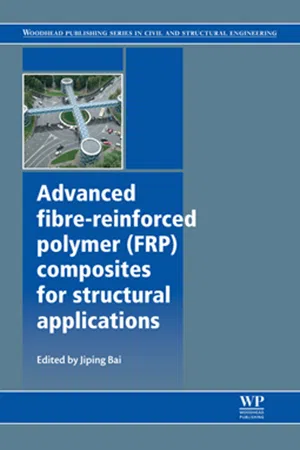
Advanced Fibre-Reinforced Polymer (FRP) Composites for Structural Applications
- 928 pages
- English
- ePUB (mobile friendly)
- Available on iOS & Android
eBook - ePub
Advanced Fibre-Reinforced Polymer (FRP) Composites for Structural Applications
About this book
Advanced fibre-reinforced polymer (FRP) composites have become essential materials for the building of new structures and for the repair of existing infrastructure. Advanced fibre-reinforced polymer (FRP) composites for structural applications provides an overview of different advanced FRP composites and the use of these materials in a variety of application areas.Part one introduces materials used in the creation of advanced FRP composites including polyester, vinylester and epoxy resins. Part two goes on to explore the processing and fabrication of advanced FRP composites and includes chapters on prepreg processing and filament winding processes. Part three highlights properties of advanced FRP composites and explores how performance can be managed and tested. Applications of advanced FRP composites, including bridge engineering, pipe rehabilitation in the oil and gas industry and sustainable energy production, are discussed in part four.With its distinguished editor and international team of expert contributors, Advanced fibre-reinforced polymer (FRP) composites for structural applications is a technical resource for researchers and engineers using advanced FRP composites, as well as professionals requiring an understanding of the production and properties of advanced FRP composites, and academics interested in this field.
- Provides an overview of different advanced FRP composites and the use of these materials in a variety of application areas
- Introduces materials used in the creation of advanced FRP composites including polyester, vinylester and epoxy resins
- Explores the processing and fabrication of advanced FRP composites and includes chapters on prepreg processing and filament winding processes
Information
Subtopic
Civil Engineering1
Introduction
J. Bai, University of, South Wales, UK
Abstract:
Fibre-reinforced polymer (FRP) composites have become essential materials for maintaining and strengthening existing infrastructure. Many new innovative types of hybrid material and structural systems have been developed using FRP composite materials. Increased utilisation of FRP requires that structural engineers and practitioners be able to understand the behaviour of FRP materials and design composite structures. This book provides an overview of different advanced FRP composites and the use of these materials in a variety of application areas. This chapter specifically covers a brief review on FRP applications and gives an outline of the book.
Key words
fibre-reinforced polymer (FRP)
composites
structural engineering
strengthening
concrete
civil engineering
Over the past few decades advanced composites have increasingly become smart materials for new structures and the renewal of existing civil engineering infrastructures. This book focuses on various aspects of advanced fibre-reinforced polymer (FRP) composites in civil engineering: materials; processing and fabrication; properties, performance and testing. It also provides an overview of the applications of advanced FRP composites in civil and structural engineering. The book is a useful text for graduate students in the area of composites in general, and civil engineering and construction in particular. It is also a comprehensive and practical resource for practising engineers, researchers, manufacturers and suppliers.
Advanced composite materials were primarily developed for aerospace to enhance the performance of commercial and military aircraft [1]. They still play a significant role in current and future aerospace components. However, in recent years composite materials have become particularly attractive for civil engineering infrastructure applications due to their exceptional strength and stiffness-to-density ratios and superior physical properties [2]. Considerable advances have been made in the use of composite materials in the construction and building industries, and this trend will continue. Fibre-reinforced polymer (FRP) composites are now widely used in civil engineering applications [3–9]. The repair and maintenance of deteriorated, damaged and substandard civil infrastructures has become one of the most important issues for the civil engineer worldwide [10–12]. The use of externally bonded fibre-reinforced polymer (FRP) composites to strengthen, rehabilitate and retrofit civil engineering structures is fully discussed throughout this book. The book is organised into four parts. Each chapter within a part is written by a leading expert (or team of experts) and deals with a specific topic with detailed referencing to primary sources for further research.
Fibre-reinforced polymer (FRP) composites are composed of fibres and matrices, which are bonded through the interface to ensure that the composite system as a whole gives satisfactory performance. Part I deals with FRP composite matrix materials which provide the foundation for composite materials. Chapter 2 reviews the chemistry of phenolic resins together with their mechanical and thermal properties. Chapter 3 discusses polyester thermoset resins as matrix materials. an overview of the chemistry of vinylester resins, together with their mechanical and chemical properties, as well as their use as a matrix material in the construction industry, is provided in Chapter 4. The final chapter in Part I begins with a review of the epoxy resins commonly available on the market, and then focuses on the principal characteristics of epoxy resin composite systems and their practical applications.
The mechanical properties of FRP composites are dependent upon the ratio of fibre and matrix material, the mechanical properties of the constituent materials, the fibre orientation in the matrix, and ultimately the processing and methods of fabrication, which are the subject of Part II. Chapters discuss prepreg processing, liquid composite moulding (LCM), filament winding processes and pultrusion of advanced fibre-reinforced polymer (FRP) composites.
FRP composite structural analysis and design require a good knowledge of material properties. Part III is primarily devoted to the properties, performance and testing of FRP composites. Chapters examine the stress-related aspects of composites in civil engineering applications – particularly the critical interfacial adhesive stresses. Part III also deals with the elastic property analysis of laminated advanced composites, gives a general overview of composite stiffness and assesses unidirectional reinforced composites. This part also looks into the basic mechanisms involved in the environmental degradation of FRP composites and the impact of the ageing mechanisms of the polymer matrix on the mechanical properties of composites. Practical tests on FRP composite substructures and full-scale structures are also discussed.
The use of FRP composites in various structural applications is reviewed in Part IV. it covers a wide range of applications of FRP in civil engineering infrastructures, including advanced FRP composites to strengthen structures vulnerable to seismic damage, FRP composite materials for bridge construction and rehabilitation, the manufacture and rehabilitation of pipes and tanks in the oil and gas industry, and for the rehabilitation of timber and concrete structures. The key material requirements for sustainable energy production are reviewed and the use of composites in renewable energy such as wind power, tidal and wave power and solar power are discussed, including the manufacture, maintenance and recycling of advanced FRP composite wind turbine blades.
FRP composite materials are durable [13,14] and have reasonable fatigue life [15–17]. They have high strength-to-weight ratios and are easily adapted almost into any shape and size of structure. FRP are corrosion-resistant and largely weather-resistant. They have excellent chemical resistance. Moreover, FRP composites are lightweight and relatively cheap to manufacture. The composites industry is still evolving in the area of high-performance materials for ageing civil engineering infrastructure. FRP composites will potentially play a major role in extending the service life of the world’s infrastructure in this century. With its distinguished international team of authors, this book offers a valuable reference for university students, researchers and scientists, as well as a practical guide for engineers, contractors and practitioners working on the new, rehabilitation and strengthening of the civil infrastructure.
1.1 References
1. Soutis, C. Fibre reinforced composites in aircraft construction. Progress in Aerospace Sciences. 2005; 41(2):143–151.
2. Cripps, A. Fibre-reinforced Polymer Composites in Construction. ClRlA, London, 2002.
3. Hollaway, L.C. A review of the present and future utilisation of FRP composites in the civil infrastructure with reference to their important in-service properties. Construction and Building Materials. 2010; 24(12):2419–2445.
4. Bakis, C., et al. Fiber-reinforced polymer composites for construction – state-of-the- art review. Journal of Composites for Construction. 2002; 6(2):73–87.
5. Kendall, D. Building the future with FRP composites. Reinforced Plastics. 2007; 51(5):26–33.
6. Kim, G.B., Pilakoutas, K., Waldron, P. Thin FRP/GFRC structural elements. Cement and Concrete Composites. 2008; 30(2):122–137.
7. Cheng, J., et al. Design and analysis of a smart composite pipe joint system integrated with piezoelectric layers under bending. International Journal of Solids and Structures. 2007; 44(1):298–319.
8. Shouman, A., Taheri, F. Compressive strain limits of composite repaired pipelines under combined loading states. Composite Structures. 2011; 93(6):1538–1548.
9. Zou, G.P., Taheri, F. Stress analysis of adhesively bonded sandwich pipe joints subjected to torsional loading. International Journal of Solids and Structures. 2006; 43(20):5953–5968.
10. Hollaway, L., Teng, J.G. Strengthening and Rehabilitation of Civil Infrastructures using Fibre-reinforced Polymer (FRP) Composites. Woodhead Publishing, Cambridge, 2008.
11. Leeming, M.B., Hollaway, L. Strengthening of Reinforced Concrete Structures: Using Externally-bonded FRP Composites in Structural and Civil Engineering. CRC Press, Cambridge, 1999.
12. Taheri, F., Shahin, K., Widiarsa, I. On the parameters influencing the performance of reinforced concrete beams strengthened with FRP plates. Composite Structures. 2002; 58(2):217–226.
13. Custódio, J., Broughton, J., Cruz, H. A review of factors influencing the durability of structural bonded timber joints. International Journal of Adhesion and Adhesives. 2009; 29(2):173–185.
14....
Table of contents
- Cover image
- Title page
- Table of Contents
- Copyright
- Contributor contact details
- Woodhead Publishing Series in Civil and Structural Engineering
- Chapter 1: Introduction
- Part I: Materials
- Part II: Processing and fabrication
- Part III: Properties, performance and testing
- Part IV: Applications
- Index
Trusted by 375,005 students
Access to over 1.5 million titles for a fair monthly price.
Study more efficiently using our study tools.
Frequently asked questions
Yes, you can cancel anytime from the Subscription tab in your account settings on the Perlego website. Your subscription will stay active until the end of your current billing period. Learn how to cancel your subscription
No, books cannot be downloaded as external files, such as PDFs, for use outside of Perlego. However, you can download books within the Perlego app for offline reading on mobile or tablet. Learn how to download books offline
Perlego offers two plans: Essential and Complete
- Essential is ideal for learners and professionals who enjoy exploring a wide range of subjects. Access the Essential Library with 800,000+ trusted titles and best-sellers across business, personal growth, and the humanities. Includes unlimited reading time and Standard Read Aloud voice.
- Complete: Perfect for advanced learners and researchers needing full, unrestricted access. Unlock 1.5M+ books across hundreds of subjects, including academic and specialized titles. The Complete Plan also includes advanced features like Premium Read Aloud and Research Assistant.
We are an online textbook subscription service, where you can get access to an entire online library for less than the price of a single book per month. With over 1.5 million books across 990+ topics, we’ve got you covered! Learn about our mission
Look out for the read-aloud symbol on your next book to see if you can listen to it. The read-aloud tool reads text aloud for you, highlighting the text as it is being read. You can pause it, speed it up and slow it down. Learn more about Read Aloud
Yes! You can use the Perlego app on both iOS and Android devices to read anytime, anywhere — even offline. Perfect for commutes or when you’re on the go.
Please note we cannot support devices running on iOS 13 and Android 7 or earlier. Learn more about using the app
Please note we cannot support devices running on iOS 13 and Android 7 or earlier. Learn more about using the app
Yes, you can access Advanced Fibre-Reinforced Polymer (FRP) Composites for Structural Applications by Jiping Bai,J Bai in PDF and/or ePUB format, as well as other popular books in Technology & Engineering & Civil Engineering. We have over 1.5 million books available in our catalogue for you to explore.