eBook - ePub
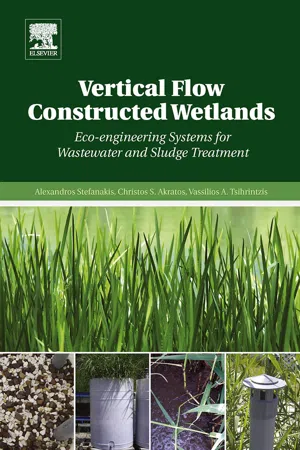
Vertical Flow Constructed Wetlands
Eco-engineering Systems for Wastewater and Sludge Treatment
- 392 pages
- English
- ePUB (mobile friendly)
- Available on iOS & Android
eBook - ePub
Vertical Flow Constructed Wetlands
Eco-engineering Systems for Wastewater and Sludge Treatment
About this book
Vertical flow constructed wetlands for wastewater and sludge treatment represent a relatively new and still growing technology. Vertical Flow Constructed Wetlands is the first book to present the state-of-the-art knowledge regarding vertical flow constructed wetlands theory and applications. In this book, you will learn about vertical flow systems with information about application and performance. Vertical Flow Constructed Wetlands also includes information on how different countries are applying the technology, with design guidelines to illustrate best practices worldwide. A focus on water conservation through reuse of treated water showcases the benefit of vertical flow construction, which has greatly increased the attractiveness of the technology in recent years.
- All state-of-the-art knowledge regarding vertical flow constructed wetlands gathered in one book
- A review of various constructed wetland approaches, including information about applications and performance, helps clarify what is currently known about constructed wetland principles and design
- Discussion of how to manage the treated wastewater leaving the vertical flow for increasing biodiversity, providing food and habitat for birds, and producing harvestable biomass or crops
- Includes case studies of constructed wetlands in developing countries
Information
Chapter 1
Introduction
Abstract
In this chapter, a first approach to the definitions of natural and constructed wetlands is presented. A brief description of the multilevel functions and values of natural wetland ecosystems is included, since the deep understanding of the multiple wetland benefits to human society is crucial for the realization of their global importance. This fact allowed for the transition from natural to engineered wetland systems. During the last century, the water purification capacity of wetland systems was recognized and it has been shown that wetlands are able to eliminate and transform various pollutants. Constructed wetlands technology was mainly developed during the last 2–3 decades, compared to conventional treatment methods which are used for more than 80 years now. These alternative, sustainable treatment systems possess a variety of ecological, economical, technical, and social advantages which place them into the forefront of scientific development. At the end of this chapter, a brief description of the book contents is presented.
Keywords
natural wetlands
constructed wetlands
values
benefits
1.1 Natural V. Constructed Wetlands
1.1.1 Definitions
Natural wetlands are transitional areas between terrestrial and aquatic systems, integrating characteristics of both dry and wet environments. They can be fully or partially covered by water for extended periods of time or during the whole year. They are dynamic systems, continuously evolving and changing their characteristics with time. The level of water saturation is a main factor that determines the nature of the soil and the types of plant and animal species that live in wetlands. The characteristics of natural wetlands are affected by a variety of local/regional parameters, including climate, hydrology, topography, water chemistry, vegetation, and human disturbance nowadays, among others. Due to these exact characteristics and parameters that regulate their status and appearance, natural wetlands can be found on every continent except Antarctica.
There is a variety of wetland types, which makes it difficult to formulate a precise, internationally accepted definition. One of the best and recognized definitions for natural wetlands was provided by the Ramsar Convention on wetlands in 1971 (Ramsar, 2012). This Convention adopted an international, intergovernmental definition for wetlands, based on a broad approach to describe to the best the main wetland characteristics. Wetlands are defined as “areas of marsh, fen, peatland or water, whether natural or artificial, permanent or temporary, with water that is static or flowing, fresh, brackish or salt, including areas of marine water, the depth of which at low tide does not exceed six meters.” Natural wetlands include areas like estuaries, mangroves, tidal flats, floodplains, deltas, freshwater marshes, lakes, lagoons, swamps, and springs of underground aquifers. As their name indicates, they are created without any human intervention. According to the same Convention, the same terms also include riparian and coastal zones adjacent to natural wetlands or islands or sea ponds that are deeper than 6 m, but located within the boundaries of the wetland. Moreover, Section 404 of the US Clean Water Act defines wetlands as follows: “Those areas that are inundated or saturated by surface or ground water (hydrology) at a frequency and duration sufficient to support, and that under normal circumstances do support, a prevalence of vegetation (hydrophytes) typically adapted for life in saturated soil conditions (hydric soils). Wetlands generally include swamps, marshes, bogs, and similar areas” (USEPA, 1972).
The IUCN (International Union for the Conservation of Nature) Natural Heritage Program, which was established in 1996, prepared a list of 77 World Heritage wetland sites with major and secondary values in 50 different countries (Thorsell et al., 1997). The world area of wetlands is difficult to estimate. Some estimates report a present total wetland area of 5.7 million km2 (6% of Earth’s surface), of which 30% are bogs, 26% fens, 20% swamps, 15% floodplains, and 2% lakes, with the addition of 0.24 and 0.6 million km2 of remaining mangroves and coral reefs, respectively (Thorsell et al., 1997). Another estimate increases the total wetland area up to 6.9 million km2, including 1.5 million km2 of rice paddies (Matthews and Fung, 1987). The Global Review of Wetland Resources and Priorities for Wetland Inventory in 1999 increased the estimated global wetlands area from national inventories up to 12.80 million km2 (Finlayson and Spiers, 1999). The data for this estimate were obtained from several sources and include inland and coastal wetlands (including marshes, lakes, and rivers), near-shore marine areas (to a depth of 6 m below low tide), and human-made wetlands such as reservoirs and rice paddies (Table 1.1).
Table 1.1
Ramsar Sites Number and Area per Region (MEA, 2005)
| Total Area of Ramsar Sites (million ha, 2011) | Number of Ramsar Sites (2011) | Wetlands of International Importance (Ramsar Sites) | |
| Africa | 85 | 310 | 160 |
| Asia | 14 | 254 | 174 |
| Europe | 25 | 939 | 805 |
| Neotropics | 33 | 161 | 126 |
| North America | 23 | 191 | 117 |
| Oceania | 8 | 77 | 74 |
| World | 189 | 1932 | 1456 |

1.1.2 Function and Values of Natural Wetlands
It is only during the last 50 years that humanity began to realize the multiple benefits of wetlands to human society. Wetlands are of special ecological importance, due to the diversity of species and population densities they support, their high productivity rate, and the particular habitats they include. They have even been called as the “biological supermarket,” since they are among the most productive natural environments on Earth (Barbier et al., 1997). They have often been described as the “Earth’s kidneys” because they operate as a filter, retaining the pollutants from water that flows through on its way to lakes, streams, and oceans (Kadlec and Knight, 1996; USEPA, 2004). Finally, they provide substantial social and economic benefits to humans.
Natural wetlands fulfill a series of multiple functions, based on their hydrological regime, i.e., the water recycling rate, the water budget, etc. From these functions arise various values for humanity. These two terms, functions and values, are often confused and are considered identical (Barbier et al., 1997). Probably this is due to the fact that some functions are beneficial for humankind without any human interference, while others add benefits only after human effort. For example, carbon dioxide absorption by wetland plants is beneficial for the global climate and takes place without any human effort, while supporting of food chains possesses a value (e.g., fishing) only after a respective human activity. Good knowledge of wetland functions is important in order to clearly determine their values for humanity and set the framework for their proper management. Wetlands generally offer the following functions (MEA, 2005; De Grot et al., 2006; Ghermandi et al., 2010):
– Enrichment of groundwater aquifers
– Control/amendment of flood incidents (protective buffers)
– Trapping of sediments and other substances
– Absorption of carbon dioxide
– Heat storage and release
– Absorption of solar radiation and respective support to food chains
The term “value” defines the services and goods that wetlands offer to humanity. These values derive from the above-mentioned natural functions. A general distinction is often made among consuming and social values. Wetland values are not independent but a change or deterioration of one causes a respective change-upgrade or deterioration of another. The importance and the range of each value is not the same for every wetland system. The values of wetlands can be distinguished into three main types: eco...
Table of contents
- Cover image
- Title page
- Table of Contents
- Copyright
- Dedication
- Author Biography
- Foreword
- Preface
- Chapter 1: Introduction
- Chapter 2: Constructed Wetlands Classification
- Chapter 3: VFCW Types
- Chapter 4: VFCW Components
- Chapter 5: Treatment Processes in VFCWs
- Chapter 6: Domestic/Municipal Wastewater Treatment with VFCWs
- Chapter 7: Treatment of Special Wastewaters in VFCWs
- Chapter 8: Modeling of Vertical Flow Constructed Wetlands
- Chapter 9: General Aspects of Sludge Management
- Chapter 10: Sludge Treatment Wetlands&—Basic Design Considerations
- Chapter 11: Processes and Mechanisms in Sludge Treatment Wetlands
- Chapter 12: Performance of Sludge Treatment Wetlands
- Chapter 13: Techno-Economic Aspects of Vertical Flow Constructed Wetlands
- References
- Nomenclature
- Index
Trusted by 375,005 students
Access to over 1.5 million titles for a fair monthly price.
Study more efficiently using our study tools.
Frequently asked questions
Yes, you can cancel anytime from the Subscription tab in your account settings on the Perlego website. Your subscription will stay active until the end of your current billing period. Learn how to cancel your subscription
No, books cannot be downloaded as external files, such as PDFs, for use outside of Perlego. However, you can download books within the Perlego app for offline reading on mobile or tablet. Learn how to download books offline
Perlego offers two plans: Essential and Complete
- Essential is ideal for learners and professionals who enjoy exploring a wide range of subjects. Access the Essential Library with 800,000+ trusted titles and best-sellers across business, personal growth, and the humanities. Includes unlimited reading time and Standard Read Aloud voice.
- Complete: Perfect for advanced learners and researchers needing full, unrestricted access. Unlock 1.5M+ books across hundreds of subjects, including academic and specialized titles. The Complete Plan also includes advanced features like Premium Read Aloud and Research Assistant.
We are an online textbook subscription service, where you can get access to an entire online library for less than the price of a single book per month. With over 1.5 million books across 990+ topics, we’ve got you covered! Learn about our mission
Look out for the read-aloud symbol on your next book to see if you can listen to it. The read-aloud tool reads text aloud for you, highlighting the text as it is being read. You can pause it, speed it up and slow it down. Learn more about Read Aloud
Yes! You can use the Perlego app on both iOS and Android devices to read anytime, anywhere — even offline. Perfect for commutes or when you’re on the go.
Please note we cannot support devices running on iOS 13 and Android 7 or earlier. Learn more about using the app
Please note we cannot support devices running on iOS 13 and Android 7 or earlier. Learn more about using the app
Yes, you can access Vertical Flow Constructed Wetlands by Alexandros Stefanakis,Christos S. Akratos,Vassilios A. Tsihrintzis in PDF and/or ePUB format, as well as other popular books in Technology & Engineering & Environmental Management. We have over 1.5 million books available in our catalogue for you to explore.