eBook - ePub
Fossil Fuel Emissions Control Technologies
Stationary Heat and Power Systems
- 514 pages
- English
- ePUB (mobile friendly)
- Available on iOS & Android
eBook - ePub
About this book
An expert guide to emission control technologies and applications, Fossil Fuels Emissions Control Technologies provides engineers with a guide to link emission control strategies to available technologies, allowing them to choose the technology that best suits their individual need. This includes reduction technologies for Nitrogen Oxides, Sulfur Oxides, Mercury and Acid Gases. In this reference, the author explains the most critical control technologies and their application to real-world regulatory compliance issues. Numerous diagrams and examples emphasizing pollution formation mechanisms, key points in pollutant control, and design techniques are also included.
- Provides numerous diagrams and examples to emphasize pollution formation mechanisms
- Coverage of critical control technologies and their application to real-world solutions
- Explains Sulfur Oxides, Acid Gases, Nitrogen Oxides Formation and Organic HAPs, Control and Reduction Technologies
- Covers Particulate Matter and Mercury Emissions Formation and Reduction Technologies
Information
1
Introduction
It has been shown that fossil fuels are a major source of energy worldwide and in the U.S., a trend that will continue for many years. A major portion of fossil fuels usage is for stationary heat and power generation, nearly all of which require some form of pollution control. Of these fuels, coal is the primary source for power generation, followed by natural gas with a very small amount of petroleum-based fuels. This chapter provides information on emissions control technologies for stationary heat and power systems, giving background on energy usage in the United States, fossil fuel usage in boilers and combustion turbines for heat and power production, characteristics and composition of fossil fuels, specifically coal, liquid fuels (petroleum products), and gaseous fuels (primarily natural gas), and the types of emissions from fossil fuel-fired systems.
Keywords
Fossil fuels; fossil fuel emissions; pollution control; emissions control; stationary heat and power system
1.1 Organization of this book
Fossil fuels historically have supplied most of the world’s energy and will continue to do so for many decades. Experts predict that petroleum, coal, and natural gas will remain the primary energy sources because they are abundant, inexpensive relative to renewables, and familiar to the user. Today’s share of fossil fuels in the global mix, approximately 82% on an equivalent energy basis, is the same level as it was 25 years ago. According to the International Energy Agency (IEA), the rise in renewable energy sources only reduces this to around 75% in 2035 [1]. Similar predictions by the U.S. Energy Information Administration (EIA) indicate that liquid fuels, natural gas, and coal still supply more than 75% of total world consumption in 2040 as shown in Figure 1.1 [2].
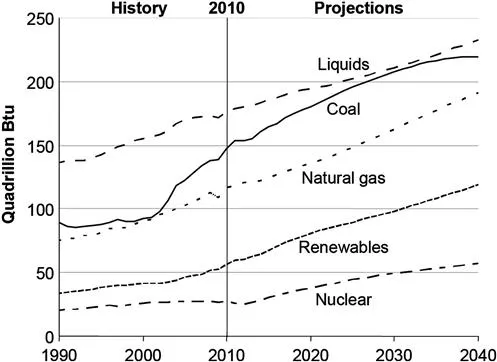
According to EIA, petroleum and other liquid fuels remain the largest source of energy but their share of the world marketed energy consumption declines from 34% in 2010 to 28% in 2040. Liquids consumpti...
Table of contents
- Cover image
- Title page
- Table of Contents
- Copyright
- Dedication
- Preface
- 1. Introduction
- 2. Federal regulations and impact on emissions
- 3. Particulate formation and control technologies
- 4. Sulfur oxides formation and control
- 5. Nitrogen oxides formation and control
- 6. Mercury emissions reduction
- 7. Formation and control of acid gases, and organic and inorganic hazardous air pollutants
- 8. Greenhouse gas – carbon dioxide emissions reduction technologies
- Appendix A. Regional definitions
- Appendix B. Fossil fuel-fired emission factors
- Appendix C. Original list of hazardous air pollutants
- Index
Trusted by 375,005 students
Access to over 1.5 million titles for a fair monthly price.
Study more efficiently using our study tools.
Frequently asked questions
Yes, you can cancel anytime from the Subscription tab in your account settings on the Perlego website. Your subscription will stay active until the end of your current billing period. Learn how to cancel your subscription
No, books cannot be downloaded as external files, such as PDFs, for use outside of Perlego. However, you can download books within the Perlego app for offline reading on mobile or tablet. Learn how to download books offline
Perlego offers two plans: Essential and Complete
- Essential is ideal for learners and professionals who enjoy exploring a wide range of subjects. Access the Essential Library with 800,000+ trusted titles and best-sellers across business, personal growth, and the humanities. Includes unlimited reading time and Standard Read Aloud voice.
- Complete: Perfect for advanced learners and researchers needing full, unrestricted access. Unlock 1.5M+ books across hundreds of subjects, including academic and specialized titles. The Complete Plan also includes advanced features like Premium Read Aloud and Research Assistant.
We are an online textbook subscription service, where you can get access to an entire online library for less than the price of a single book per month. With over 1.5 million books across 990+ topics, we’ve got you covered! Learn about our mission
Look out for the read-aloud symbol on your next book to see if you can listen to it. The read-aloud tool reads text aloud for you, highlighting the text as it is being read. You can pause it, speed it up and slow it down. Learn more about Read Aloud
Yes! You can use the Perlego app on both iOS and Android devices to read anytime, anywhere — even offline. Perfect for commutes or when you’re on the go.
Please note we cannot support devices running on iOS 13 and Android 7 or earlier. Learn more about using the app
Please note we cannot support devices running on iOS 13 and Android 7 or earlier. Learn more about using the app
Yes, you can access Fossil Fuel Emissions Control Technologies by Bruce G. Miller in PDF and/or ePUB format, as well as other popular books in Technology & Engineering & Environmental Management. We have over 1.5 million books available in our catalogue for you to explore.