eBook - ePub
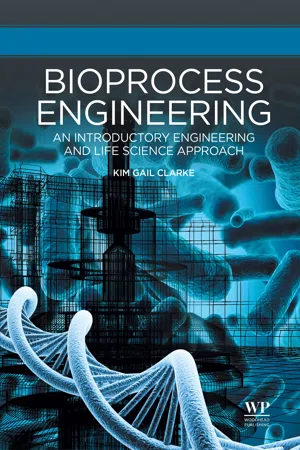
Bioprocess Engineering
An Introductory Engineering and Life Science Approach
- 266 pages
- English
- ePUB (mobile friendly)
- Available on iOS & Android
eBook - ePub
About this book
Biotechnology is an expansive field incorporating expertise in both the life science and engineering disciplines. In biotechnology, the scientist is concerned with developing the most favourable biocatalysts, while the engineer is directed towards process performance, defining conditions and strategies that will maximize the production potential of the biocatalyst. Increasingly, the synergistic effect of the contributions of engineering and life sciences is recognised as key to the translation of new bioproducts from the laboratory bench to commercial bioprocess. Fundamental to the successful realization of the bioprocess is a need for process engineers and life scientists competent in evaluating biological systems from a cross-disciplinary viewpoint. Bioprocess engineering aims to generate core competencies through an understanding of the complementary biotechnology disciplines and their interdependence, and an appreciation of the challenges associated with the application of engineering principles in a life science context. Initial chapters focus on the microbiology, biochemistry and molecular biology that underpin biocatalyst potential for product accumulation. The following chapters develop kinetic and mass transfer principles that quantify optimum process performance and scale up. The text is wide in scope, relating to bioprocesses using bacterial, fungal and enzymic biocatalysts, batch, fed-batch and continuous strategies and free and immobilised configurations.
- Details the application of chemical engineering principles for the development, design, operation and scale up of bioprocesses
- Details the knowledge in microbiology, biochemistry and molecular biology relevant to bioprocess design, operation and scale up
- Discusses the significance of these life sciences in defining optimum bioprocess performance
Information
Subtopic
Biotecnologia1
Historical development: from ethanol to biopharmeceuticals
Abstract:
Biotechnology has a long history, but rapid advances have been seen in the past forty years. This chapter provides a brief overview of bioprocesses, from 6000BC to the present day.
Key words
history
biotechnology
bioprocess engineering
advances
Penicillium
Eschericia coli
Biotechnology is a fast expanding field frequently mooted as the new environmentally sustainable route to providing commercially viable alternatives to conventional chemical technologies. Yet biotechnology is deeply rooted in the past when traditionally food preservation and wine making dominated, with the earliest bioprocess recorded around 6000BC.1 For over 7000 years, microorganisms provided sustenance (bread, yoghurt, cheese, vinegar, potable alcohol) under self-sustaining2 conditions before their existence was known. In the late seventeeth century, with the invention of the microscope,3 300 × magnification became possible and microorganisms were viewed for the first time. For about a hundred years after their discovery, microorganisms were believed to have arisen spontaneously from non-livingmatter (dubbed the theory of spontaneous generation) and the enormity of the discovery of an entire new life form was completely overlooked. The theory of spontaneous generation was finally disproved in the mid 1800s4 when microorganisms were demonstrated to come from preexisting life and finally recognised as the causative agents facilitating the bioprocess. This discovery signalled the start of commercial bioproduction.
During the late nineteenth century, bioprocesses themselves were beginning to be understood. Initially bioprocesses in the West and East developed differently. In the West, submerged culture bioprocesses were established, while solid state or surface culture was developed in the East. With the new understanding of bioprocesses, the emphases changed from exclusively food-related products to include industrial products. Submerged culture was typified by ethanol, acetate, lactate and glycerol while surface culture produced fungal enzymes. At this stage, however, bioprocesses were still limited to those that were self-sustaining with little need and no regard for environmental control or asepsis.
The engineering of large scale bioprocesses was developed largely during the first half of the twentieth century in response to the needs of the two World Wars for bioprocesses which required stringent aseptic conditions and environmental control on an industrial scale. The first of these bioprocesses, the production of the solvents acetone and butanol by Clostridium acetobutylicum, was developed in 19155 to supply acetone for cordite and aeroplane dope during World War 1. This was historically the first bioprocess that was not self-sustaining. The environmental conditions together with the rich nutrients were suitable for a variety of competing microorganisms. For the first time, process equipment had to be developed to operate under strict asepsis and the process conditions had to be controlled to optimise the yield of solvents by C. acetobutylicum.
Later, during World War II, butanol became the preferred product from this fermentation when it was used in the manufacture of synthetic rubber. After the wars, butanol was exploited extensively as a solvent in the nitrocellulosic lacquers used in the expanding automobile industry until the advent of cheap oil supplies rendered the biological route to butanol uneconomical in the USA. The acetone-butanol bioprocess remained commercially viable in South Africa where the solvents were produced from molasses,6 until it was superseded by coal to liquid fuel technology7 in the mid 1980s. Ironically, interest in the acetone-butanol process has recently resurged in the move to replace fossil fuels with microbially produced butanol, or biobutanol, as it has now become known.
The major advance in bioprocess development which occurred during World War 2 was the large scale production and purification of penicillin,8 using the Penicillium mould discovered nearly 20 years earlier.9 This introduced a new level of control since Penicillium spp., unlike Clostridium spp., require oxygen to grow and the technology for large scale aerobic bioprocesses was yet to be developed. Necessity being the mother of invention, the design of equipment was developed for the supply of considerable quantities of air during large scale aseptic operation. Another pivotal breakthrough in the success of penicillin production, and one not often realised, was the development of the downstream purification of the penicillin. A novel extraction process was devised,10 using amylacetate as the solvent, by making use of pH to alter the distribution of penicillin between the aqueous and solvent phases11 In this process, the contact time of the penicillin and amylacetate was minimised with the use of centrifugal extraction.
At this stage, scale up was constrained to multiplication of elements. Penicillin was produced in small milk bottles, increasing the number of bottles to thousands in an attempt to meet the demand for this product. However, rapid advances in bioprocess development over the next 40 years saw the technology progress to more sophisticated engineered processes such as large scale submerged production of antibiotics, vitamins, amino acids and enzymes.
From the late 1950s isolated enzymes were used as biocatalysts. Initially, only extracellular enzymes were exploited, such as amylases and proteases for the hydrolysis of starch and proteins respectively. The first intracellular enzyme to be used commercially was xylose isomerase. Xylose isomerase, which catalyses the isomerisation of glucose to fructose, was used in conjunction with amylase for the production of fructose from corn starch. The abundance of corn in the 1970s provided the stimulus for large scale manufacture of sweet syrups12 using this process.
Prior to 1960, bioprocesses were almost exclusively batch operations. A major advance of the 1960s was the development and optimisation of large scale continuous bioprocesses. A notable example was the production of yeast from hydrocarbons as single cell protein in the 1960s, intended for human and animal consumption, which contributed significantly to the advancement of bioprocess scientific and engineering knowledge. Unfortunately, protein for human consumption never realised its potential, with excessive regulatory controls and/or the cost of raw material held responsible. Nevertheless, numerous continuous processes enjoy success to date in a wide variety of industries. In the early 1980s, continuous processing spread to the mineral industry via the BIOX®13 process for tank bioleaching of base and noble metals from sulphite ore, a process now extensively used worldwide.
After recombinant DNA technology was developed in the late 1970s, a new era of biotechnology was heralded. By the 1980s, genetic manipulation had removed many of the boundaries previously constraining the range of commercially viable bioproducts and bioprocess engineering advanced in great strides. Most notable of these early recombinant bioproducts is insulin, commercially manufactured using genetically modified Escherichia coli. Insulin was the first of the recombinant biopharmaceuticals and precipitated the now expansive biopharmaceutical market based on recombinant DNA technology.
Today, the biological route is frequently preferred over the chemical route. Bioprocess conditions are moderate and biocatalysts very specific so that comparatively few by-products are produced; further, bioprocesses are environmentally benign. Bioprocess-derived products are ubiquitous in diverse industries, including food and beverage, health care (therapeutics and diagnostics), cosmetic, agricultural, biomining, fuels (ethanol and butanol), bioremediation, mineral processing and waste treatment. In the future, biotechnology promises to broaden its impact further through its contribution to new technologies, one example being power generation without noxious combustion gases, such as biological hydrogen production for use in fuel cells.14
There has never been a time when the Bioprocess ...
Table of contents
- Cover image
- Title page
- Table of Contents
- Copyright
- Dedication
- List of figures
- List of plates
- Preface
- About the author
- Chapter 1: Historical development: from ethanol to biopharmeceuticals
- Chapter 2: Microbiology
- Chapter 3: Metabolic macromolecules
- Chapter 4: Molecular biology
- Chapter 5: Carbon metabolism
- Chapter 6: Enzymes as biocatalysts
- Chapter 7: Microbial kinetics during batch, continuous and fed-batch processes
- Chapter 8: The oxygen transfer rate and overall volumetric oxygen transfer coefficient
- Chapter 9: Bioprocess scale up
- Chapter 10: Bioprocess asepsis and sterility
- Chapter 11: Downstream processing
- Index
Trusted by 375,005 students
Access to over 1.5 million titles for a fair monthly price.
Study more efficiently using our study tools.
Frequently asked questions
Yes, you can cancel anytime from the Subscription tab in your account settings on the Perlego website. Your subscription will stay active until the end of your current billing period. Learn how to cancel your subscription
No, books cannot be downloaded as external files, such as PDFs, for use outside of Perlego. However, you can download books within the Perlego app for offline reading on mobile or tablet. Learn how to download books offline
Perlego offers two plans: Essential and Complete
- Essential is ideal for learners and professionals who enjoy exploring a wide range of subjects. Access the Essential Library with 800,000+ trusted titles and best-sellers across business, personal growth, and the humanities. Includes unlimited reading time and Standard Read Aloud voice.
- Complete: Perfect for advanced learners and researchers needing full, unrestricted access. Unlock 1.5M+ books across hundreds of subjects, including academic and specialized titles. The Complete Plan also includes advanced features like Premium Read Aloud and Research Assistant.
We are an online textbook subscription service, where you can get access to an entire online library for less than the price of a single book per month. With over 1.5 million books across 990+ topics, we’ve got you covered! Learn about our mission
Look out for the read-aloud symbol on your next book to see if you can listen to it. The read-aloud tool reads text aloud for you, highlighting the text as it is being read. You can pause it, speed it up and slow it down. Learn more about Read Aloud
Yes! You can use the Perlego app on both iOS and Android devices to read anytime, anywhere — even offline. Perfect for commutes or when you’re on the go.
Please note we cannot support devices running on iOS 13 and Android 7 or earlier. Learn more about using the app
Please note we cannot support devices running on iOS 13 and Android 7 or earlier. Learn more about using the app
Yes, you can access Bioprocess Engineering by Kim Gail Clarke in PDF and/or ePUB format, as well as other popular books in Tecnologia e ingegneria & Biotecnologia. We have over 1.5 million books available in our catalogue for you to explore.