Providing fundamental knowledge necessary to understand graphene's atomic structure, band-structure, unique properties and an overview of groundbreaking current and emergent applications, this new handbook is essential reading for materials scientists, chemists and physicists.Since the 2010 physics Nobel Prize awarded to Geim and Novosolev for their groundbreaking work isolating graphene from bulk graphite, there has been a huge surge in interest in the area. This has led to a large number of news books on graphene. However, for such a vast inflow of new entrants, the current literature is surprisingly slight, focusing exclusively on current research or books on previous "hot topic" allotropes of carbon.This book covers fundamental groundwork of the structure, property, characterization methods and applications of graphene, along with providing the necessary knowledge of graphene's atomic structure, how it relates to its band-structure and how this in turn leads to the amazing properties of graphene. And so it provides new graduate students and post-docs with a resource that equips them with the knowledge to undertake their research.
- Discusses graphene's fundamental structure and properties, acting as a time-saving handbook for validated research
- Demonstrates 100+ high-quality graphical representations, providing the reader with clear images to convey complex situations
- Reviews characterization techniques relevant to grapheme, equipping the reader with experimental knowledge relevant for practical use rather than just theoretical understanding
The Nobel prize for physics in 2010 was awarded to Sir Professor Andrei Geim and Sir Professor Kostya Novoselov, from the Manchester University, for their ‘ground-breaking experiments regarding the two-dimensional material graphene’. Reading these words carefully, there is no mention of ‘discovery’ and this is a debatable topic, and a similar discussion clouds the discovery of carbon nanotubes and its relation to the landmark paper of Sumio Iijima that stimulated the field of nanotubes (Iijima, 1991). In contrast, the Nobel prize in chemistry (1996) was awarded to Robert F. Curl Jr, Sir Harold W. Kroto, and Richard E. Smalley for ‘their discovery of fullerenes’, leaving no ambiguity.
Whilst it was pointed out by Professor Walt de Heer from the Georgia Tech University that numerous factual errors were made by the Nobel Committee in their scientific background document on the Nobel prize for graphene, there is no doubt that the papers in 2004 and 2005 by Novoselov et al. were instrumental in igniting the field of graphene (Novoselov et al., 2004, 2005). The Manchester group is seen as developing the ‘scotch-tape’ mechanical exfoliation technique for graphene production that was simple, effect, cheap, and therefore could be taken up rapidly by research groups all across the world. It is this simplicity that helped the graphene research develop at a remarkable pace and generate momentum. Although this technique had been applied for cleaving graphite for scanning tunnelling microscopy studies, there was no further development in demonstrating how it could be used to discover the superb electronic properties of graphene.
The pioneering work of Professor de Heer should be recognised, as his group developed synthetic graphene from silicon carbide precursors and undertook electronic measurements of monolayer graphene independently of the Manchester group (Berger et al., 2004). He was already aware of the wonders that graphene could offer before the 2004 report of Novoselov et al. (2004). His group published a report showing 2D electron gas properties in ultrathin epitaxial graphite films and opened a route towards scalable graphene-based nanoelectronics (Berger et al., 2004). In 2005, Professor Philip Kim’s group from the Colombia University reported the observation of the quantum Hall effect and Berry’s phase in graphene and extended this further with many important contributions to discovering the amazing electronic properties of graphene (Zhang et al., 2005). Their method for obtaining graphene was similar to that reported in Novoselov’s 2004 report as is cited as such. Professor Rodney Ruoff, from the University of Texas at Austin, has also been instrumental in advancing the chemical vapour deposition growth of graphene using metal catalysts that is critical to graphene having a commercial impact. There have been numerous other leaders in the field of graphene research and far too many to mention without offending someone by unintentionally leaving them out. Instead, we celebrate all contributions to graphene research that has led to so much high impact science and helped forge/reinvigorate/establish many careers for both the young and experienced.
The boom in graphene was helped by many people who were already studying carbon nanotubes and fullerenes, simply translating their activities into this new area. The apparatus for characterising graphene is often similar to those used for nanotubes, such as transmission electron microscopy (TEM), scanning electron microscopy (SEM), electronic device fabrication, diffraction and Raman spectroscopy. This also bodes well for rapid advances in understanding the properties of new 2D crystals that may exhibit new behaviour absent in graphene.
Graphene is the building block for understanding the structure of fullerenes, nanotubes and graphite, and given the simplicity of its isolation, it is surprising it was studied last. Many people who do not work on graphene question its hype, which is fair considering the hype that surrounded the discovery of fullerenes (1985) and nanotubes (1991) and the lack of real world implementation and life-changing technology that has resulted. Perhaps the biggest difference between fullerenes and nanotubes with graphene is the manufacturing aspect. It is challenging to produce vast quantities of fullerenes that are pure, apart from C60 and C70. Some of the most interesting and useful properties of fullerenes come by adding dopants or molecular functional groups, but this makes their separation using high-performance liquid chromatography time consuming and thus the end product expensive. Carbon nanotubes are facing criticism as being asbestos-like when inhaled. More work is needed to be sure of this as residual metal catalysts that are known to be toxic are often retained in the material. Carbon nanotubes also suffer from the problem of mixed chiralities that lead to both semiconducting and metallic electronic transport behaviour. This has limited their application in electronics, despite demonstrating their outstanding properties at the single-device level. Carbon nanotubes will continue to be intensively studied as they encompass the ideology of a 1D nanowire at its best. Graphene, on the other hand, looks to be solving these manufacturing challenges with SiC and chemical vapour depositions proving fruitful for electronic-grade graphene, whilst chemical exfoliation is excellent for solution-based processing for spray-casting and polymer blending. In order for graphene to be useful in applications, there will be a strong need to interface it with other materials, in particular semiconductor nanomaterials. The pathway for cheap, high-quality graphene suited for a variety of applications is achievable. Perhaps, it is this reason that graphene leaped ahead of carbon nanotubes in being awarded a Nobel prize, since carbon nanotubes also display amazing electronic and mechanical properties that captured the imagination and interest of the world for more than 10 years.
1.1 About the book
This book is aimed at undergraduate students towards the end of the degrees and PhD students starting out, plus anyone new entering into the field of graphene. The objective of the book is to provide the necessary basic information about graphene in a broad variety of topics. Each chapter is designed to be relatively self-contained, and as a consequence, there may be some occasions of slight repetition. The field has grown extensively over the past 9 years, and it is not possible to cover every published piece of work, and therefore, we have restricted discussions to the key findings in the field. The book starts with a description of the atomic structure of graphene, as this essentially dictates the properties of graphene. Monolayer, bilayer, trilayer and few-layer graphene are all discussed and how they stack in both AB Bernal stacking as well as Rhombohedral stacking. The relationship of graphene to nanotubes is explored, namely rolling up graphene to form a cylinder. Once an understanding of the atomic structure is obtained, we move towards describing graphene’s properties: electrical, chemical, spin, mechanical and thermal. It is these amazing properties that have generated the exuberant fascination in graphene.
Any experimental researcher will need to know how to obtain graphene, and for theoretical scientists, it is important to have a real-world understanding of how graphene can be made, what can be expected in terms of material structure and what the limiting factors are for each approach. We have included Chapter 4 as summarising methods for getting graphene in your hands. It covers the Manchester ‘Scotch-tape’ mechanical exfoliation, solution-phase chemical exfoliation, bottom-up chemical methods using molecular precursors, chemical-vapour deposition and silicon carbide. A section on how to transfer graphene to arbitrary substrates is included as this is an essential part of getting graphene where you want it, which is often on an insulating substrate or partially suspended like a drum-skin.
Too often, when reviewing papers for journals, poor characterisation has limited the chance of the work being accepted for publication. Effective characterisation is the key for proving you have what you claim, and then being able to draw the right conclusions about from the results. We encourage the use of multiple techniques, with each one providing a piece of the jigsaw that you can fit together for a solid and robust conclusion. We could not cover all characterisation techniques, and recommend further reading on angular-resolved photoemission spectroscopy and X-ray photoemission spectroscopy for graphene characterisation, which are not covered in this book.
The final chapter presents an overview of seven key application areas that graphene has shown promise in: electronic devices, spintronics, transparent conducting electrodes (TCE), Nano-Electro-Mechanical Systems (NEMS), free-standing membranes, energy and super-strong composites. Whilst it was the outstanding properties of graphene in electronic devices that received the most attention, this area is seen as one of the most challenging in terms of developing a commercial product that will replace silicon electronics due to the absence of an appreciable band-gap. It seems that the niche area of high-frequency electronics may be more suitable for graphene than logic-based transistors. Graphene TCEs have already been used to make touch-screens and outperform Indium Tin Oxide (ITO) on flexible substrates in terms of durability. The major limiting factor here is that the sheet resistance of graphene is still too high. Further advancements in materials design through substitutional doping, intercalation and multilayering will solve this problem in the near future.
We hope this book serves well to get you started and leads to more activity in graphene research. Time will tell whether graphene can live up to its promise, but right now, graphene research is at its pinnacle, and it is never too late to join in the fun.
References
1. Berger C, Song Z, Li T, et al. Ultrathin epitaxial graphite: 2D electron gas properties and a route toward graphene-based nanoelectronics. J Phys Chem B. 2004;108:19912–19916.
2. Iijima S. Helical microtubules of graphitic carbon. Nature. 1991;354:56–58.
3. Novoselov KS, Geim AK, Morozov SV, et al. Electric field effect in atomically thin carbon films. Science. 2004;306:666–669.
5. Zhang Y, Tan Y-W, Stormer HL, Kim P. Experimental observation of the quantum hall effect and Berry’s phase in graphene. Nature. 2005;438:201–204.
Chapter 2
The Atomic Structure of Graphene and Its Few-layer Counterparts
Franziska Schäffel
University of Oxford, Oxford, UK
2.1 Graphene
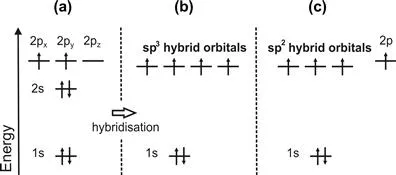
In order to understand the atomic structure of graphene, it is helpful to first gain an understanding of the peculiarities of elemental carbon as well as its three-dimensional (3D) allotropes. The general interest in carbon arises from the variety of structural forms in which this element is available. This variety results from a special electron configuration of carbon that provides the ability to form different types of valence bonds to various elements, including other carbon atoms, through atomic orbital hybridisation. Carbon has the atomic number 6 and therefore, electrons occupy the 1s2, 2s2, 2px1 and 2py1 atomic orbitals as illustrated in Fig. 2.1a (ground state). It is a tetravalent element, i.e. only the four exterior electrons participate in the formation of covalent chemical bonds.
FIGURE 2.1 Atomic orbital diagram of a carbon atom. The four electrons in the doubly occupied spherical 2s orbital and the half occupied dumbbell-shaped 2p-orbitals participate in the chemical bonding of carbon. (a) Ground state, (b) sp3-hybridised as in diamond and (c) sp2-hybridised as in graphite and graphene.
When forming bonds with other atoms, carbon promotes one of the 2s electrons into the empty 2pz orbital, resulting in the formation of hybrid orbitals. In diamond the 2s-energy level hybridises with the three 2p levels to form four energetically equivalent sp3-orbitals that are occupied with one electron each (Fig. 2.1b). The four sp3-orbitals are oriented with largest possible distance from each other; they therefore point towards the corners of an imaginary tetrahedron. The sp3-orbitals of one carbon atom overlap with the sp3-orbitals of other carbon atoms, forming the 3D diamond structure. The high hardness of diamond results from the strong binding energy of the C–C bonds.
In graphite only two of the three 2p-orbitals partake in the hybridisation, forming three sp2-orbitals (Fig. 2.1c). The sp2-orbitals are oriented perpendicular to the remaining 2p-orbital, therefore lying symmetrically in the X–Y plane at 120° angles. Thus, sp2-carbon atoms form covalent in-plane bonds affecting the planar hexagonal “honeycomb” structure of graphite. While the in-plane σ-bonds within the graphene layers (615 kJ/mol) are even stronger than the C–C bonds in sp3-hybridised diamond (345 kJ/mol), the interplane π-bonds, formed by the remaining 2p-orbitals, have a significantly lower binding energy, leading to an easy shearing of graphite along the layer plane. A single layer of graphite (the so-called graphene layer) has a lattice constant
where a0 = 1.42
is the nearest neighbour interatomic distance (Haering, 1958). The interplane distance between two adjacent graphene layers in AB stacked graphite is 3.35
(Haering, 1958).
The term ‘graphene’ is often incorrectly used for ultrathin graphite layers. Strictly it only refers to a quasi-two-dimensional isolated monola...
Table of contents
Cover image
Title page
Table of Contents
Copyright
Chapter 1. Introduction
Chapter 2. The Atomic Structure of Graphene and Its Few-layer Counterparts
Chapter 3. Properties of Graphene
Chapter 4. Methods for Obtaining Graphene
Chapter 5. Characterisation Techniques
Chapter 6. Applications of Graphene
Index
Trusted by 375,005 students
Access to over 1.5 million titles for a fair monthly price.
Study more efficiently using our study tools.
Frequently asked questions
Yes, you can cancel anytime from the Subscription tab in your account settings on the Perlego website. Your subscription will stay active until the end of your current billing period. Learn how to cancel your subscription
No, books cannot be downloaded as external files, such as PDFs, for use outside of Perlego. However, you can download books within the Perlego app for offline reading on mobile or tablet. Learn how to download books offline
Perlego offers two plans: Essential and Complete
Essential is ideal for learners and professionals who enjoy exploring a wide range of subjects. Access the Essential Library with 800,000+ trusted titles and best-sellers across business, personal growth, and the humanities. Includes unlimited reading time and Standard Read Aloud voice.
Complete: Perfect for advanced learners and researchers needing full, unrestricted access. Unlock 1.5M+ books across hundreds of subjects, including academic and specialized titles. The Complete Plan also includes advanced features like Premium Read Aloud and Research Assistant.
Both plans are available with monthly, semester, or annual billing cycles.
We are an online textbook subscription service, where you can get access to an entire online library for less than the price of a single book per month. With over 1.5 million books across 990+ topics, we’ve got you covered! Learn about our mission
Look out for the read-aloud symbol on your next book to see if you can listen to it. The read-aloud tool reads text aloud for you, highlighting the text as it is being read. You can pause it, speed it up and slow it down. Learn more about Read Aloud
Yes! You can use the Perlego app on both iOS and Android devices to read anytime, anywhere — even offline. Perfect for commutes or when you’re on the go. Please note we cannot support devices running on iOS 13 and Android 7 or earlier. Learn more about using the app
Yes, you can access Graphene by Jamie H. Warner,Franziska Schaffel,Mark Rummeli,Alicja Bachmatiuk in PDF and/or ePUB format, as well as other popular books in Technology & Engineering & Electrical Engineering & Telecommunications. We have over 1.5 million books available in our catalogue for you to explore.