eBook - ePub
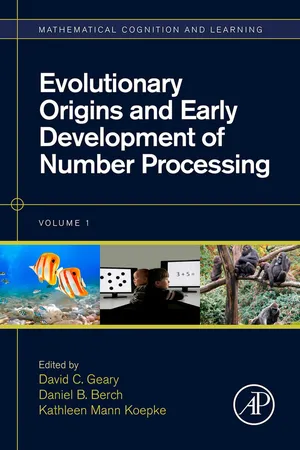
Evolutionary Origins and Early Development of Number Processing
- 400 pages
- English
- ePUB (mobile friendly)
- Available on iOS & Android
eBook - ePub
Evolutionary Origins and Early Development of Number Processing
About this book
The first volume in this ground-breaking series focuses on the origins and early development of numerical cognition in non-human primates, lower vertebrates, human infants, and preschool children. The text will help readers understand the nature and complexity of these foundational quantitative concepts and skills along with evolutionary precursors and early developmental trajectories.
- Brings together and focuses the efforts and research of multiple disciplines working in math cognition.
- The contributors bring vast knowledge and experience to bear on resolving extant substantive and methodological challenges to help advance the field of basic number processing.
- Introductory sections and summaries will be included to provide background for non-specialist readers.
Information
Part I:
Number and Magnitude in Non-Human Animals
Chapter 1
At the Root of Math
Numerical Abilities in Fish
Christian Agrillo; Maria Elena Miletto Petrazzini; Angelo Bisazza Department of General Psychology, University of Padova, Italy
Abstract
There is a well-established tradition of studying numerical abilities in mammals and birds; however, only recently has it been proposed that some species of fish possess similar capacities. Here, we review the evidence for the presence of rudimentary numerical abilities in fish. There is substantial evidence that fish can use purely numerical information both when they are trained to discriminate among different quantities and when they are required to choose which group of social companions is less/more numerous. In both contexts, however, they tend to use primarily continuous quantities (e.g., area) instead of discrete numbers when both types of information are available. Similarities among species appear greater than differences and, in general, fish numerical capacities closely match those reported in mammals and birds. The study of developmental trajectories suggests that fish have multiple core number systems that are domain-specific and serve to solve a limited set of problems.
Keywords
nonsymbolic numerical abilities
ANS
subitizing
continuous extent
spontaneous choice tests
training procedure
fish
Introduction
Laboratory and field studies have suggested that numerical abilities may be useful for mammals and birds in several ecological contexts. For instance, chimpanzees (Pan troglodytes) and dogs (Canis lupus familiaris) are more willing to enter social contexts when their group outnumbers that of opponents (Bonanni, Natoli, Cafazzo, & Valsecchi, 2011; Wilson, Britton, & Franks, 2002). Numerical abilities may also be important for anti-predator strategies. It has been shown that redshanks (Tringa totanus) are less likely to be predated when part of a larger flock, highlighting the importance of selecting the larger group of social companions (Cresswell, 1994). Foraging decisions represent another context in which numerical abilities may be useful, with robins (Petroica australis, Hunt et al., 2008) and parrots (Psittacus erithacus, Al Aïn, Giret, Grand, Kreutzer, & Bovet, 2009) being able to select the larger amount of food when different alternatives are available. Also, numerical skills can provide benefits in mate choice: the ability to count the number of conspecifics encountered seems to enable bank voles (Myodes glareolus) to adaptively adjust their reproductive strategy to the level of sperm competition (i.e., males produce more sperm when multiple other mates are present; Lemaitre, Ramm, Hurst, & Stockley, 2011). Indeed, laboratory studies controlling for non-numerical cues have demonstrated that many species of mammals (chimpanzees: Beran, McIntyre, Garland, & Evans, 2013, Beran et al., this volume; dogs: West & Young, 2002; rats [Rattus norvegicus]: Davis & Bradford, 1986) and birds (parrots: Pepperberg, 2012, this volume; chicks [Gallus gallus domesticus]: Rugani, Regolin, & Vallortigara, 2008; Vallortigara, this volume) can solve most of these tasks by using numerical information only.
Similar selective pressures in favor of processing quantitative information are likely to have also acted in species more distantly related to humans, such as fish. It has been demonstrated that several fish species tend to join the larger shoal when exploring a potentially dangerous environment (Hager & Helfman, 1991; Svensson, Barber, & Forsgren, 2000), a context in which the probability of being spotted by predators decreases with increasing shoal size (Brown, Laland, & Krause, 2011). The capacity to select the larger or smaller group may provide benefits in resource competition as well: for instance, when food is available, banded killifish (Fundulus diaphanus) form smaller shoals, probably to reduce the competition for food resources (Hoare, Couzin, Godin, & Krause, 2004). The successful rate of some predators (e.g., wolf-fish [Hoplias malabaricus], acara cichlids [Aequidens pulcher], and pike cichlids [Crenicichla frenata]) is related to the shoal size of their prey, and it was demonstrated that they often ignore a single near prey in order to attack a shoal containing a larger number of individuals (Botham, Kerfoot, Louca, & Krause, 2005). Lastly, in guppies (Poecilia reticulata) and mosquitofish (Gambusia holbrooki), the capacity to discriminate the sex-ratio of social groups is thought to allow males to adjust their reproductive strategies to the existing level of sperm competition (Lindstrom & Ranta, 1993; Smith & Sargent, 2006).
In the aforementioned examples, fish might use multiple strategies to discriminate the larger or smaller quantity. For example, they can base their discrimination on continuous variables that co-vary with numerosity such as the sum of the areas occupied by the items to enumerate, the overall space occupied by the entire set, or the density of objects in space; these are all cues to determine shoal size in natural contexts. Recent studies have been investigating these issues in teleost fish through controlled laboratory experiments (see Table 1-1).
Table 1-1
Summary of fish species in which some capacity to discriminate quantities (without experimental control of continuous quantities) is found, and species in which the use of numerical information has been demonstrated (with experimental control of continuous quantities)
| Species (alphabetic order) | Quantity Discrimination (Number + Continuous quantities) | Numerical Discrimination |
| Angelfish | Gómez-Laplaza & Gerlai, 2011a, 2011b, 2012, 2013 | Agrillo, Miletto Petrazzini, Tagliapietra, & Bisazza, 2012b |
| Banded killifish | Krause & Godin, 1994 | — |
| Blue acara | Krause & Godin, 1995 | — |
| Central mudminnow | Jenkins & Miller, 2007 | — |
| Climbing perch | Binoy & Thomas, 2004 | — |
| Fathead minnow | Hager & Helfman, 1991 | — |
| Goldbelly topminnow | Agrillo & Dadda, 2007 | — |
| Golden shiner | Reebs & Sauliner, 1997 | — |
| Guppies | Agrillo, Piffer, Butterworth, & Bisazza, 2012c; Ledesma & McRobert, 2008; Piffer, Agrillo, & Hyde, 2012 | Agrillo, Miletto Petrazzini, Tagliapietra, Bisazza, 2012b; Agrillo, Miletto Petrazzini, & Bisazza, 2014; Bisazza, Serena, Piffer, & Agrillo, 2010 |
| Mosquitofish | Agrillo et al., 2007, 2008b | Agrillo, Dadda, Serena, & Bisazza, 2009; Agrillo, Piffer, & Bisazza, 2010; 2011, Agrillo, Miletto Petrazzini, Tagliapietra, & Bisazza, 2012b; Dadda, Piffer, Agrillo, & Bisazza, 2009 |
| Red-bellied piranha | Queiroz & Magurran, 2005 | — |
| Redtail splitfin | Stancher et al., 2013 | Agrillo, Piffer, Bisazza, & Butterworth, 2012 |
| Sailfin molly | Bradner & McRobert, 2001 | — |
| Siamese fighting fish | Snekser, McRobert, & Clotfelter, 2006 | Agrillo, Miletto Petrazzini, Tagliapietra, & Bisazza, 2012b |
| Swordtail | Buckingham, Wong, & Rosenthal, 2007 | — |
| Three-spined sticklebacks | Barber, Downey, & Braithwaite, 1998; Tegeder & Krause 1995 | — |
| Two-spotted goby | Svensson et al. 2000 | — |
| Wolf fish | Botham & Krause, 2005 | — |
| Zebrafish | Pritchard, Lawrence, Butlin, & Krause, 2001 | Agrillo, Miletto Petrazzini, Tagliapietra, & Bisazza, 2012b |

Overview
In this chapter, we will first summarize methodological issues related to the study of numerical abilities in fish. In the second section, we will focus on the relation between numerical and non-numerical cues during numerical discrimination of fish (see also Lourenco, this volume). Debate surrounding the existence of single vs. multiple systems of numerical representation will be summarized in the third section, followed by an overview of the results of studies on the ontogeny of numerical abilities of fish. In the final section, we will examine inter-specific differences among teleost species and provide a comparison of the mathematical abilities of fish with warm-blooded vertebrates.
Problems and Methods of Study
The investigation of numerical abilities in fish presents the same methodological problems that are encountered in the study of nonsymbolic numerical abilities in infants, mammals, and birds (Starr & Brannon, this volume). The most obvious problem is the lack of verbal abilities in fish, which forces researchers to infer the existence of numerical abilities from subjects’ behavior. Furthermore, we have all been able to discriminate between two quantities without necessarily counting the number of objects in everyday life, such as when looking at fruit baskets or two queues at the airport. Numerosity typically co-varies with other physical attributes, and fish can use the relative magnitude of non-numerical cues (hereafter “continuous quantities”), such as the cumulative surface area of the stimuli, the overall space occupied by the sets, or their density, to estimate which set is larger/smaller (Agrillo et al., 2008b, 2009; Gómez-Laplaza & Gerlai, 2013). For this reason, controlled experiments are necessary to assess whether fish can use discrete numbers, continuous quantities, or both types of information to determine relative quantities.
Methodologies Adopted
Different methods have been adopted in comparative psychology to study numerical abilities of mammals (Beran, 2006; Beran ...
Table of contents
- Cover image
- Title page
- Table of Contents
- Copyright
- Contributors
- Foreword
- Preface
- Part I: Number and Magnitude in Non-Human Animals
- Part II: Number and Magnitude in Infants and Young Children
- Part III: Number Judgments: Theoretical Perspectives and Evolutionary Foundations
- Index
Trusted by 375,005 students
Access to over 1.5 million titles for a fair monthly price.
Study more efficiently using our study tools.
Frequently asked questions
Yes, you can cancel anytime from the Subscription tab in your account settings on the Perlego website. Your subscription will stay active until the end of your current billing period. Learn how to cancel your subscription
No, books cannot be downloaded as external files, such as PDFs, for use outside of Perlego. However, you can download books within the Perlego app for offline reading on mobile or tablet. Learn how to download books offline
Perlego offers two plans: Essential and Complete
- Essential is ideal for learners and professionals who enjoy exploring a wide range of subjects. Access the Essential Library with 800,000+ trusted titles and best-sellers across business, personal growth, and the humanities. Includes unlimited reading time and Standard Read Aloud voice.
- Complete: Perfect for advanced learners and researchers needing full, unrestricted access. Unlock 1.5M+ books across hundreds of subjects, including academic and specialized titles. The Complete Plan also includes advanced features like Premium Read Aloud and Research Assistant.
We are an online textbook subscription service, where you can get access to an entire online library for less than the price of a single book per month. With over 1.5 million books across 990+ topics, we’ve got you covered! Learn about our mission
Look out for the read-aloud symbol on your next book to see if you can listen to it. The read-aloud tool reads text aloud for you, highlighting the text as it is being read. You can pause it, speed it up and slow it down. Learn more about Read Aloud
Yes! You can use the Perlego app on both iOS and Android devices to read anytime, anywhere — even offline. Perfect for commutes or when you’re on the go.
Please note we cannot support devices running on iOS 13 and Android 7 or earlier. Learn more about using the app
Please note we cannot support devices running on iOS 13 and Android 7 or earlier. Learn more about using the app
Yes, you can access Evolutionary Origins and Early Development of Number Processing by David C. Geary,Daniel B. Berch,Kathleen Mann Koepke in PDF and/or ePUB format, as well as other popular books in Psychology & Cognitive Psychology & Cognition. We have over 1.5 million books available in our catalogue for you to explore.