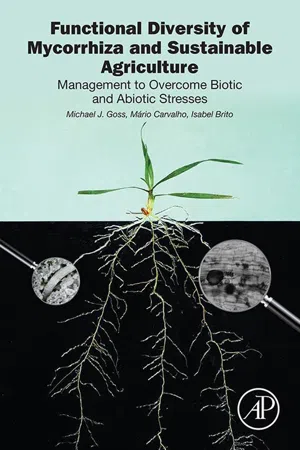
eBook - ePub
Functional Diversity of Mycorrhiza and Sustainable Agriculture
Management to Overcome Biotic and Abiotic Stresses
- 254 pages
- English
- ePUB (mobile friendly)
- Available on iOS & Android
eBook - ePub
Functional Diversity of Mycorrhiza and Sustainable Agriculture
Management to Overcome Biotic and Abiotic Stresses
About this book
Functional Diversity of Mycorrhiza and Sustainable Agriculture is the first book to present the core concepts of working with Arbuscular mycorrhizal fungi to improve agricultural crop productivity.
Highlighting the use of indigenous AM fungi for agriculture, the book includes details on how to maintain and promote AM fungal diversity to improve sustainability and cost-effectiveness. As the need to improve production while restricting scarce inputs and preventing environmental impacts increases, the use of AMF offers an important option for exploiting the soil microbial population. It can enhance nutrient cycling and minimize the impacts of biotic and abiotic stresses, such as soil-borne disease, drought, and metal toxicity.
The book offers land managers, policymakers, soil scientists, and agronomists a novel approach to utilizing soil microbiology in improving agricultural practices.
- Provides a new approach to exploiting the benefits of mycorrhizas for sustainable arable agricultural production using indigenous AMF populations and adopting appropriate crop production techniques
- Bridges the gap between soil microbiology, including increasing knowledge of mycorrhiza and agronomy
- Presents real-world practical insights and application-based results, including a chapter focused primarily on case studies
- Includes extensive illustrative diagrams and photographs
Information
Chapter 1
Challenges to Agriculture Systems
Abstract
Food production has to be greatly increased simply to feed a population growing from 7 billion to in excess of 9 billion over the next 35 years and we still have more than a billion undernourished people. To increase global food production is an unprecedented challenge in the history of agriculture, particularly if we consider that the solutions adopted in the past are much less of an option. Previous solutions have been to increase the area made available for agriculture and to enhance land productivity by an increase in crop yields, with the latter being particularly important. Only limited areas of new land are available for adoption by agriculture but soil degradation and urbanization are removing considerable areas from the existing productive land bank. In consequence, intensification of production is going to be essential. At the same time there is an urgent need to reduce the environmental impacts of food production. It will be crucial to close the gap in yield between the climatic potential and what farmers achieve across the different regions of the world, particularly those areas where the difference is greatest due to environmental, economic, and social conditions. The world is not in a position to ignore the possible contribution from any technological solution on ideological grounds and the concept of sustainable intensification of agriculture has to be on the agenda. Among the possible solutions the intentional use of beneficial soil microbes in agricultural systems is only in its early days. There is a much greater need than ever to find ways of exploiting the benefits from the microbes in our soils and to develop tools that will help farmers implement strategies related to sustainable soil use and management. Our focus is on arbuscular mycorrhizal fungi (AMF) that can impact several soil processes, including the cycling of phosphorus and nitrogen, their acquisition by plants and reducing losses of nitrogen by leaching or volatilization, as well as play other crucial roles within the agricultural ecosystem. AMF can protect their host plants from both biotic and abiotic stresses, including root pathogens, toxic metals, and water shortage. Managing the soil microbiota, particularly AMF, has the potential not only to increase production, while decreasing the incorporation of inputs, with the potential to be applied to productive and marginal soils and used in regions of the world where the resources required by farmers are scarce.
Keywords
Population growth; agricultural production; environmental impacts; sustainable intensification; agricultural land bank; yield gap; technological solutions; soil biota
1.1 Current and Future Challenges to Agriculture Systems
Food production is probably one of the greatest challenges facing the world. Despite the increase in agricultural production since the 1960s, when the “green revolution” started to be implemented in the developing world, we still have more than 1 billion undernourished people (FAO, 2009, 2015a). There has to be a greatly increased production simply to feed a population growing from 7 billion to in excess of 9 billion over the next 35 years (Fig. 1.1).

This growth in population, the improvement of world gross product (WGP) and consequent greater consumption of food, together with changes to the human diet, particularly the switch to grain-fed animal protein, all combine to exert further pressure on agricultural production. Even allowing for the uncertainties related to each of these factors, it is estimated that by the year 2050 world food production will have to increase by 50%–70% (FAO, 2009; The Royal Society, 2009).
A key concern is how this additional production is going to be achieved. In the past, the response in both developed and developing countries to a greater demand for food has been to increase the area made available for agriculture and enhancing land productivity by an increase in crop yields. For example, over the period 1961–2005, expansion of harvested land contributed between 14% and 25% to improved crop production compared with the 78%–86% resulting from improved productivity, with about 10% of the latter resulting from increased cropping intensity, that is the ratio of harvested land to the total arable land (Table 1.1) (Bruinsma, 2011). Nevertheless, the aggregate land area in developed countries showed a decline over the same period, so improvement in yield was even more important as a factor (Bruinsma, 2003).
Table 1.1
Estimation of relative contributions to improved crop production of increases in harvested land area, crop yieldsa and cropping intensity of agriculture over the period from 1961 to 2005 (Bruinsma, 2011).
| Harvested Area (%) | Crop Yields (%) | Cropping Intensity (%) | |
| Developing countries | 22 | 70 | 8 |
| World | 14 | 77 | 9 |

aWeighted yields (international price weights) based on 34 crops.
The available evidence strongly points to the conclusion that increasing the land area under cultivation will be inadequate as an option to meet the current challenge. In 30 years after 1950, more land was converted to cropland than in the 150 years between 1700 and 1850 (Millennium Ecosystem Assessment, 2005). Worldwide agriculture has already been responsible for the conversion of 70% of grassland, 50% of savanna, 45% of temperate deciduous forest, and 27% of tropical forest biome (Foley et al., 2011). This represents 38% of Earth’s terrestrial surface with the soils most suitable for agriculture already under cultivation. In addition to the reduced opportunity for further land use change, good agricultural land is lost every year to build houses and necessary infrastructures to accommodate the growth of the world population and the migration to cities (Fig. 1.2). By 2030 there are expected to be 1.75 billion more urban residents, requiring about 42.4 million ha of new urban land cover (Dumanski, 2015).

Degradation of land due to desertification, soil erosion from water or wind, acidification, nutrient deficiency or being affected by salt, compaction, or contamination by toxic materials is also a threat to the available land dedicated to food production (Box 1.1). In addition to these aspects, climate change will impact land productivity in large area of the planet and will likely compound the negative impacts of agriculture on land degradation. The net combination of anthropogenic impacts has meant that the average area of arable land per person has more than halved since 1960 and is currently a little less than 0.2 ha (Fig. 1.1).
These concerns result in a need to improve production (better postharvest preservation is insufficient) but in a context of reduced manufactured inputs and restricting impacts on the environment. In particular, increased production needs to take place where inputs are traditionally much less or are even not available.
The impact of the conversion of forest and native grassland to agricultural production on biodiversity at the planet scale has been tremendous and, across a range of taxonomic groups, the population size or range (or both) of the majority of species is declining (Millennium Ecosystem Assessment, 2005). Because the most fertile areas have long been exploited, any further increase of the land dedicated to agricultural production will be at the expense of high value ecological reserves, especially important for biodiversity, carbon storage, and water cycling but with less proportional benefits in terms of their potential for food security. The consequences for the production of food crops is that increasingly they will be grown on less favorable land that has poorer soil quality and is more susceptible to degradation.
The technological advances in agricultural p...
Table of contents
- Cover image
- Title page
- Table of Contents
- Copyright
- List of Figures
- List of Plates
- List of Tables
- Preface
- Taxonomy of Arbuscular Mycorrhizal Fungi Referred to in this Book
- Chapter 1. Challenges to Agriculture Systems
- Chapter 2. Agronomic Opportunities to Modify Cropping Systems and Soil Conditions Considered Supportive of an Abundant, Diverse AMF Population
- Chapter 3. The Roles of Arbuscular Mycorrhiza and Current Constraints to Their Intentional Use in Agriculture
- Chapter 4. Diversity in Arbuscular Mycorrhizal Fungi
- Chapter 5. Impacts on Host Plants of Interactions Between AMF and Other Soil Organisms in the Rhizosphere
- Chapter 6. The Significance of an Intact Extraradical Mycelium and Early Root Colonization in Managing Arbuscular Mycorrhizal Fungi
- Chapter 7. New Tools to Investigate Biological Diversity and Functional Consequences
- Chapter 8. Management of Biological and Functional Diversity in Arbuscular Mycorrhizal Fungi Within Cropping Systems
- References
- Index
Trusted by 375,005 students
Access to over 1.5 million titles for a fair monthly price.
Study more efficiently using our study tools.
Frequently asked questions
Yes, you can cancel anytime from the Subscription tab in your account settings on the Perlego website. Your subscription will stay active until the end of your current billing period. Learn how to cancel your subscription
No, books cannot be downloaded as external files, such as PDFs, for use outside of Perlego. However, you can download books within the Perlego app for offline reading on mobile or tablet. Learn how to download books offline
Perlego offers two plans: Essential and Complete
- Essential is ideal for learners and professionals who enjoy exploring a wide range of subjects. Access the Essential Library with 800,000+ trusted titles and best-sellers across business, personal growth, and the humanities. Includes unlimited reading time and Standard Read Aloud voice.
- Complete: Perfect for advanced learners and researchers needing full, unrestricted access. Unlock 1.5M+ books across hundreds of subjects, including academic and specialized titles. The Complete Plan also includes advanced features like Premium Read Aloud and Research Assistant.
We are an online textbook subscription service, where you can get access to an entire online library for less than the price of a single book per month. With over 1.5 million books across 990+ topics, we’ve got you covered! Learn about our mission
Look out for the read-aloud symbol on your next book to see if you can listen to it. The read-aloud tool reads text aloud for you, highlighting the text as it is being read. You can pause it, speed it up and slow it down. Learn more about Read Aloud
Yes! You can use the Perlego app on both iOS and Android devices to read anytime, anywhere — even offline. Perfect for commutes or when you’re on the go.
Please note we cannot support devices running on iOS 13 and Android 7 or earlier. Learn more about using the app
Please note we cannot support devices running on iOS 13 and Android 7 or earlier. Learn more about using the app
Yes, you can access Functional Diversity of Mycorrhiza and Sustainable Agriculture by Michael J. Goss,Mário Carvalho,Isabel Brito in PDF and/or ePUB format, as well as other popular books in Technology & Engineering & Agriculture. We have over 1.5 million books available in our catalogue for you to explore.