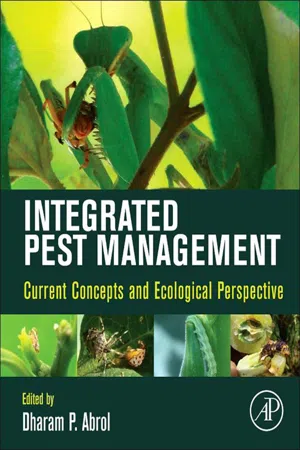
eBook - ePub
Integrated Pest Management
Current Concepts and Ecological Perspective
- 576 pages
- English
- ePUB (mobile friendly)
- Available on iOS & Android
eBook - ePub
Integrated Pest Management
Current Concepts and Ecological Perspective
About this book
Integrated Pest Management: Current Concepts and Ecological Perspective presents an overview of alternative measures to traditional pest management practices using biological control and biotechnology. The removal of some highly effective broad-spectrum chemicals, caused by concerns over environmental health and public safety, has resulted in the development of alternative, reduced risk crop protection products. These products, less toxic to the environment and easily integrated into biological control systems, target specific life stages or pest species. Predation — recognized as a suitable, long-term strategy — effectively suppresses pests in biotechnological control systems.
Integrated Pest Management covers these topics and more. It explores the current ecological approaches in alternative solutions, such as biological control agents, parasites and predators, pathogenic microorganisms, pheromones and natural products as well as ecological approaches for managing invasive pests, rats, suppression of weeds, safety of pollinators, role of taxonomy and remote sensing in IPM and future projections of IPM. This book is a useful resource to entomologists, agronomists, horticulturists, and environmental scientists.
- Fills a gap in the literature by providing critical analysis of different management strategies that have a bearing on agriculture, sustainability and environmental protection
- Synthesizes research and practice on integrated pest management
- Emphasizes an overview of management strategies, with critical evaluation of each in the larger context of ecologically based pest management
Information
Table of contents
- Cover image
- Title page
- Table of Contents
- Copyright
- About the Editor
- Preface
- List of Contributors
- Chapter 1. Host-Plant Resistance in Pest Management
- Chapter 2. Impact of Climate Change on Pest Management and Food Security
- Chapter 3. Application of Remote Sensing in Integrated Pest Management
- Chapter 4. Weather-based Pest Forecasting for Efficient Crop Protection
- Chapter 5. Forecasting of Colorado Potato Beetle Development with Computer Aided System SIMLEP Decision Support System
- Chapter 6. Role of Semiochemicals in Integrated Pest Management
- Chapter 7. Pesticides Applied for the Control of Invasive Species in the United States
- Chapter 8. Potential and Utilization of Plant Products in Pest Control
- Chapter 9. Use of Pheromones in Insect Pest Management, with Special Attention to Weevil Pheromones
- Chapter 10. Role of Entomopathogenic Fungi in Integrated Pest Management
- Chapter 11. Potential of Entomopathogenic Nematodes in Integrated Pest Management
- Chapter 12. Entomopathogenic Viruses and Bacteria for Insect-Pest Control
- Chapter 13. The Bioherbicide Approach to Weed Control Using Plant Pathogens
- Chapter 14. Biological Control of Invasive Insect Pests
- Chapter 15. Spiders – The Generalist Super Predators in Agro-Ecosystems
- Chapter 16. Biotechnological Approaches for Insect Pest Management
- Chapter 17. Biotechnological and Molecular Approaches in the Management of Non-Insect Pests of Crop Plants
- Chapter 18. Role of Genetically Modified Insect-Resistant Crops in IPM: Agricultural, Ecological and Evolutionary Implications
- Chapter 19. Breeding for Disease and Insect-Pest Resistance
- Chapter 20. Integrated Management of Rodent Pests
- Chapter 21. Eco-Friendly Management of Phytophagous Mites
- Chapter 22. IPM Extension: A Global Overview
- Chapter 23. Biological Control of Insect Pests in Crops
- Index
Trusted by 375,005 students
Access to over 1.5 million titles for a fair monthly price.
Study more efficiently using our study tools.
Frequently asked questions
Yes, you can cancel anytime from the Subscription tab in your account settings on the Perlego website. Your subscription will stay active until the end of your current billing period. Learn how to cancel your subscription
No, books cannot be downloaded as external files, such as PDFs, for use outside of Perlego. However, you can download books within the Perlego app for offline reading on mobile or tablet. Learn how to download books offline
Perlego offers two plans: Essential and Complete
- Essential is ideal for learners and professionals who enjoy exploring a wide range of subjects. Access the Essential Library with 800,000+ trusted titles and best-sellers across business, personal growth, and the humanities. Includes unlimited reading time and Standard Read Aloud voice.
- Complete: Perfect for advanced learners and researchers needing full, unrestricted access. Unlock 1.5M+ books across hundreds of subjects, including academic and specialized titles. The Complete Plan also includes advanced features like Premium Read Aloud and Research Assistant.
We are an online textbook subscription service, where you can get access to an entire online library for less than the price of a single book per month. With over 1.5 million books across 990+ topics, we’ve got you covered! Learn about our mission
Look out for the read-aloud symbol on your next book to see if you can listen to it. The read-aloud tool reads text aloud for you, highlighting the text as it is being read. You can pause it, speed it up and slow it down. Learn more about Read Aloud
Yes! You can use the Perlego app on both iOS and Android devices to read anytime, anywhere — even offline. Perfect for commutes or when you’re on the go.
Please note we cannot support devices running on iOS 13 and Android 7 or earlier. Learn more about using the app
Please note we cannot support devices running on iOS 13 and Android 7 or earlier. Learn more about using the app
Yes, you can access Integrated Pest Management by Dharam P Abrol,Dharam P. Abrol in PDF and/or ePUB format, as well as other popular books in Biological Sciences & Entomology. We have over 1.5 million books available in our catalogue for you to explore.